




By Isabel Del Mastro and René Kladzyk / Project on Government Oversight
When the inspectors came to Prairieland Detention Facility, pancakes appeared on the breakfast menu, Leqaa Kordia recalled. The walls sported a fresh coat of paint. A new water cooler appeared in the intake room. In the days before the inspection in December 2025, Kordia – who had been held at the Texas ICE facility for nine months at that point – said she observed a dramatic transformation.
A sub-agency of ICE, the Office of Detention Oversight is required to inspect detention facilities like Prairieland, making sure conditions are safe and align with detention standards. If a facility gets a failing inspection grade twice in a row, its contract with ICE is supposed to be defunded and terminated.
Kordia, a Palestinian woman who was detained by ICE in March 2025 for overstaying her student visa and incarcerated at Prairieland for a year, described the conditions there as humiliating and horrible. She recalled medical complaints going ignored, tap water with “things swimming in it,” and dorm rooms that smelled like “you’re sitting, sleeping, eating in a big bathroom.”
Kordia decided to tell the ODO inspectors about her concerns, she said.
Over the course of multiple conversations, she alerted them about the poor water quality, violations of her religious rights through a lack of Halal food or access to a Quran, and about her concerns over medical care at the facility, she recalled in an interview with POGO Investigates. She had her own health scare, when she’d endured a terrible fever that she said worsened because she was ignored and denied medical care. She ultimately ended up in the hospital after suffering a seizure and was chained to the hospital bed, she said, “like an animal.”
POGO Investigates spoke with multiple attorneys whose clients had similar allegations of medical neglect, poor food quality, and lack of religious accommodations while detained at Prairieland. Conditions at the facility were also the subject of a March congressional oversight visit by Rep. Marc Veasey, D-Texas.
Scott Sutterfield, a former senior ICE official and spokesperson for LaSalle Corrections, the private prison company that runs Prairieland, emailed POGO Investigates a blanket denial of all allegations about the facility in this investigation.
“We take any concerns about the welfare of individuals in our care very seriously,” he said, emphasizing that the facility is regularly inspected “by both internal and external bodies.” Sutterfield has not responded to a request for clarification and information about complaints filed by Kordia while detained at Prairieland, including whether they were investigated.
Kordia said the inspectors assured her that Prairieland’s issues would be fixed, and people would be held accountable.
“But none of this happened,” she said.
A month later, ODO published its inspection report of the facility. Prairieland received a “Superior” rating: the highest possible grade for a detention facility. In the report, ODO indicated its inspectors had interviewed 38 people held at Prairieland, all of whom “reported satisfaction” with the facility. The report indicated that the facility hadn’t violated a single standard: perfect marks.
This dynamic isn’t unique to Prairieland.
It’s part of a nationwide system set up in a way that ensures most ICE detention facilities stay open, no matter how bad the conditions. That’s according to former ICE officials, immigration data experts, advocates, lawyers, and people recently held in detention.
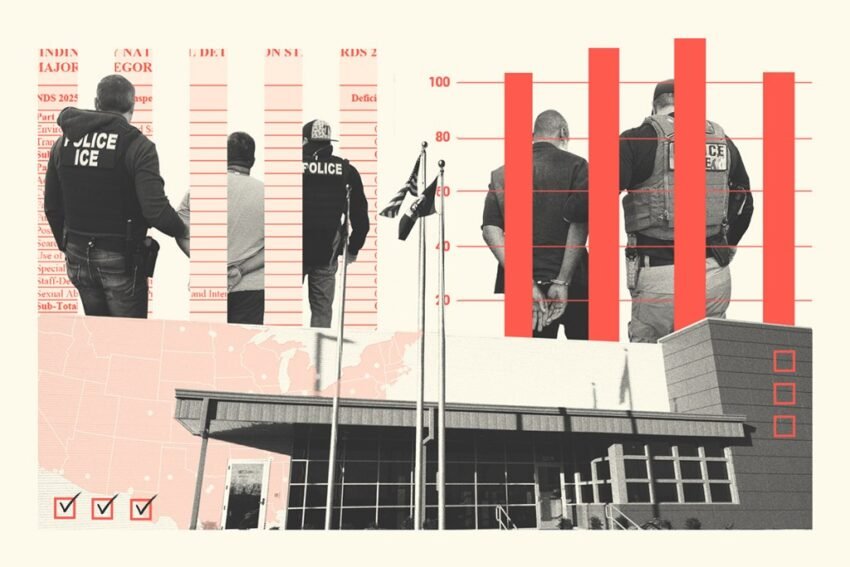
POGO Investigates and the Investigative Reporting Workshop at American University compiled and analyzed data from ODO’s inspection reports website to identify recent trends in how ICE rates its facilities. Judging from detention inspection data from the beginning of fiscal year 2022 through July 23, 2026, ICE facility conditions appear to have undergone a dramatic improvement.
ICE is identifying fewer problems in facilities across the board. Called “deficiencies,” these violations to detention standards are used to determine what grade a facility gets and whether it stays open. The number of these violations dropped by nearly 70% between fiscal years 2022 and 2025.
Meanwhile, the proportion of ICE detention facilities receiving a “Superior” rating nearly tripled since fiscal year 2024 as of July 23, after declining by 61% between fiscal years 2022 and 2024. The recent spike in “Superior” grades coincides with increasingly weakened detention standards and a drop in the overall number of inspections being conducted.
ICE also doesn’t give itself a failing grade on detention inspections. During the period analyzed, ICE never failed a “dedicated” ICE facility — one that solely incarcerates people in ICE custody. Of the few facilities that did receive a failing grade, all were “non-dedicated” facilities, typically county and municipal jails holding a mixture of imprisoned U.S. citizens and people detained by ICE.
Inadequate oversight has clear ties to unsafe and even deadly conditions in detention, according to Scott Shuchart, a former senior advisor for the Department of Homeland Security Office of Civil Rights and Civil Liberties.
“The amount of oversight has been scaled back irresponsibly,” he said. The outcome, according to Shuchart, is that “ICE detention seems to be more dangerous and working worse than ever before.”
Since the start of the second Trump administration, DHS has shuttered several key oversight offices. Meanwhile, the number of people detained by ICE increased by 75% during the first year of President Donald Trump’s second term in office and reached a record high early this year with 73,400 people in ICE detention on a single day. As of July 11, over 65,000 people were being incarcerated by ICE, 70.6% of whom had no criminal conviction, according to TRAC reports.
ICE does not publish a dataset dedicated to ODO inspections that would enable the public to garner insights about trends in inspection ratings or standards violations. For this investigation, data points were pulled from individual inspection report PDFs on ODO’s website to create a dataset of inspection report ratings and violations of detention standards from fiscal years 2022 through July 23, 2026.
ICE has not responded to multiple requests for interview and comment related to this investigation, its methodology, and data findings.
Former ICE acting Chief of Staff Deborah Fleischaker said she wasn’t surprised by the glowing marks facilities are receiving in recent inspection reports, though they don’t necessarily seem accurate.
“I would not be surprised if ODO understood its job to be to bless most of what they see and only say anything in the most significant circumstances,” she said. “I think there is an understanding that they need to get out of the way.”
Superior Ratings, Record Deaths in Custody
Kordia was “very disappointed” to learn that, after her conversations with the inspectors, ODO ended up giving Prairieland perfect marks in their 2026 inspection report, she said. “Superior” — the highest rating possible — was a significant jump from Prairieland’s previous rating, “Acceptable/Adequate.”
Prairieland’s recently improved score is emblematic of a broader trend in ODO facility ratings. Although 70% of facilities received “Superior” ratings in fiscal year 2022, when ODO began using this rating system, the number of “Superior” ratings declined from fiscal years 2023 to 2024. Then, the share of facilities getting ODO’s highest grade doubled between fiscal years 2024 and 2025. As of July 23, roughly 74% of detention facility inspections in fiscal year 2026 have resulted in a “Superior” rating.
As “Superior” ratings have increased across detention facilities nationally, so have deaths in ICE custody. In 2025, ICE reported that 33 people died in its custody, the highest number of any year in over two decades. As of August 11, ICE reported the deaths of 23 people in 2026. The agency announced in June that it will stop reporting deaths of those who die shortly after being released from ICE’s custody.
According to ICE data expert Adam Sawyer, this trend doesn’t make sense. He said you’d expect an inverse relationship between improved inspection ratings and increased deaths in custody.
“You would not expect the number of deaths to go up along with the assessed conditions of those facilities,” Sawyer explained.
Border czar Tom Homan defended ICE in response to questions about the rising number of deaths in detention during an interview with CBS News in May. “Our deaths in custody are lower than everybody’s,” Homan said, adding that many of the people detained in ICE facilities have poor medical histories. “What the media don’t talk about [is] how many lives do we save in custody,” Homan said.
ICE detention expert and immigration lawyer Andrew Free refuted Homan’s claims in a video response on his Substack, arguing that the DHS official’s talking points about deaths in ICE custody are a “gross over-generalization” relying on false comparisons and arguments that are factually unsupported.
Four people have died since last August at Adelanto ICE Processing Center in California, according to ICE’s website. That’s the most deaths at any facility in the country during that period, a POGO analysis found.
Ismael Ayala-Uribe, a Mexican immigrant and former DACA recipient who came to the U.S. as a child, was one of those people. He was detained at the car wash he worked at in Huntington Beach. He died at age 39 in ICE custody on September 22, 2025, from complications of an abscess on his buttock.
That’s according to the San Bernardino County Sheriff’s Coroners Report, obtained by POGO through public records requests. The coroner’s report indicated that Ayala-Uribe had complained of fever, shivers, and rectal bleeding for three weeks while detained at Adelanto.
“Family stated the ICE facility did not provide him with medical attention and were only administering Tylenol,” the coroner’s report noted.
Christopher Ferreira, a spokesperson for GEO Group, the private prison company that runs Adelanto, declined to comment on this investigation in an email to POGO, directing reporters’ questions to ICE.
ICE did not respond to requests for comment.
ICE’s detainee death report for Ayala-Uribe makes no mention of medical care following his initial screening on the day he arrived at Adelanto, until a “medical emergency” in his dorm four days before his death.
ODO officials inspected Adelanto just days before Ayala-Uribe’s death and gave the facility zero violations for medical care and a rating of “Good.” The report noted, “most detainees reported satisfaction with facility services.” Adelanto’s fiscal year 2025 rating of “Good” was a downgrade. From fiscal years 2022 to 2024, the facility had consistently received “Superior” ratings by ODO. As of August 11, ODO had not yet published a 2026 inspection report for Adelanto.
Another official inspection of the facility that same year arrived at starkly different conclusions. The California Department of Justice inspected Adelanto in July 2025, finding inadequate medical and detention staffing levels, failures to do consistent medical, dental, and mental health screenings, and failures to provide “necessary and timely medical treatment, even for emergency care.” (California is one of the first states to conduct inspections of ICE detention facilities; most don’t.)
The California attorney general is not the only one to contradict ODO’s findings about Adelanto. Advocacy groups, attorneys, people held at Adelanto, and lawmakers have consistently decried substandard and dangerous conditions at the facility, all while ODO painted a rosy picture in reports.
Disability Rights California, a California-based advocacy group with legal authority to conduct inspections of ICE facilities, also identified issues with medical neglect and substandard conditions in a 2025 inspection of Adelanto. Paula Sandoval, a supervising investigator at Disability Rights California, told POGO Investigates that Adelanto’s history of “Superior” and “Good” ratings by ODO did not sound accurate.
“If this is what they claim is … ‘Superior,’ and if they’re inspecting facilities nationwide, I cannot imagine what those other facilities are like,” Sandoval said in an interview.
Alison Steffel, an attorney who said she has visited Adelanto at least five times this year, argues the characterization of medical care at Adelanto in ODO’s report is “blatantly untrue.” Steffel is an attorney in a lawsuit against Adelanto over conditions at the facility. A federal judge recently ruled in the case that people detained at the facility must be provided sufficient medical care and clean drinking water.
“They have this mechanism to do inspections and to make sure that people aren’t literally dying, but they’re not doing that,” Steffel said when asked why accurate inspections would be meaningful. She said she believes Adelanto should have failed two inspections by now, which would mean it would lose federal funding.
But in recent years, not a single dedicated ICE detention facility like Adelanto has failed an inspection.
ICE Doesn’t Give Itself a Failing Grade
The federal government designated inspection failures as a key threshold to hold ICE detention facilities accountable in cases of unsafe conditions: If a detention facility fails inspections twice in a row, it can lose eligibility for federal funding and be shut down, according to an appropriations measure passed by Congress.
“It is important that chronic failures to meet detention standards are not ignored,” the House report accompanying the bill stated.
Despite this provision — or perhaps because of it — detention facilities rarely received failing grades from inspectors between fiscal years 2022 and 2026. Detention facilities saw the highest number of failing grades in 2023, when 10% of the 113 inspected facilities failed their inspection reports. Only one of the 102 inspections conducted in fiscal year 2025 resulted in a failure. As of July 23, every detention facility passed their inspection for fiscal year 2026.
ODO’s inspection report data also shows that, since fiscal year 2022, facilities used solely for ICE detention have never failed an inspection.
Non-dedicated facilities, which incarcerate a mix of people held by the county or municipality for criminal charges and people detained by ICE, now face less scrutiny by ODO than in past years. Formerly, Congress mandated that any facility incarcerating 10 or more people for ICE for over 72 hours had to conduct inspections twice a year. But ICE changed that in 2025 after Congress didn’t require inspections in the new funding bill, according to reporting by CBS News. ODO now must inspect dedicated facilities only once per year and non-dedicated facilities every other year.
Between fiscal years 2022 and 2026, only six facilities failed two inspections in a row: Baldwin County Correctional Center in Alabama; Randall County Jail in Texas; Cache County Jail in Utah; Cobb County Jail in Georgia; and Elmore County Jail and Minicassia Detention Center in Idaho. Even though the DHS provision indicates they should have lost federal funding and their contract with ICE, five of those six facilities are currently used for ICE detention.
Shuchart said he’s not surprised. “The failure mechanism that Congress has put in has literally never worked,” he said, “They’ve always allowed ICE to get away with granting waivers or excusing (violations).”
ICE can grant waivers for facilities, “in essence exempting the facility from compliance” with detention standards, according to a 2018 report by the DHS inspector general’s office.
“Mushy” Standards
ICE designs the standards that detention facilities are held to, and those standards are then used to determine what rating a facility gets and whether it passes or fails an inspection. According to former senior ICE official Claire Trickler-McNulty, these standards are part of the problem when it comes to facilities actually being held accountable for poor conditions.
ICE subjects different facilities to different sets of detention standards, which have become increasingly watered down over the years, according to former senior ICE officials. In fiscal year 2026, POGO Investigates found that ICE detention facilities were inspected using six different sets of detention standards, based on the year the facility signed a contract with ICE. These include the newest 2026 standards, which ICE described as streamlined.
The differences in these standards can be significant for the people held by ICE: The new 2026 standards, for example, removed protections that would require detained people to be paid for participating in the facility’s “Voluntary Work Program.” The Washington Post reported this change was made after ICE contractor GEO Group privately asked for it.
There are numerous cases of ICE detention standards shifting away from specificity in recent years, removing clear requirements for maintaining safe conditions, including how often certain aspects of the facility should be inspected and by whom. For example, the 2011 standards required a state laboratory to test the water in ICE detention facilities every year. The 2026 standards removed the annual requirement and omitted the mandate that a state laboratory (i.e., an independent body) do the testing.
Although ICE did not respond to interview and comment requests for this investigation, the agency’s website indicates that the revised 2026 standards are intended to “reduce the burden on detention operators.” The introduction of the 2026 standards indicates that “Detention conditions shall be non-punitive and ensure the due process, health, safety, and security of all individuals in custody.”
ODO’s use of varying detention standards is no accident, according to Trickler-McNulty, who said the standards are “a mess.”
“When you make the standards language mushy, it’s very hard to translate that into actual inspection findings and inspection findings that could be leveraged against the facilities,” TricklerMcNulty said.
Fleischaker tied the expansion of detention under the Trump administration directly to watered down ICE standards for inspections. “They want to be able to have more detention facilities. They want to be able to do it cheaper. They want to be able to do it faster and simpler,” she said. “That means it is difficult to live up to the more robust detention standards.”
A Steep Drop in Violations
Alma Bowman has been detained by ICE multiple times, despite filing court petitions arguing she is actually a U.S. citizen. She was most recently detained at Stewart Detention Center in Georgia for eight months in 2025, and, prior to that, at Irwin County Detention Center in Georgia for over three years. There, she was one of the whistleblowers whose testimony led to a Senate committee investigation which found that the facility subjected women to “excessive, invasive, and often unnecessary gynecological procedures.”
During an interview, we informed Bowman that Stewart Detention Center had received no violations for medical care in fiscal year 2025, the time she was there.
“That’s really funny,” Bowman said, laughing. She recalled how people detained there who were sick were “lucky if you get seen within a week.” Bowman has sleep apnea and uses a CPAP machine to sleep. She described extensive difficulties in obtaining permission to plug in her machine at night. She is also a diabetic, but when she was first detained at Stewart, she didn’t have her diabetes medication on her. She said it took about a month before she was able to see a doctor, and that she also faced delays in getting medication.
According to the standards that ODO used to evaluate Stewart in fiscal year 2025, people who take medications are supposed to be seen by a health care professional no more than 24 hours after arriving at the facility.
Ryan Gustin, spokesperson for Stewart contractor CoreCivic, said the contention that ODO inspection findings don’t reflect on-the-ground conditions “does not hold” at Stewart. He cited ODO’s inspection report as evidence that Stewart’s medical care is not deficient. Gustin disputed all of Bowman’s claims, arguing that people detained at the facility have daily access to medical care, that people with diabetes get “blood sugar testing, insulin and diabetic medications,” and that accommodations are made for CPAP machines. In Bowman’s case, he said she “was regularly monitored by facility medical staff, with all known medical issues being addressed.” He also said the facility’s medical care receives “layered, continuous oversight,” including government monitoring and audits.
Recent media reports about the facility also allege substandard medical care, and a Senate investigation led by Senator Jon Ossoff, D-Georgia, details medical neglect at facilities that include Stewart. In July, 29-year-old Prisciliano Trejo Ricano died after he was allegedly denied medical care while detained at Stewart.
Gustin said he is “deeply saddened” by the passing of any person in CoreCivic’s care, but that Trejo Ricano was “appropriately screened” and no medical problems were disclosed or identified. Trejo had posted on Facebook about the lack of medical care at Stewart prior to his death, according to reporting by Mother Jones. He was diagnosed with acute leukemia and released from ICE’s custody while in a coma. His death does not appear in ICE’s official tally of deaths because he was no longer officially in ICE custody at the time of his death.
Nationwide, the average number of detention inspection violations dropped by nearly 70% between fiscal years 2022 and 2025. Between fiscal years 2024 and 2025, the average number of violations dropped by more than half — the largest year-over-year drop from 2022 to 2026. During this same time period, there has also been a significant drop in the number of initial and follow-up inspections of ICE detention facilities.
In July, CBS News published an investigation on violation trends in ODO inspection reports compared to facility size. While the number of reported violations generally trended downward since 2019, they found that the number of violations at larger facilities has trended upward since fiscal year 2025. They also found that when facilities switched to using the May 2025 U.S. Marshals Service’s standards, the average number of violations dropped sharply.
Even when a detention facility does receive many violations, ICE may not have the infrastructure needed to take action. ICE’s process to remediate problems found in detention facilities has “never worked,” according to Shuchart.
“There is no office in (Enforcement and Removal Operations) that is equipped with enough people or enough power to take the result of an ODO inspection … and really fix all the problems,” he said.
It’s also unclear what kind of relationship a facility’s violations have with the ultimate rating they receive, in part because the rubrics for how ratings are determined are not made public.
For example, Camp East Montana in El Paso, Texas, received an “Acceptable/Adequate” rating despite having 49 standards violations listed in the 2026 inspection report, among the highest number of violations in a single report of any facility.
During the period analyzed, only three other detention facilities — Euless City Jail in Texas, River Correctional Center in Louisiana, and Allen Parish Public Safety Complex in Louisiana — received as many violations and still passed the inspection.
Of the 15 facilities with the most violations between fiscal years 2022 and 2026, eight were rated either “Acceptable/Adequate” or “Good.”
Meghan Squires, an assistant director at the Government Accountability Office who worked on a 2025 report about ICE’s facility inspection program, said the relationship between a facility’s total number of standards violations and what rating that facility gets “doesn’t quite make sense.”
“You can get a lot of (violations) but still pass,” she said, explaining that even though the GAO identified over 5,000 violations in fiscal years 2022 through 2024, most facilities passed. “That, I think, is hard to square up.” Squires said the GAO did not have access to the worksheet that ODO used at the time to conduct inspections.
“ODO officials told us that the strategic goal of the inspection program has been to ensure the health, life, safety, and welfare of detained individuals,” the GAO report reads, explaining that ODO has not adopted any performance goals or measures to ensure that actually happens.
The GAO also issued a separate report in June about oversight failures at Camp East Montana, finding that the facility did not meet ICE’s National Detention Standards and didn’t conduct required inspections. In a written response to the report, DHS Director of Financial Management Jeffrey Bobich emphasized that the average time a person is detained at Camp East Montana is low, and said, “DHS remains committed to protecting America by enforcing immigration laws.” As of July 9, the average detention period at Camp East Montana is 12 days.
Among the GAO’s recommendations to DHS, there was one the agency refused to adopt. It would have entailed reinstating a sub-agency that conducted inspections at detention facilities. That sub-agency was one of several DHS oversight bodies that were shuttered in 2026. As ICE arrests record numbers of people and detains them in detention facilities, the agency has struggled to leverage detention standards in a way that would hold detention facilities accountable, according to Trickler-McNulty.
“There’s a million ways detention can be bad, or miserable, or hard,” said the former senior ICE official, “and without really understanding all of the things that are happening at a facility and doing a robust accounting, certainly, conditions can get very bad.”
For people who have been detained by ICE, like Leqaa Kordia, these failures to create and uphold adequate standards have very real implications.
“We’re talking about people’s lives,” Kordia said. “We’re talking about people’s dignity. We’re talking about people’s freedom being taken away from them.”
The post Inside ICE’s broken system for inspecting detention facilities appeared first on El Paso Matters.
Read: Read More