




Martin Ramirez was a self-described “disruptive” young student. His coursework bored him and, because he lacked a challenge, he often got in trouble in class. Despite his behavior, his parents continued to instill in him the need to go to college.
His parents, both first-generation immigrants with no more than a secondary education, learned about a new program where high school students could earn an associate degree while in high school at no extra cost. The family of six had a modest income so Ramirez’s parents took him to a meeting and convinced him this was his ticket to college.
It was 2007, and to be a good son, Ramirez agreed to enroll at Mission Early College High School, which is part of the Socorro Independent School District. He wanted to save his parents, an insurance salesman father and a stay-at-home mother, some money.
“I didn’t know what I was getting into,” said Ramirez, who grew up playing middle school and city league soccer in far East El Paso near El Dorado High School.
Mission ECHS, the first of its kind in the Borderland, opened in July 2006 and celebrated its 20th anniversary last month.

Despite a rough academic start at Mission ECHS, Ramirez began to realize with the help of his teachers that the only one holding him back academically was himself. That attitude adjustment helped him earn his associate degree in criminal justice.
Today, Ramirez is associate dean of student affairs at Colorado (Leadville) Mountain College and is two semesters away from earning a doctorate in educational leadership from the University of Arizona. His dissertation is about how early college high schools influence first-generation Latino/a students’ graduate school aspirations.
He is among the thousands of El Pasoans who recognize firsthand the academic, economic and professional benefits of dual credit programs offered through El Paso Community College and their public, private, charter and home school partners. He credits his Mission ECHS teachers for encouraging him and setting him on the path of knowledge.
“Through Mission, I met people who started giving me pieces of the map that I didn’t even know I needed,” he said during a phone interview.
Since the launch of Mission ECHS, EPCC and its partners have established 18 other early colleges and 21 P-TECHS, or Pathways in Technology Early College High Schools. It plans to open its latest early college program in fall 2027 at Austin High School, which will focus on criminal justice.
The start
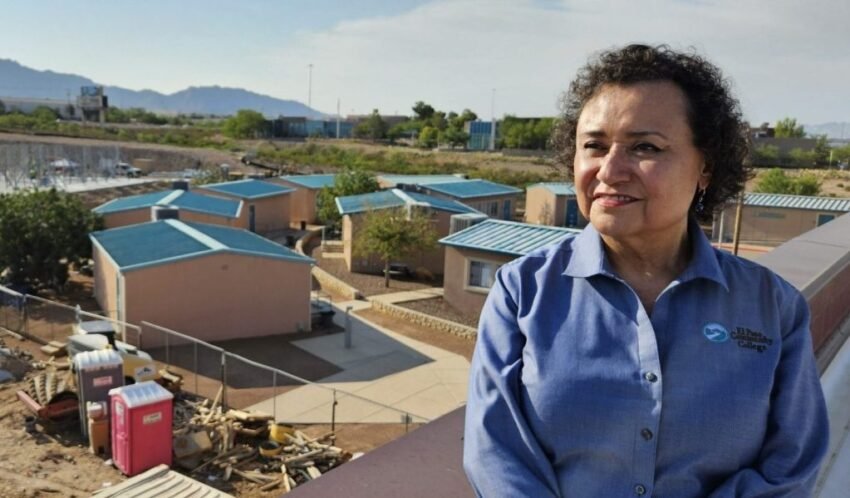
Maria A. “Tonie” Badillo, EPCC’s dean of Dual Credit and Early College High Schools, has been in charge of the programs for the past 10 years. She reminisced about the successes and challenges during an interview at the Northwest Early College High School, 6701 S. Desert Blvd.
The campus, part of the Canutillo Independent School District, is among the 12 dual credit programs in the region to earn the state’s “Designated with Distinction” honors, which means it achieved high outcome-based standards.
The interview also gave her a chance to review the progress of the new $30 million, 53,000-square-foot campus building that should open next fall. It will be the first stand-alone brick-and-mortar early college high school in the El Paso area. It will replace the current portable village.
READ MORE: EPCC’s $8 million state funding loss could affect raises, property taxes
EPCC started to offer dual credit courses in 2001 with 93 enrolled students. These college-level courses allow high school students to earn both college and high school credit at the same time.
The programs were created to help first-generation college students considered at-risk or economically challenged. An at-risk learner is a student with a higher than average chance of failing academically or dropping out before graduation.
By 2006, MECHS opened and the combination of the early college and dual credit courses attracted almost 2,000 students across the region. Ten years later, the number reached almost 7,000. As of 2025, a little more than 10,500 students were enrolled in dual credit courses or programs.
Badillo said that dual credit students make up about 34% of EPCC’s enrollment, and she expects that it will grow to 50% within three years.
While the El Paso programs attracted students of all aptitudes, the Texas Education Agency stipulated that each early college or P-TECH program needed to meet a certain target population level. For example, 25% of those enrolled must be deemed at-risk, and at least 10% needed to be economically disadvantaged. The TEA penalizes schools that do not meet those metrics.
The attraction
Badillo said the college does little if any advertising for its dual credit programs, and credits the growth to word-of-mouth at the middle schools and high schools. She said students and parents find the possible financial savings and quicker time to degree attractive.
High school students who earn an associate degree from EPCC save their families almost $8,200 on tuition and fees. They also save on books and other instructional materials, which the school districts provide.

Through the programs, EPCC awards associate of arts, associate of arts in teaching, associate of science and associate of applied science degrees. From there, graduates enter the workforce or transfer to a four-year institution such as the University of Texas at El Paso. EPCC also awards industry certifications through P-TECH.
EPCC has awarded almost 10,000 degrees or credentials to high school students since the dual credit programs started. EPCC’s Office of Institutional Research reported that dual credit students earn higher GPAs (3.7 vs. 2.7) and are more likely to complete their degree plans than students who did not take dual credit courses.
“We tell parents and students that this will not be easy,” Badillo said. “This will be challenging.”
Students need a minimum of 60 semester credit hours to complete an associate degree at EPCC.
Badillo said the programs are so popular that some programs have lotteries to determine which students can enroll. For example, a Socorro ISD spokeswoman said that it is common for 300-500 students to apply for the 135 slots at the district’s four early colleges, and 100 requests to enroll in its P-TECH programs which have 50-85 slots.
SEE ALSO: EPCC, UTEP auto-graduation program quietly awards associate degrees to eligible students
Regardless of the number of credit hours high school students earn upon graduation, studies have shown that those who take dual credit courses are more likely to graduate from high school, as well as enroll and persist in college and earn a degree or credential.
It is not uncommon for early college students enrolled at EPCC to complete their associate degree credits as juniors and spend all or part of their senior year at UTEP.
“Students in eighth grade need to see themselves in a college program in high school even if it is not an early college, even if it is not a P-TECH,” Badillo said. “They need to see themselves pursuing college courses. Even if they take one (college) class – one class – and they’re successful, then they see themselves as a college student.”
Perspectives
Despite the numerous advantages, there are qualitative trade-offs to dual credit programs, said Julia Duncheon, associate professor of educational policy, organization and leadership at the University of Washington in Seattle. One of her research interests is the implementation of early college high schools and different approaches to dual credit coursework.

In a 2025 journal article she co-authored, Duncheon argued that “speed” is not always a universal positive for students.
During interviews with early college graduates, Duncheon said some lamented how the sense of urgency to complete their degree limited their time to build relationships with professors, to join school clubs and organizations, and to seek leadership roles with those groups, or even to change their majors after they transferred to a university.
Duncheon, who taught at UTEP’s Department of Educational Leadership and Foundations from 2015 to 2019, said some counselors do not explain the rigors of the academic workload and social sacrifices.
The education professor suggested students interested in early college programs should consider if their academic interests would be better served at a four-year institution instead of through accelerated dual credit courses, and if their families’ economic status might qualify them for free tuition at a university.
“It’s really just a question of thinking about what’s best for the individual students and trying to make sure that we’re doing dual credit in a way that is growing an opportunity on both ends of high school and college,” Duncheon said during a phone interview.
Armando Aguirre, executive director of Region 19 Education Service Center, served as Mission ECHS’ first principal for six years. He recalled initial concerns that the program pushed students too quickly, but said the key to success was finding students with the right mindset.
“When you think of the number of students who are now completing their associate degrees and going out to four-year universities, I think it has proven that it was the right move,” Aguirre said during a phone interview.
Benefits and growing pains
Tom Fullerton, professor of economics at UTEP and director of the Border Region Modeling Project, said the dual credit program is a good fit for El Paso, where educational attainment lags behind the state.
The January 2026 edition of “Borderplex Economic Outlook,” plus prior BRMP income studies, indicate that raising El Paso County’s educational attainment levels up to Texas state averages would increase the county’s aggregate personal income by nearly $3.1 billion in 2025 dollars. Aggregate personal income includes pre-tax total wages and salaries, business profits, investment earnings, retirement transfers and government support payments to individuals.
“That figure represents a 6.9% potential income increase – an impressive gain in regional economic terms,” Fullerton said in an email response to El Paso Matters.
Despite the program’s successes, Badillo said some of her recurring concerns she deals with are staff turnover at the dual credit programs, and the need to boost enrollment in rural areas.
She said the smaller, rural schools to include those in Dell City and Fort Hancock often lack the faculty who can teach dual credit courses. Teachers must have earned a graduate degree in any discipline as well as 18 graduate credit hours in the specific subject that they plan to teach. Without the qualified dual credit teachers, the schools cannot offer those courses to students.
As for turnover, Badillo said she and her staff offer multiple trainings during the year to help new administrators, faculty, and staff including counselors to learn what they need to know about resources and expectations.
“When you get a person who is brand new, they don’t know what they don’t know,” Badillo said. “It takes a while for them to understand the processes and documentation necessary for a (high school) student to become a college student.”
The post El Paso’s early college experiment turns 20 — and dual credit is still growing appeared first on El Paso Matters.
Read: Read More