




Never miss an episode. Subscribe to the El Paso Matters Podcast on YouTube, Apple Podcasts or Spotify.
This episode was recorded Aug. 20, 2026.
Read the transcript
Diego Mendoza-Moyers: Today: we’re talking about the city’s budget, and a property tax increase on El Pasoans in the upcoming year.
I think the best way to get into this is to highlight some of the comments Mayor Renard Johnson made during the council’s budget meeting this week, which encapsulated where the city leadership is at right now.
Amid hours of debate on Tuesday, before council approved an annual budget, Johnson said “we owe it to the public to give the city a budget. They cannot operate without a budget.”
Well, yeah.
Mayor Johnson made other comments during the at-times rancorous, testy budget meeting, where numerous initial attempts to pass a city budget failed to garner a majority vote: “Each one of us was elected to govern,” Johnson said.
He added: “Every council member had an opportunity to provide input, use the budget calculator online, and here we are.”
At one point, Johnson asked the city’s chief financial officer if El Paso’s City Council had ever failed to pass an annual budget before. The answer was, “No.”
In other words, the mayor of a large U.S. city had to emphasize the point to his colleagues that declining to pass a budget is not workable.
To me, the immense difficulty our City Council had completing perhaps its most fundamental task – setting an annual budget and tax rate – reflected months of division and discord among the city’s elected officials.
Obviously, it’s also a sign of a tough political environment: El Paso households are seeing rising costs for utilities, housing and basic goods at the same time the city is experiencing a budget crunch. Of course, no one wants to be the City Council representative who voted to raise taxes.
City staffers have been crafting the budget proposal since May, and conducted budget workshops and meetings with City Council representatives over the last couple of months.
So, when District 4 city Rep. Cynthia (Boyar) Trejo asked City Manager Dionne Mack if there were any additional cuts the city could make to internal spending to avoid a tax hike on residents, Mack’s response was respectful but curt: “That’s what our budget process is,” Mack said in response.
Eventually, the city on Tuesday approved a new budget and higher tax rate by a 6-to-2 vote, with Trejo and District 7 city Rep. Lily Limón voting no, although neither proposed spending cuts to avoid a tax increase.
El Paso senior reporter Elida Perez will join me in a moment to discuss the city’s budget, the tax increase residents should expect to see, and to walk us through her experience at the City Council budget meeting and what the lack of consensus tells us about our city government at the moment.
First, this El Paso Matters Podcast episode is brought to you by our podcast title sponsor Tawney, Acosta and Chaparro, truck crash and injury attorneys. Their team of local, seasoned trial attorneys are ready to help if you’ve been injured in a crash.
And you can sign up for our newsletter or read our free reporting at elpasomatters.org, where you can also learn about and register for our 9.15K run that’s coming up on September 19th.
Now, on to the show.
Elida, long time no talk. Thanks for joining me.
Elida S. Perez: Thanks for having me. Here we are again.
Diego: Yep, I said I wanted to have you back after maybe we had a better idea of exactly what the budget and taxes would look like.
Elida: You’re a man of your word.
Diego: So, just to get into it, what was the budget that the city adopted this past week and what’s the average tax increase that homeowners should expect to see?
Elida: So, they ended up landing on a $658.6 million general fund budget. The tax increase is going to be about an impact of $105 on the average value home. That’s in the $236,000-ish range. I can’t remember the specific numbers, but that’s across the board on your average homeowner.
Diego: And we talked about this in our previous podcast, but just to reiterate, can you explain, like, the reason for the tax increase and the stated – just the reason that City Council is having to lift the tax rate and kind of experiencing a little bit of a bad budget situation?
Elida: Yeah. So, just like everybody is feeling at home, there’s no way to really avoid these rising costs of things like utilities, of contracts, of all services, really. Everything is going up. They also have built-in obligations that are largely funded by, or driven, I should say, by public safety, collective bargaining agreements, things like that.
Those that are already in place have existing increases, and the fire union is in the middle of negotiating a new contract that’s going to add millions of dollars of, in essence, required spending to the city budget over the next four years. The police collective bargaining agreement has built-in pay increases and things like that. And their contract is up for negotiation next year. So, just overall, everything costs more these days.
READ MORE: After hours of tense debate, divided El Paso City Council adopts budget, raises taxes
Diego: And I guess the mayor was kind of putting it on prior councils, as we’ve discussed, adopting a no-new-revenue rate and maybe not raising taxes in past years when maybe the finances called for it. You think that’s fair to say?
Elida: That definitely has something to do with it. Because, not this last year, because they did do a tax increase last year for the current fiscal year, but the prior two fiscal years, the mayor, the former mayor, Oscar Leeser, really doubled down on, “I will veto anything that isn’t funded by a no-new-revenue rate.”
And, so, they had to jump through a bunch of hoops, financial hoops, if you will, to make that happen, including dipping into their reserves, getting rid of these tax increment finance zones that capture property taxes within a certain area for improvements within those areas. So, they got rid of one or two that they were able to, because those aren’t necessarily easy to get out of, to be able to use those bulk one-time funding sources to keep things at bay. But the chief financial officer has been warning for a long time that you just simply cannot continue to do that.
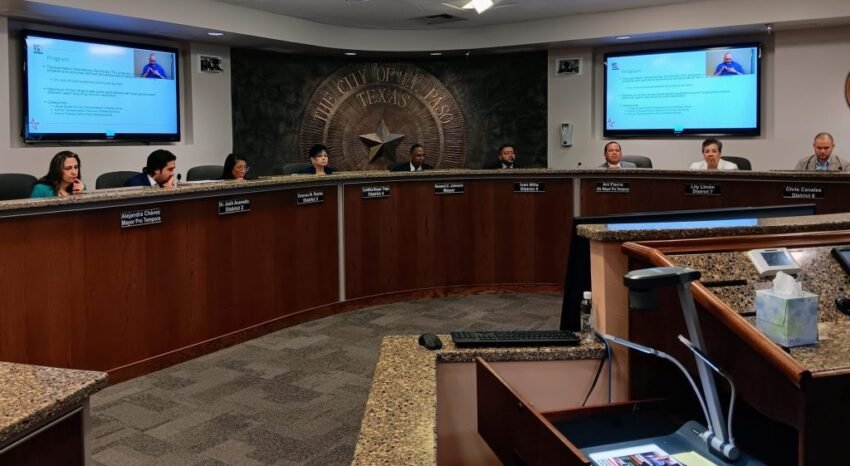
Diego: Yeah. So, can you just share what your experience was like at the City Council meeting this week where they eventually adopted a budget after several hours of debate, right? And, yeah, just what was that like for you to sit there and witness?
Elida: I’ve been thinking about how to phrase this for a couple days now. And I think the kindest way to put it is that it was a little painful. It was a little painful to watch and highly unusual for the City Council on the day of budget adoption to simply reject the budget and take a while to realize that they needed to take action, because you couldn’t just walk away without adopting a budget on the day of the budget adoption. That’s what they plan for months and months in advance. So, we’ll start there. Keep asking me questions.
Diego: Well, it seemed like the city manager, Dionne Mack, seemed to try to be communicating to council, like, “We’ve been working on this budget since May. If you wanted to carve out cuts, you’ve had a few months to do that” seemed to be her message to City Council representatives who were unhappy with the budget and with the prospect of raising taxes.
Elida: I don’t think that the plan to outright reject the budget was very well thought-out. There’s a couple of indicators for that. So, for example, the city manager started budget sessions six weeks early this year. They started strategic planning in February, preparing budget stuff, preparing departments to get into the budget season early, to start having these workshops, community meetings, you name it, everything that they go through, they started early for the exact purpose of getting to August 18th, ready to go. “This is where we’re at,” you vote.
That being said, there was a work session on Monday and a public hearing on the tax rate. So, that work session, they went through the entire budget. They presented the very same presentation that they presented on Tuesday in detail. Interestingly, none of the representatives that voted against the budget on Tuesday made any sort of protest on Monday to say, “You know what, we’ve talked to our constituents, there’s no way that I can approve this budget tomorrow. Can you come back with a lower tax rate? Can you come back with a lesser spending proposal?” That simply didn’t happen, which is where, really, it should have.
Like, if they were going to have more debate and ask for last-minute changes, it should have been on Monday, theoretically. Obviously, they’re able to do whatever they want to do. And, come Tuesday, that’s exactly what happened. They decided they wanted to vote against the budget.
There had to have been some thought into rejecting the budget because two of the city reps that voted against it, Alejandra Chavez and Cynthia Boyar Trejo, had written statements prepared. So, they had time to prepare a written statement to read after they voted to reject the budget. But, in that same token, they didn’t offer any alternative budget or cut, initially.
It was actually Chris Canales that had to remind them that he was not on the prevailing side of the vote, so he couldn’t make a motion to bring back the budget for discussion, it was one of them who voted against the budget that had to open it up again so that they could pass a budget. And, so, this kind of dialogue went on and on. And it was a while before somebody even came up with an idea of what to go for as far as a change in the budget, which was going back to that May proposal. It was extremely irregular.
Diego: And I think, to give Representative Trejo credit, I guess, she asked Dionne Mack specifically about, “Hey, can you cut staff travel time among city employees? Can you freeze executive salaries?” She was trying to raise these things at the last second to say, “Can you carve that out to lower the budget?” I don’t know that, even if they had adopted those recommendations, that it would have made a huge dent in the budget and had really any material impact on the tax increase. But that’s interesting. It seems like maybe you could raise those concerns on Monday and before the actual hearing.
But, so, I guess, I mean, was council really almost not going to pass a budget in your perspective? And another thing was that it seemed like maybe some people on council were suggesting like, “Can we delay this?” And then I think the city staffers were like, “No, we’ve kind of missed a deadline. There’s certain notifications we have to issue with a certain amount of time.” And, so, it was, like, “Look, we’ve got to do it today,” right?
Elida: Yeah. So, it wasn’t until, I don’t know, maybe at least an hour into this back-and-forth. Actually, I don’t think it was until after the recess that Cynthia Boyar Trejo made a last ditch effort to say, “Cut out A, B and C.” And even the city manager was like, “We’ve already looked at all the potential cuts.” And, even if they had at the last minute cut that out, it wouldn’t have been $6 million. It wouldn’t have been a significant reduction in spending.
Diego: Yeah, and we should mention that they went into an hour-long recess, I think, when it became clear that there wasn’t a consensus among the council on passing the budget. They just went into recess, which I hadn’t seen before.
Elida: Yeah, they went through – I lost track of how many different ways they tried to piece this together at the last minute. At one point, like I said, it was kind of shocking that, at some point, they had to consistently be reminded that you can’t just say “We’re not adopting a budget” and leave it at that. They had to be reminded like, “This is the day, you have to do it today, because we have timelines.”
There are state law requirements on notices. And, at some part of the day, they missed what would have been a notice to publish another, notice in the newspaper or whatever to alert the community that this was happening. So, they went back and forth so much and for so long that they missed that time frame.
So, they were in the position where it had to happen. But time and time and time again, they were just getting nowhere fast. And they were just making multiple amendments. I’ve never seen anything like it. I’ve been covering council for almost, like, about 10 years, and never once have seen this happen.
RELATED: Why 39% of El Paso County homeowners will pay no school property taxes this year
Diego: That gets into one of the broader questions that I was left with after watching some of that budget session, which is that, do you think this is another sign of maybe some level of discord among council?
And I’ll just add, I think a lot of these council members have been in office maybe a year-and-a-half and some a little bit longer. But there was a wave of council that came in last year in 2025, I think new to legislating and municipal government and all that. And, so, I think maybe some of them, I don’t know how much experience they had with this. But then the whole data center situation with Meta’s data center a couple of months ago where Representative Acevedo put this motion forward to try to cancel this city contract with Meta.
And there was hours and hours of public comment. It was a very heated debate. And it seems to me – and maybe some of these divisions preceded that – but it seems like that really created a real divide and a real kind of tense atmosphere among council. Like, the people who wanted to get out of this Meta deal like Josh Acevedo and Representative Canales. And I think maybe Representative Limón also voted to cancel that deal. And then the other council representatives were vehemently against that.
And we’ve seen moments where – of tension on council. I’ve witnessed where, like, for example, Representative Chavez on the Westside will – she’s gotten kind of snippy with, like, Representative Limón or with Representative Canales. And just these different moments that, I think, if you’re watching, it’s plain to everybody, like, there’s some tension there. And, so, I just wonder what you make of that, right?
And I think some of the council members have said it on the record. Like, “This is a divided council.” It just seems like kind of a moment of paralysis. I don’t know that the mayor has built a lot of consensus or goodwill among the council. And I just wonder what has been your perspective on this kind of watching the council the last so many months?
Elida: No, there’s definitely not smooth sailing. This happened with the Welcome Center vote when they first were thinking about allocating that ARPA funding, that ARPA interest funding to them.
Diego: And talk about that a little bit more about?
Elida: Yeah. So, in a brief rehash, they had some American Rescue Plan Act interest savings that could have been allocated to the Welcome Center. Which is run by the Opportunity Center for the Homeless.
Diego: It’s, like, an intake center for people off the street, right?
Elida: It’s, like, a point of entry, if you will. An emergency place where people can go 24-7 or they get triaged. It’s, like, a triage place where you can get assessed, get a meal, maybe stay a couple nights and then find out what other different services you can get. So, it’s a really important part of street outreach and the homeless response in the community. So, their funding was going to run out at the end of this month and the $430,000 could have gone a long way to help them keep operating. Well, at the time that this meeting was held–
Diego: Which is, like, a couple of months ago.
Elida: Yeah, I think so now. At first, the item gets approved to allocate the funding. And then, less than an hour later, Alejandra Chavez brings it back, changes her vote, somebody else changes their vote. Then you’ve got a tie. The mayor votes to not give them the funding. And then it’s just – it left the whole thing in limbo. And then they come back a month later, and now it’s a unanimous vote. It’s just one of those instances where there was just a lot of – there was tension for sure there.
Diego: Like, one council representative in this case, Alejandra Chavez, blocking, I think it was a priority by Chris Canales to direct some funding to the Welcome Center. I think you’ve said that that was almost, like, a revenge vote against that funding by Representative Chavez to sort of – maybe it was over the Meta controversy. But there was some sort of tension that led to that rejection of that funding, right?
Elida: Yeah, no, and not my words of revenge vote. Some of the council members that were on the receiving end of the – I guess on the short end of the stick thought that, perhaps, that Meta situation had something to do with it.
Now, even during the budget discussion Tuesday, there were some issues. There was some funding that would have been cut if they had gone back down to that initial budget that they finally approved for, like, animal services, spay and neuter services, for replacing some of the fleet for animal services, things like that were added in that would have been funded by that voter approval rate.
Chris Canales, I’ll give him credit for trying every which way to salvage all, if not some of that funding. He made several different motions. Most of them got rejected. I think finally – and, to me, it seemed a little odd that some representatives were really just doubling down on not approving, like, $78,000 for spay and neuter services. Like, community-wide spay and neuter services.
They were just really doubling down and not wanting to budge or approve that. I think that one finally came down to an amendment that was a tie that the mayor had to break just to keep that little scrap of funding in there.
Diego: At a moment where there’s quite a bit of consternation and concern about the state of animal services and stray animal numbers and things like that in the city?
Elida: Yeah, that’s what I was thinking. So many people in the community complain about animal services. And here is just a couple of little things that could go a long way to improve the conditions of, like, at least controlling the stray population by providing spay and neuter services. And it was just so bizarre to me that they were just, like, not budging.
SEE ALSO: Four El Paso City Council races are on the November ballot. Here’s who’s running
Diego: Yeah. We’ll wrap up here soon, Elida. We’ll have a little flash round here. But I guess, just quickly, like, where do you think City Council goes from here, right?
Elida: That is an excellent question. After witnessing that unfold the way it did on Tuesday, it’ll be interesting to see how the rest of at least this year goes. They want to say that, “No, everything’s great.” The mayor even said he was really proud of the council Tuesday. I don’t know. It just, it was …
Diego: We should mention that four City Council representatives are up for election in November, which is Chris Canales, Alejandra Chavez, Ivan Niño on the Eastside, and Art Fierro as well, right? And, so, we’ll have to see how that plays out.
One last question here, Elida. OK, so, we’ve gotten to $105 increase on the average value home by the city. Just one side question. We talked last time about the county tax increase as well. What can you tell us about that?
Elida: So, the county, as I suspected, went down to the no-new-revenue rate. That’s still going to be a tax increase for the average value homeowner. So, for county portion of the tax bill, that’ll go up about $41 for the average value home. And with the hospital district, I mean, taxpayers of the average home are looking at about $156 increase, total.
Diego: So, the county plus the hospital district combined, right?
Elida: Plus the city.
Diego: Oh, yeah, OK.
Elida: Yeah. And, so, I mean, the good side is that’s down from about $306 that we discussed last week. So there is a little bit of a decrease there, a little bit of relief. But even when I was listening to the county talk about their tax rate adoption, again, they warned, “We’re going to have to raise the tax rate.” And, again, they went with the no-new-revenue rate.
SEE ALSO: Most El Paso County elected officials poised for 4% raise; commissioners narrowly opt out
They increased the percentage that non-uniform employee salary pay raises are going to be. But they’re dipping into their reserve fund to pay for it. So, we’re in that situation again where they just keep wanting to avoid increasing the tax rate, and rightly so. Nobody wants to make people pay more. But, at some point, the costs are going to go up.
Diego: Yeah, tough fiscal times for the local governments in El Paso.
All right, well I have to run to another interview, Elida. But sure appreciate your time and kind of keeping us informed on some of these wacky, odd moments in city government, right? So, we’ll have you back on again going to talk soon about more interesting stuff, hopefully.
Elida: It was a wild scene. Thank you for having me.
The post Podcast: El Paso city property tax increase looms after a chaotic, divided council budget clash appeared first on El Paso Matters.
Read: Read More