



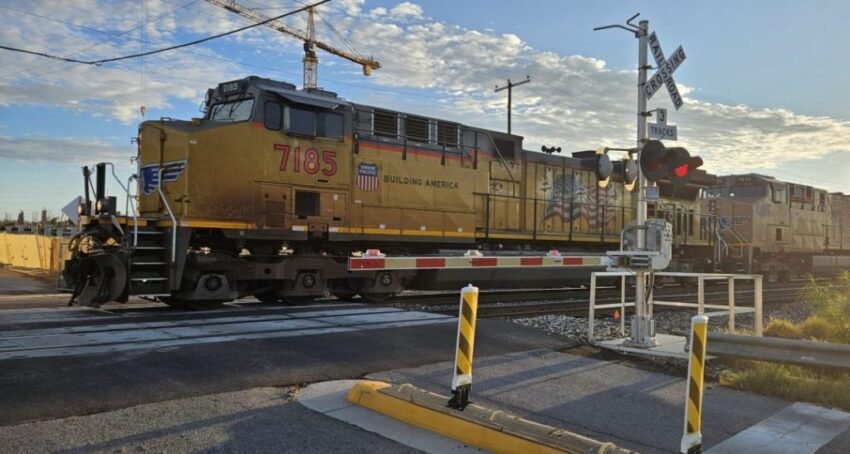

Traveling around the planned Steve and Nancy Fox Cancer Center will be safer and easier for pedestrians and drivers after the state completes a $25.7 million project that will recreate where the Union Pacific Railroad crosses Rick Francis Street in South El Paso.
The Rick Francis Street Rail Grade Separation Project will create an alternate passageway – either an overpass or under pass – at the railroad crossing that now is at ground-level with the street. Creating that alternate connection could lessen the chance of a train-pedestrian collision and reduce or eliminate wait times when trains pass by.
The work is expected to benefit thousands of people who work at or visit the Medical Center of the Americas and Texas Tech Health El Paso to include the Fox Cancer Center and the Clinical Sciences Building, which are under construction on the north end of the Texas Tech campus.
The intersection has not been used much by campus students and employees since September 2025 when TTHEP started construction of the cancer center and clinical sciences building.
Details related to final design, schedule and construction phasing of the Rick Francis Street project will be determined through the project development process in coordination with stakeholders and partner agencies, said a Texas Department of Transportation spokeswoman in an email response to El Paso Matters.
Nahum Apodaca, manager of Environmental, Health and Safety, Land Holdings and Planning with the Medical Center of the Americas Foundation, said he expects the change of grade will be an underpass because it would be the quickest and most effective option.
He said the train traffic has created some connectivity issues with foundation employees. Their offices are in the Cardwell Collaborative, 5130 Gateway Blvd. East, which is just northeast of the TTHEP campus.

Apodaca said the foundation learned about the approval of the funds for the TxDOT project early last week, and there was a lot of support for it.
“This will reduce congestion tremendously,” said Apodaca, who added those trains have occasionally caused him to be late for work or to meetings at TTHEP or University Medical Center.
While happy for this step, Apodaca was not sure when the change of grade work will be done. He said there are a lot of stakeholders involved and some of them work slower than others. However, he is aware that the goal is to open the Fox Cancer Center in late 2028 so the importance of that project could speed things up.
SEE ALSO: Montana Avenue expansion gets $100 million
In a March 2024 TTHEP mobility study, TxDOT reported that trains use the tracks about 23 times per day. It also mentioned planned growth on the north and south ends of campus and the anticipated student enrollment increase. This would mean more vehicle, bicycle and pedestrian traffic along Rick Francis Street, which is the inner campus’ main thoroughfare.
The report found that there had been no highway-rail accidents at the Rick Francis Street site from 2018 to 2022.
There were two instances of a blocked crossing from January 2020 and June 2023. A blocked crossing is when a train impedes the flow of vehicular or pedestrian traffic for an extended period of time. In these cases, the delays were 30-60 minutes long and prevented students and healthcare workers from getting to their classes or shifts on time.
The study included several grade-separation options that were technically and financially feasible, but stakeholders have not made any decisions yet.
The Federal Railroad Administration selected the Rick Francis Street project, one of 12 in Texas, after a competitive selection process. Of the total funding amount, $20.6 million comes from federal funds.

The National Railroad Partnership Program/Federal Railroad Administration’s Federal-State Partnership for Intercity Passenger Rail Grant Program awarded more than $756 million to TxDOT for the dozen projects. Among the partnership’s goals are to improve transportation system performance through railroad grade separations (overpasses or underpasses) on local, non-state roadways.
“By eliminating at-grade rail crossings, we can improve safety, reduce congestion and keep people and goods moving more efficiently,” Marc Williams, TxDOT executive director, said in a news release.
RELATED: Long-delayed Pellicano Drive work nears milestone, but hurdles remain before completion
Part of the money for the project comes from the new Off-System Rail Grade Separation Program, which the Texas Legislature established last year. One of the program’s goals is to help communities address dangerous and congested railroad crossings.
State Sen. César Blanco, whose District 29 encompasses El Paso, said these projects address dangerous rail crossings and keep critical projects moving forward.
One of those projects is the TTHEP cancer center and clinical sciences building. A university spokesman said the contractors are erecting the final foundation wall section and are completing the first-floor deck slab. Officials expect work on the second floor to start soon.
The cancer center will be about 131,000 square feet and cost $138.2 million. The CSB will cover 225,000 square feet and cost $203.7 million. The multi-story projects are being built simultaneously but have separate funding sources.

Blanco also acknowledged the work done by U.S. Rep. Veronica Escobar, D-El Paso, to secure the necessary federal funds. He called the Rick Francis Street project a great example of what can be accomplished when local, state and federal partners work together.
Escobar, in an email response to El Paso Matters, said this project will be another exciting step in the development of the area and improve efficiency around the growing healthcare community.
In her December 2025 letter of support to the Texas Transportation Commission, Escobar pointed out that the growth of MCA and TTHEP, including the addition of the cancer center, will mean additional pedestrian traffic made up of students, patients, faculty and physicians. They will need a better way to get to and from the assets at that medical hub.
Eastside resident Patricia Williams worked at TTHEP about 10 years ago and remembers occasionally having to wait for a passing train.
She said it usually happened at inopportune times such as when she was returning to the office after lunch, when she needed to pick up her children from daycare or when she was running late in the morning.
“It didn’t impact me much, but when it did, it was really frustrating,” she said about waiting at the double-track rail corridor.
Williams said the news that the TxDOT is going to remedy that situation was a step in the right direction.
“I think anything that’s going to help alleviate congestion in an area that continues to grow in our community is a good thing,” she said.
The post $25.7 million rail project aims to ease congestion at Texas Tech Health El Paso appeared first on El Paso Matters.
Read: Read More