



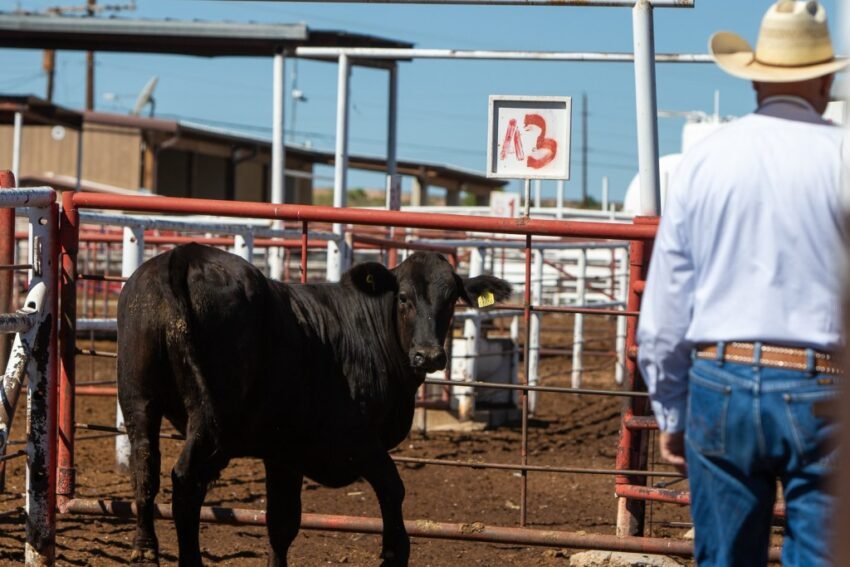

ANTHONY, New Mexico — John K. Hudgens strode past empty pen after pen at the Vaquero Trading stockyards before approaching the first herds of cattle. In a back pen, hefty, solid black Angus steers clustered in the shade. He walked into another pen with smaller, light gray Brahman cross steers – those will go to a pasture to graze and put on weight, he said.
There’s only about 100 heads of cattle here during a recent morning, outnumbered by the birds that pillage the soil for spilled grain.
Until recently, these grounds stood barren.
The stockyards can hold up to 4,000 cattle at a time, with numbers fluctuating depending on the time of year, Hudgens said. The majority of U.S. cattle imports from Mexico originate in Chihuahua. But the steers at the stockyards this morning came from the Mexican state of Sonora through Douglas, Arizona, he said.
The U.S. Department of Agriculture suspended the import of live cattle and horses May 11, 2025, after the detection of New World screwworm infestations creeping north in Mexico. Cattle are susceptible to the parasitic flies, which lay eggs in open wounds.
Then in late August this year, the USDA began a staggered reopening of livestock crossings, starting with the Douglas port of entry, which is only allowing live cattle imports from neighboring Sonora.
Now the busiest cattle crossing on the U.S.-Mexico border is set to reopen.
Livestock trade will resume Sept. 24 at the Santa Teresa, New Mexico, port of entry, U.S. Secretary of Agriculture Brooke L. Rollins announced last week. As part of stricter entry protocols, the livestock crossing will only allow cattle imports from neighboring Chihuahua.

More than 250 miles south, third-generation cattle rancher Marco Cuesta has already begun preparations for the port reopening. His cattle must receive parasitic treatment such as ivermectin and undergo pre-inspection at his ranch outside Chihuahua City. Then they can head north for two more examinations with inspectors and screwworm-sniffing detection dogs before they can pass through the Santa Teresa port.
His family business, Ganadería Potrero de Mápula, already has Angus and Charolais cattle among the more than 100,000 cattle in Chihuahua registered to enter the Santa Teresa port, he said. Each head requires an electronic tag to track movement.
Prior to the trade suspension, Mexico exported more than 1.2 million heads of cattle into the United States in one year, according to USDA data. About 40% of all Mexican cattle entered through the Santa Teresa port.
Cuesta said the port closure created a crisis, forcing Chihuahuan cattle ranchers to sell steers in the Mexican market for half of what U.S. buyers would pay. In the beginning, some ranchers held onto their cattle in hopes the ports would reopen, but once the cattle got to a certain weight, they had no choice but to sell for “huge discounts” to Mexican feedlots, he said.
“We started selling to national feedlots who have never had the quality of cattle we started delivering to them,” Cuesta said. “In Chihuahua, we have a saying: ‘We produce some of the best cattle in the world, but we eat the worst meat in the world.’ Everything that’s young and productive, we sell to the United States, and we eat all the old cows, old bulls, all that just finished their time on the ranch.”

On Sept. 17, on Rollins’ reopening notice, New Mexico officials announced the state’s second case of New World screwworm – a horse in Grant County, about 150 miles outside of El Paso. The closest screwworm case to El Paso occurred in a dog in Ciudad Juárez in August.
Since the start of the outbreak, there have been 50 cases of New World screwworm reported in Texas and New Mexico, and more than 300 cases reported in Chihuahua, as of Sept. 21.
Sterile flies and reporting crucial in screwworm response
The more-than-yearlong suspension of cattle trade has been part of an aggressive and ongoing response to the reemergence of New World screwworm, a parasite that was eradicated in the United States in the 1960s. Female flies are especially attracted to the umbilical stump of newborn calves. The larvae that hatch burrow in the wound and feed on living tissue.
Human and wildlife cases of screwworm are rare sightings. All the screwworm infections reported in the United States so far have been in domesticated animals, with cattle making up the highest number of cases.
While the flesh-eating maggots can cause damage, if treated early, the animal survives in most cases, said veterinarian and rancher Dustin Dorris, region director for the Texas Animal Health Commission.

After a confirmed screwworm case, the Texas Animal Health Commission and USDA create a temporary quarantine zone within a 12.5-mile radius that restricts animal movement without prior authorization.
Dorris was among the speakers last week at Texas A&M AgriLife Extension in El Paso to give an update on the New World screwworm outbreak and share management tips.
“The fastest way to move a screwworm is on a trailer,” said Sonja Swiger, an entomologist at Texas A&M AgriLife Extension, during a presentation.
New World screwworms can fly more than 12 miles to find a suitable host, but have historically spread through the movement of infested livestock, she said. The United States began eradicating screwworm in the 1950s by releasing sterile male flies that mate with wild female flies, causing them to lay eggs that don’t hatch.
An estimated 500 million sterile flies need to be released each week in outbreak areas in Mexico and the United States to eradicate screwworm again, Swiger said.
Mexico opened a sterile fly facility in June in the southern state of Chiapas, releasing 30 million flies a week to start with the goal of ramping up to 100 million flies by the end of the year, Swiger said. The United States plans to open another facility in April 2027 at Moore Air Force Base in Edinburg, Texas. The facility will release 100 million flies a week in the first phase, then scale up to 300 million flies a week, she said.

Reporting screwworm infections is a crucial aspect to this management technique, Dorris said. Yet still, Dorris has heard from ranchers who said they won’t report cases because they don’t want to trigger a quarantine zone.
“If I can’t report back … and say, we’ve got an outbreak, another one in this area, or a new one in this area, that dictates how many flies get dropped over that area and dictates how long,” Dorris said.
Mexican cattle ranchers take precaution, cut losses
Cuesta said his business had its own safeguards in addition to regulations from U.S. and Mexican authorities.
He and his workers stopped branding, castrating and dehorning young cattle in the hottest months when there are the most flies, Cuesta said. They also apply a tincture on newborn calves to protect their navels from screwworm flies.
“We come from a working culture, so it’s OK,” Cuesta said about the extra steps.
But he and others in the cattle industry question the USDA’s decision to close the ports of entry to livestock for so long.

Cuesta and other ranching families are part of Chihuahua Verified Beef, a company that markets the value of Chihuahuan cattle because unlike the United States, Mexico does not grade beef quality.
Chihuahua Verified Beef retains ownership of the cattle all the way to slaughter, Cuesta said. Prior to the Santa Teresa port closure, the company was in talks with retailers including H-E-B to sell their beef in stores. But the import suspension disrupted those discussions, he said.
In addition to the losses in Mexico, the cattle industry generates jobs in the United States and Mexican cattle gain an estimated two-thirds of their value going through the U.S. supply chain, said Álvaro Bustillos, owner of Vaquero Trading and president of Unión Ganadera Regional de Chihuahua, the cooperative representing livestock producers in Chihuahua.
“It cost the U.S. so much,” Bustillos said. “These cattle are more American than Mexican by the time they become food.”
Typically, Mexican ranchers sell their cattle to U.S. buyers in an auction or contract, who then sell the cattle to a feedlot or pasture business, who then sell the cattle to meatpackers who slaughter and process the meat, which is then put in American packaging to be sold to consumers, he explained.
But feedlots have fallen in capacity and truck drivers who transported the cattle found jobs elsewhere, such as in the West Texas oil fields, Hudgens said.

“We thought it (screwworm) was going to be a big problem in Texas, but truthfully all the protocols have worked,” Cuesta said. “In the end, I think more chaos and panicking from people than screwworm affected cattle numbers and ranches.”
There are two active cases of screwworm infestation in Texas and New Mexico, as of Sept. 21, and more than 85 cases in Chihuahua. The most recent case in Texas was a horse in Presidio County confirmed Sept. 9, according to the USDA’s screwworm data dashboard.
Hudgens was born in Chihuahua, Mexico, where he’s known as Juan Carlos. He has been in the cattle industry for at least 45 years, following in his father’s footsteps.
“I’ve been in this business a long time,” Hudgens said. “And when they shut the border down, that was all I knew to do. I was on vacation for a year.”
Up until 1993, when the Santa Teresa livestock crossing opened, cattle would be transported through Juárez and cross over the Bridge of the Americas into El Paso where they were held in different pens from Fabens to Canutillo, Hudgens said.
Today’s treatments and preventive medication weren’t around when his father started his business. To contain the spread of screwworm, the U.S. and Mexican governments teamed up to fly over and drop off little boxes of sterile flies for people to release on their ranch, Hudgens said. People also put a black paste on the cattle after castration to keep the flies away, he added.
“Of course nobody wants to have a flesh-eating fly,” Hudgens said. “What they did back then was treat the animal. It’s not a death sentence for the animal. You cleaned it out, got all the maggots out and started putting sulfur and penicillin in there to let the wound heal up.”
While the traditional remedy of sulfur and penicillin does not kill screwworm larvae, ranchers have modern treatments now: antiparasite drugs doramectin and ivermectin, as well as oral drugs for dogs.

Dorris stressed that keeping a close eye on animals – for unusual smells and behaviors, on wounds – is one of the most critical actions in managing the outbreak. Being observant can be what saves a calf, he said.
“This is a community issue,” Dorris said. “Yeah, we’ll talk about the rancher… It’s going to take him, it’s going to take his neighbors, it’s going to take everybody involved. There’s not enough folks in my agency, there’s not enough folks in the USDA to cover every animal out there. But the best thing the rancher told me he has is his eyes.”
The post As screwworm outbreak slows down, Mexican cattle ranchers prepare for Santa Teresa port to reopen appeared first on El Paso Matters.
Read: Read More