



by Tim Holt
I’ve noticed that we’ve developed a new form of intellectual debate on social media. Someone (i.e., me) posts a picture, a poster, or a message, and invariably, some genius in the comments announces, “That’s AI!”
Well, thank you, El Sherlock. Another mystery solved. Alert the authorities. I used a frickin’ computer. Apparently, identifying the technology used to create something now qualifies as an intelligent response to whatever it was trying to communicate.
Recently, I posted a promotional poster for an upcoming education conference here in the Borderland. It invited teachers, researchers, and other education professionals to share their knowledge. Its headline was simple: “You Have Something Worth Sharing!” Along with the poster was information about the conference and how to participate.
Apparently, almost everyone responding on the El Paso subreddit thought the most important thing was that the artwork appeared to have been created using artificial intelligence. Not the conference. Not the invitation to share knowledge. Not the opportunity for teachers to learn from one another. Nope. The problem was the artwork.
Think about that. Here’s a poster encouraging educators to share ideas, and the response is essentially, “Ewwww! AI!” It’s like sitting in a restaurant, taking one bite of your dinner, and announcing, “This tastes terrible because I don’t like the plate it was served on.”
Much of my education career was spent working with instructional technology. For decades, we’ve encouraged teachers and students to embrace new technologies and prepare for a rapidly changing world. We’ve spent billions putting computers into classrooms and attended countless conferences about innovation and creativity. We’ve told teachers to think outside the box and prepare students for jobs that haven’t even been invented yet. “Think different” and all that.
Now somebody uses a new-ish technology to advertise an education conference, and suddenly we’re horrified. Perhaps I should have used construction paper, Magic Markers, and an Elmer’s glue stick. Add some popsicle sticks and cotton-ball clouds, too! Cutting edge there, Skippy! That’s the technological innovation we’ve been encouraging for forty years. Welcome to the 1970’s, El Paso!
Here’s my question: What, exactly, is wrong with the message? Should teachers not share their knowledge? Should researchers keep their findings to themselves? Or are we so offended by the possibility that someone used AI that we’ve forgotten what the poster is asking people to do?
Someone could reasonably say, “I have no problem with the conference. I just don’t like the poster.” Fair enough. Criticize the typography, the colors, or the mountains that look like something from a cheap tourism brochure and a skyline from an imagined version of DTEP. Those are legitimate criticisms. But announcing that something is AI-generated isn’t a design critique. It’s merely identifying how it might have been made.
I see this increasingly on social media. Someone posts a message or illustration, and somebody announces, “AI slop!” The ultimate rebuttal. Two words that let you dismiss a message without reading it, understanding it, or, God forbid, thinking about it. It’s the social media equivalent of sticking your fingers in your ears and yelling, “LA LA LA, I CAN’T HEAR YOU!” Only now you get to feel technologically sophisticated.
Suppose someone creates a poster saying, “Please Adopt Shelter Animals.” It features a cute puppy with enormous sad eyes that make you want to adopt seventeen dogs. The puppy and lettering were generated by AI in thirty seconds. Does that mean we shouldn’t adopt shelter animals? Should we notify the Humane Society that its mission has been invalidated because somebody used a computer?
I suppose the message would be acceptable if someone hired a photographer, rented a studio, bought lighting equipment, and hired a graphic designer. Now THAT would be an authentic message about adopting dogs. Of course, by the time the poster was finished, the puppy would be three years old and collecting doggy Social Security.
I understand the objections to artificial intelligence. Really, I do. I’m a photographer and writer, and I worry about what AI means for people who make their living creating things. There are legitimate questions about copyright, compensation, and training AI on other people’s work without permission. There are serious concerns about misinformation, fabricated photographs, and determining whether something online actually happened.
Those are real problems worth discussing. But they’re not the same as automatically dismissing content because AI helped create it. Somewhere along the way, we’ve confused the method of production with the value of the product. A fact doesn’t become false because a machine communicated it. Nor does a lie become true because a human typed it.
(On ironic response to me was to “use Canva.” Canva is one of the leading proponents of using AI to create content like the poster I posted.)
And let’s not pretend humans have a spotless record producing perfect content. We’ve manufactured nonsense for thousands of years. When I was growing up in Northeast El Paso, there was a seafood restaraunt on Hondo Pass and Dyer that, honest to God, had a sign out in front for years that said “All Eat Cat.” Okay. They went out of business. I guess they ran out of cat. No artificial intelligence required.
What fascinates me is how quickly identifying AI has become a substitute for substantive discussion. Someone shares a message about climate change, education, or immigration. Instead of discussing the issue, you point out that someone in the illustration has six fingers. Aha! Six fingers! Climate change has been disproven! Congratulations. You identified an illustration error while avoiding the subject entirely.

Here’s something else I find amusing. Many people condemning AI-generated images carry smartphones that use artificial intelligence to produce their photographs. Their phones recognize faces, adjust exposure, combine images, reduce noise, and decide what colors the sky should be. But that’s different, apparently. Their photographs are authentic because they pushed a button. My illustration is garbage because they typed a sentence.
Some of the same people dismissing AI-generated posters will happily fork over twenty bucks to watch the latest Avengers movie, essentially a two-and-a-half-hour computer-generated fever dream. They’ll watch superheroes fly through computer-generated cities, battle computer-generated monsters, and save a computer-generated universe. But show them a computer-generated puppy encouraging animal adoption, and suddenly they’re defenders of artistic integrity. Have you ever seen a Pixar movie? Yea. Computer generated from the first frame to the last. But,but, but, that’s different!
Apparently, computer-generated imagery is perfectly acceptable as long as Disney charges admission. Yes, CGI and generative AI are different technologies, and the differences in creative labor and ownership matter. But if your objection is simply that an image was computer-generated, Hollywood has been committing that artistic sin for decades.
Now, before somebody starts typing furiously, I’m not suggesting all AI-generated content is good. Far from it. Much is dreadful. The internet is filling with plastic-looking people, impossibly perfect sunsets, fabricated quotations, and videos of cats performing complicated surgical procedures. We’re producing digital garbage at a speed that would have impressed Henry Ford. And we are experiencing AI-generated content that looks like the real thing, even though it isn’t. AI-generated revenge porn is a real problem.
And I find it troubling when people present AI-generated images as actual photographs. Show me a politician accepting a suitcase of cash, and I want to know whether it happened. Claim you photographed a rare bird in the Franklin Mountains, and I don’t want to discover it has three wings and was invented by a computer’s hallucination. But notice the distinction. The problem isn’t simply that AI was used. The problem is the deception.
Someone, or some organization might have an important message but lack the artistic ability, money, or skills to produce a professional poster. AI gives that person a way to communicate visually. It doesn’t necessarily supply the idea or determine whether it’s worthwhile. It provides another means of expression. We used to think making communication easier was a good thing.
Which brings me back to the education conference poster. I have no idea how much AI was involved in creating it, and frankly, I don’t care. I can see what it’s trying to accomplish: encouraging educators to share knowledge. Its closing slogan is “Inspire. Innovate. Ignite Curiosity.” Yet the possibility that someone used innovative technology apparently inspired curiosity about only one thing: whether AI was involved.
Perhaps the conference should offer a session titled “Innovation Is Wonderful, Provided Nobody Actually Uses It.” That might be the most popular session of the day, judging from the comments.
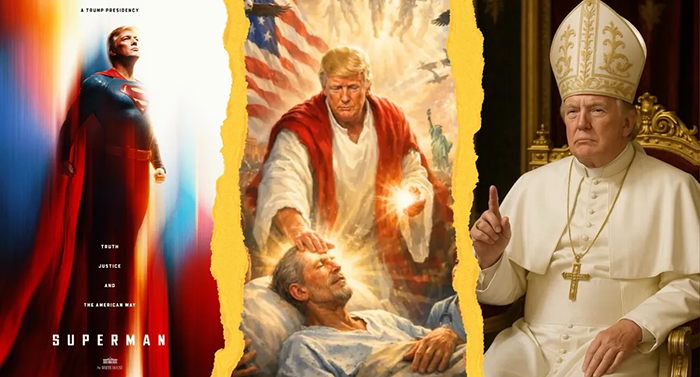
I don’t expect everyone to embrace artificial intelligence. I certainly don’t. There are legitimate questions about its development, business practices, environmental costs, and effects on creative professions. Here in the Borderland, we’re already arguing about the water and electricity demands of proposed data centers. Those are serious questions involving real resources and real consequences. Whether someone used AI to create a conference poster is a rather different matter. But if you are reposting a picture of Trump flying through the air like Superman shitting on California, don’t complain to me about my little poster.
If you disagree with a message, explain why. If its facts are wrong, demonstrate that. If it’s misleading, identify the deception. If the image is ugly, say so. Those are actual criticisms. They require thought. Simply announcing “That’s AI!” tells us nothing about whether a message is true, false, important, or ridiculous. It’s roughly the intellectual equivalent of looking at a painting and announcing, “That’s paint!”
And if your entire response to an idea is to dismiss it because a computer helped communicate it, perhaps the problem isn’t that artificial intelligence was involved. Perhaps the problem is that human intelligence wasn’t.
Read: Read More