



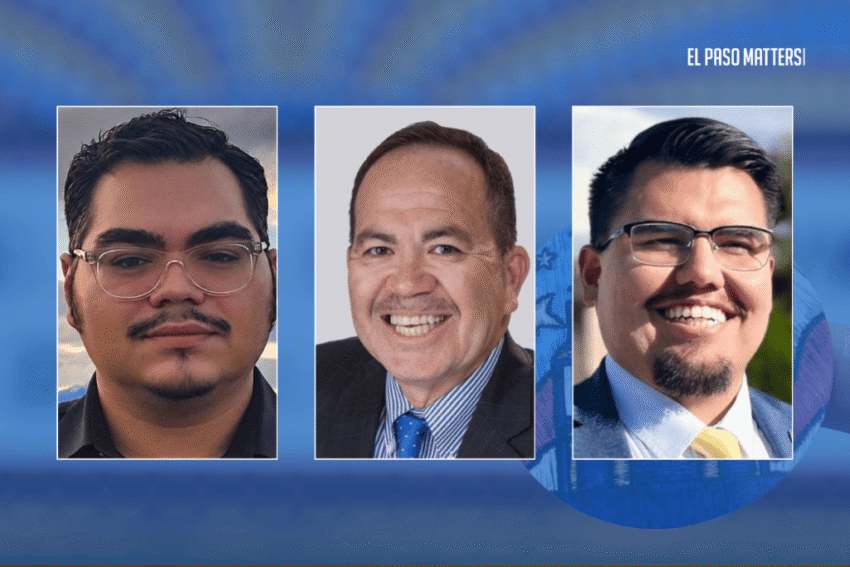

Incumbent city Rep. Art Fierro faces four challengers in the race for the District 6 City Council seat, as the city’s agreement with a Meta data center, a coming property tax increase and rising utility bills have put affordability at the center of the Nov. 3 election.
The Eastside district encompasses much of the 79936 ZIP code, including neighborhoods around Marty Robbins Park.
Fierro, 64, is seeking a second term on council after serving on the El Paso Community College board and in the Texas House. He won the council seat in 2022 after losing the Democratic primary for his legislative seat to Claudia Ordaz earlier that year. He points to park improvements, street resurfacing and investments in public safety – mostly compensation for firefighters and, soon, police officers – as reasons to keep him in office.
Jesus “Jesse” Moreno, 25, is a former City Council staffer who worked for District 3 Reps. Cassandra Hernandez and Deanna Maldonado-Rocha before recently departing Rocha’s office.
A Bowie High School graduate studying economics at the University of Texas at El Paso, Moreno worked multiple jobs while attending school before entering city government through a workforce program. He says his experience handling constituent issues, reviewing budgets and working with city departments would allow him to take office with an accumulated knowledge of city government.
Pedro Fernandez Jr., 26, graduated from Americas High School and UTEP, where he studied political science. The son of two Army veterans, Fernandez worked on congressional and statewide political campaigns before moving to Washington, D.C., where he worked for the Western Caucus Foundation, an organization focused on Western land, environmental and energy policy. He returned to El Paso and now works for a staffing agency. Fernandez describes himself as fiscally conservative and politically pragmatic.
Claudia Contreras Siller, a care provider for her mother and an animal welfare advocate, and photographer Hector Alba are also on the ballot. Neither responded to multiple interview requests from El Paso Matters. Alba did submit responses to a questionnaire from El Paso Matters.
Contreras Siller’s platform emphasizes animal welfare, including education about reporting cruelty and controlling stray cat populations.
In his questionnaire, Alba said he wants to see “more projects that make a lasting difference in transportation, infrastructure, Downtown and public spaces.”
“We should build on our art, music and culture, support local talent, attract new businesses and jobs, and plan for growth without losing the character that makes our city unique,” Alba said.
Moreno and Fernandez both also argued that Fierro should hold more meetings and spend more time explaining the votes he casts. Fierro disputed that criticism, saying his office holds a monthly Saturday meeting and at least one evening meeting each quarter.
Moreno promises two meetings monthly, including a virtual option, and more direct contact with residents and businesses.
“When you’re voting on an issue, defend your vote,” Moreno said.
Fernandez proposes monthly town halls, student visits to City Hall and neighborhood groups to hold the district office accountable.
City budget, taxes
Fierro voted in August for a $659 million general fund budget and a tax rate that increased city taxes on an average-value home by about $105 annually. The city’s police and fire departments made up over 56% of the city’s total budget.
Fierro said the compromise protected services while reducing the size of the overall tax increase. He said a no-new-revenue rate – which is designed to collect roughly the same tax revenue as the previous year from the same properties – would be “devastating for the city.”
“I couldn’t vote to set our public safety back,” Fierro said. “I also have a responsibility to the taxpayers who want and need services, like the libraries.”
Moreno wants outside audits of city departments, and less reliance on outside attorneys and contractors. Specifically, he called for a review of the city’s use of certain radio handsets for mobile communication, which he said costs thousands of dollars per unit.
“Is there another service we can use?” Moreno said. “Is there a contract we need to re-evaluate?”
He argued City Council should scrutinize contracts and spending decisions more carefully before asking residents to pay more. But he acknowledged that maintaining city services limits how much officials can cut.
The city already has an internal audit function as well as an independent auditing firm. Forvis Mazars LLP, is the city’s independent financial auditing firm that issued a “clean” opinion for the city’s fiscal year that ended in August 2025, according to the city’s most recent Annual Comprehensive Financial Report.
Fernandez proposes testing zero-based budgeting in some departments, requiring them to justify spending from the ground up, and reviewing executive positions. He also opposes debt issued without voter approval for projects that do not address emergency infrastructure.
Neither challenger provided a dollar estimate showing how much those changes would save or whether the savings would offset rising public safety costs.
Fernandez acknowledged that slashing city spending could ultimately require difficult decisions about city services.
“Right now, it’s about having honest conversations with people,” Fernandez said. “If they’re fine with closing the library, that’s probably what we’ll have to do.”
Contreras Siller told KVIA in a candidate questionnaire that she would oppose projects she considers unnecessary, review the budget and eliminate travel benefits for council members and managers. She did not quantify the potential savings.
Meta data center, tax breaks
Fierro supported the original Meta data center tax break and incentives that council approved in late 2023, and voted June 9 against directing city officials to negotiate an end to the agreement. He argues that attracting major commercial taxpayers is important to reducing homeowners’ tax bills.
“It wasn’t to do anything but terminate the 380” agreement, Fierro said, referring to the tax break deal. “We had legal counsel, outside legal counsel, whose expertise is working with breaking contracts like this. They came back and said ‘Look, you guys are talking about a billion dollars in restitution to Meta for for this.’”
Meta’s $14 billion Northeast El Paso campus is expected to become the city’s largest property taxpayer, generating about $15 million annually in city taxes when fully built in 2028, officials estimate. The agreement offers an 80% rebate on city property taxes.
Fernandez and Moreno criticized the generosity of the incentives, which also included a $12.5 million outlay of city funds to fix the roads around Meta’s data center.
Fernandez said the city should have demanded stronger contractual protections regarding water usage and environmental impacts.
Although he remains skeptical of Meta, Moreno said in an interview that terminating the tax break agreement after construction has begun would be unrealistic and potentially costly.
“I think agreeing to terminate was a bit extreme,” he said.
Contreras Siller said she opposes data centers altogether.
“I am 100% against data centers,” she wrote to KVIA. She suggested suing over deceptive trade practices, but her response did not identify the alleged deception or explain how a lawsuit would overcome the city’s contractual obligations.
Fierro said legal advisers warned that breaking the tax break agreement with Meta could expose taxpayers to substantial costs.
“I find it very difficult to support another data center,” he said, citing the projects already planned across the region. He voted to approve the city’s adopted policy directing staff not to recruit or incentivize additional facilities.
The candidates also differ on economic development beyond Meta.
Fierro emphasizes attracting employers with higher-paying jobs.
“There’s no way that property taxes are going to ever drop if we don’t bring more businesses into the community,” he said. “We also need to make sure that we have jobs for young people.”
In 2024, Fierro voted against a large fee increase El Paso Water sought to charge homebuilders that are developing houses on the edge of the city – a move that means El Paso Water ratepayers continue to partially subsidize the cost of building water infrastructure to newly built neighborhoods.
Fierro joined a majority on council who argued the higher impact fees would increase the price of new homes.
Moreno favors more infill development within existing neighborhoods rather than continued expansion into the city’s outskirts, where new roads, utilities and other infrastructure add to public costs.
Fernandez wants a broader economic strategy involving the airport, transportation and opportunities for graduates.
Rising utility bills
All three interviewed candidates expressed concern about rising water, electric and natural gas bills. The city owns El Paso Water, but has limited authority over gas and electric utility rates.
Fierro pointed out that City Council cannot independently block increases sought by El Paso Electric, which are ultimately decided by the Public Utility Commission of Texas.
“We really can’t tell El Paso Electric ‘You can’t raise our rates,’” he said. “But we do go to litigation. And, since 2023, when I was sworn in, we’ve taken 60 cases to litigation.”
The City Attorney’s Office routinely intervenes along with other businesses and advocacy groups when El Paso Electric asks for permission from the PUC to do various things, such as increase rates, implement bill fees or build new infrastructure. The City Attorney’s Office acts as an opposing party to El Paso Electric, but the PUC has authority over the utility.
Moreno said he wants City Council to directly appoint members of the Public Service Board, the seven-member body that governs El Paso Water and votes on rate increases. Currently, a selection committee reviews applications and submits three finalists for council approval. He also called for stronger city advocacy at the Texas Legislature in Austin.
Fernandez calls for more public discussion of utility costs, but he didn’t identify a specific mechanism to lower electric, gas or water rates.
Street repairs
Fierro and Moreno disagreed over whether the city should implement a household fee to raise money for street repairs. The city has said its street maintenance program is underfunded by tens of millions of dollars per year.
In November 2025, council voted 5-3 to delete a planned presentation on a transportation user fee from its agenda; city staffers previewed the fee to reporters but never presented the idea publicly. The proposal included options for residential fees ranging from $4.40 to about $11 monthly, with businesses paying according to estimated traffic generated by their properties. City staffers estimated the options could raise from $29 million to $75 million, annually.
Fierro wants a dedicated street funding source but said he did not support imposing a fee on households. He did not identify a replacement revenue source in the interview.
“We have a choice of not improving our streets or finding a path to improve our streets,” Fierro said.
Moreno would revive the discussion through a work session and outreach to residents.
“That didn’t even get discussed,” Moreno said. “The staff had been working for months on that project, and this was finally a solution, but yet you’re going to shoot it down.”
Fernandez emphasizes sustainable funding and better communication about repair schedules. He argued residents receive little notice of roadwork and streets with unresolved damage.
Deck plaza
Fierro and Moreno support the idea of a park over Interstate 10 in Downtown as long as it’s not funded by taxpayers. Fernandez opposes the project, while Contreras Siller opposes spending on it that would increase property taxes.
“I would love for us to see a deck park without any taxpayer dollars,” Fierro said, suggesting the business community help fund it.
The Downtown Deck Plaza Foundation backing the project has said it envisions a mix of private donations and public funding. It estimates $207 million for the park and structure, plus potentially $32 million for retaining walls, and says it has raised $74 million in funding.
Moreno supports public-private partnerships and state and federal transportation funding while opposing another burden on local residents. He also questions who would cover maintenance and programming once the park opens.
Fernandez said the financing and promised economic benefits remain too uncertain to support the project.
“It’s a giant question mark,” he said.
Campaign finance
Fierro has a substantial fundraising advantage. His campaign reported $23,100 in contributions in the first half of 2026 and another $40,492 from July 1 through Sept. 24, including $5,392 in donated signs.
Fierro’s contributors include developer Woody Hunt, homebuilders Robert and Randall Bowling, the municipal police officers’ Political Action Committee, El Paso Electric’s employee PAC and the utility’s recently-retired CEO Kelly Tomblin. Tomblin and the employee PAC each gave $1,500.
Asked whether business donors influence him, Fierro said he has never had a contributor ask him to take a specific action. He attributes his fundraising advantage to relationships and his record in public office.
Moreno said he would avoid donations from prominent repeat political contributors. His largest donation was $2,000 from Pablo Duran. His report also includes $250 from former city Rep. Cassandra Hernandez.
Fernandez’s largest contribution was $500.
Alba reported that he neither raised campaign funds nor spent any money on his campaign. Contreras Siller did not file a campaign finance report.
City representatives serve four-year, nonpartisan terms and are paid $72,800 annually. The City Council, which adopts the annual budget and tax rate, sets city policy, and hires and oversees the city manager, city attorney and chief internal auditor.
Early voting runs Oct. 19-30. The winner will serve a four-year term beginning in January.
The post Incumbent Art Fierro faces four challengers in East El Paso District 6 race appeared first on El Paso Matters.
Read: Read More