



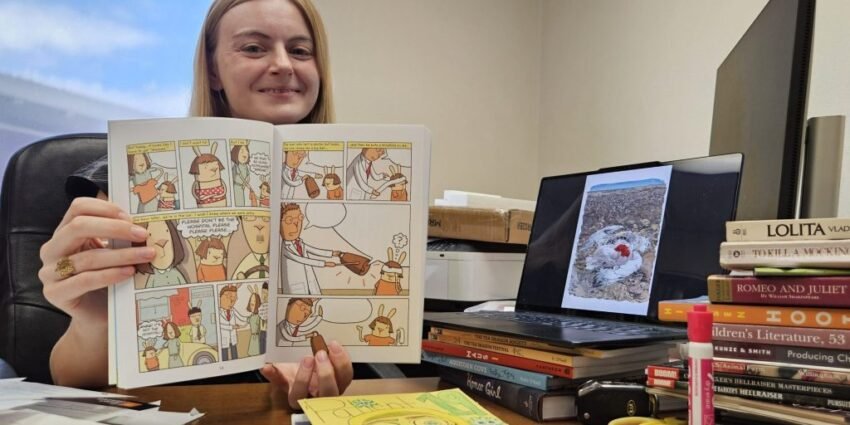

It’s a bird. It’s a plane. It’s a possible path to improved K-12 student reading outcomes, and it’s tied to a Superman seminar. At least, that’s the back story of Brianna Anderson, assistant professor of English at the University of Texas at El Paso.
Anderson, who is in her third year at UTEP, is using graphic novels in her fall 2026 courses – “Children’s Literature” for undergraduates and “Literature for Youth” for graduate students – that cater to people who are or plan to be elementary- or secondary-education teachers.
Since the 2010s, graphic novels have become an accepted method to teach about history, STEM, and complex literature, as well as an option to start discussions about controversial topics such as racism, disabilities, LGBTQIA+ issues, the environment, the Holocaust, immigration, and even school shootings.
Graphic novels are self-contained stories told through sequential drawings along with text and dialogue, although some stories only use art. They are similar, but different from the serialized superhero comics that feature the likes of Spider-Man, Batman and Wonder Woman.
“They are really engaging,” Anderson said about graphic novels during a conversation in her third-floor office in UTEP’s Hudspeth Hall. “No matter what the genre or topic, the kids are interested, especially boys.”
She mentioned research that showed how boys tend to like graphic novels more than regular novels. The engagement level is higher among elementary-school-age students who may want to read the “Diary of a Wimpy Kid” or the “The Adventures of Captain Underpants” series.
“It’s a good way to engage people who might be reluctant readers,” Anderson said.

Her origin story
Anderson was a bit dismissive of the undergraduate honors course centered on Superman that she registered for at Lake Erie College near Cleveland, Ohio, the birthplace of the Man of Steel’s creators, Jerry Siegel and Joe Shuster.
“I thought that comics were kind of for nerdy boys,” she said.
To her surprise, some of the storylines in the superhero comics she read for the course included political critiques and environmental messages. She realized that comics might convey deeper lessons.
“It wasn’t just beating up bad guys,” she said.
Her true conversion took place while a doctoral student at the University of Florida. She enrolled in an environmental literature seminar course and found a comic strip called “I’m not a plastic bag.”
The story is a wordless satire about a discarded plastic bag and its effect on the environment. It references the Great Pacific Garbage Patch located between Hawaii and California. The patch, which is about twice the size of Texas, was depicted as a monster that grew larger page after page.
It made her realize that this medium was uniquely suited to tell environmental stories because of the depth and breadth of the issues, which can be hard to comprehend in other media. As part of her courses, she tasks students to come up with their own short comic book that addresses an ecological issue.
As a teacher of the next generation of teachers, Anderson said she wants her students to create projects that make children think for themselves, and to empower them to speak about issues that they care about such as pollution and climate change, why it matters and possible solutions.
While used successfully as a teaching tool, Anderson said that there is still a stigma about the use of graphic novels among peers who believe they simplify issues.
“I don’t think that’s true,” Anderson said. “I think that you can express really complex ideas with the visuals and the text working together and have it be more emotionally impactful, too.”

In academia
Anderson said some students in her undergraduate course, which includes a wide variety of majors, initially think they can earn an “easy A,” but they soon realize they need to study the visual features of the graphic novels to decode ideas and messages about different topics including environmentalism.
The UTEP professor said the stories in her graduate course focus on the environment including climate change, pollution and water conservation. These issues generate discussions about such hot topics as artificial intelligence and data centers.
Brad Jacobson, associate professor of English at UTEP and director of the English Education Program, said he understood that there can be misconceptions about the value of graphic novels in education, but he believes there is a place for them at all ages.
“All of us interested in literacy and learning, and just having a kind of knowledgeable student base and citizenry can do well by paying attention to graphic novels,” Jacobson said.

Emily Midkiff, assistant professor in the Department of Teaching, Leadership and Professional Practice at the University of North Dakota, said K-12 students perceive graphic novels as a fun and more accessible format to read, which builds motivation and comprehension.
“If you are interested in learning something, then you are more likely to actually understand it,” Midkiff said during a phone interview.
The graphic novels also serve to build emotional intelligence as the students see the expressions on the characters’ faces and can follow their emotional trajectory easier than with an all-text book. That is why it is easier sometimes to present tough subjects through graphic novels.
For those reasons, teachers have to be cognizant of the content of the graphic novels they choose. There are studies that show that images in books like “They Called Us Enemy” about Japanese internment in U.S. concentration camps during World War II have more emotional depth than from the written word.
Additionally, Midkiff said graphic novels are great tools to help English Language Learners as the pictures help tell the stories even when the students continue to struggle with the words.

Jazmine Torres, a fifth-year teacher at Young Women’s STEAM Research and Preparatory Academy, agreed with Midkiff.
Torres said graphic novels help emergent bilingual students, as well as those with dyslexia, ADHD and on the autism spectrum. They also serve as bridges for students who find it difficult to read traditional books or do not find them interesting.
“They are able to grasp the concepts a little bit more,” said Torres, who is a first-year graduate student in Anderson’s Literature for Youth course. “With English, it’s really subjective, right? Subjective to the author, subjective to the reader, but I feel like graphic novels are able to make those connections a lot easier.”
Community
Anderson also has used the graphic novel concept at youth camps offered during spring and fall intersessions and the summer at the Frontera Land Alliance and the Alamito STREAM Learning Center in the Segundo Barrio. She uses the picture books to get participants to think about environmental issues or issues that interest them. She encourages them to create comics about those topics.
She said it is important for children to do hands-on activities and work on their communication skills, “especially in our brain-rot phone era.”
Abigail Minor, the Frontera project manager, said many of the 62 children ages 11-14 who participated in any of the group’s four sessions focused on their projects, which helped them to visualize what they had learned about the environment, especially the Chihuahuan Desert.
In one case, a camper used several panels on one sheet of paper to show how trash in the ocean could lead to the death of marine life. The creative process, which can intimidate some, is more about putting ideas on paper than artistic ability, Minor said.
“This medium is a very evocative way to do that,” she said.
The post UTEP professor uses graphic novels to engage reluctant readers, teach complex subjects appeared first on El Paso Matters.
Read: Read More