




The company planning to build a 12,500-seat amphitheater in Northeast El Paso used land it acquired from the city as collateral for a $20 million loan to help finance construction of another amphitheater near Dallas, according to federal securities filings.
Venu Holding Corp., the Colorado-based entertainment company developing the Sunset Amphitheater at the former Cohen Stadium site, borrowed the money in July from Ryan LLC, a Texas-based tax consulting firm and business partner of the company.
The 90-day loan carried an 18% annual interest rate.. To secure it, Venu pledged properties and other assets connected to several projects, including its 20-acre El Paso site.
The arrangement highlights how Venu’s construction spending far outpaces the revenue its existing operation generates – meaning the company has to seek funding from investors, lenders and real estate transactions while its new amphitheaters remain under development.
The city of El Paso provided Venu incentives worth nearly $31 million and conveyed city-owned land for the project.
“VENU is developing several amphitheaters at once. Like any developer building at that pace, we use our full balance sheet to keep every project on schedule,” the company said in an emailed response to questions. “Pledging assets to support a short-term construction facility is a common tool and does not change our commitment to any market.”
Since putting the El Paso property up as collateral in July, Venu has strengthened its short-term finances with a $60 million sale-leaseback transaction involving the company’s McKinney, Texas, property with STORE Capital, a real estate investment company.
Under the sale-leaseback arrangement, Venu sold the land beneath the McKinney venue and parking garage before agreeing to rent it back. The sale-leaseback deals that Venu has also used elsewhere allow the company to raise cash from real estate without issuing new shares, although it also creates ongoing rental expenses.
Venu said it used the proceeds from that transaction to repay the Ryan loan and to finance the remaining construction of the venue in McKinney. That project is a 20,000-seat amphitheater expected to open early next year at a price of about $330 million.
In securities filings, Venu described the July loan secured by the El Paso property as temporary financing intended to keep construction in McKinney advancing until longer-term funding became available.
“The Ryan loan did exactly what it was designed to do. It kept construction moving in McKinney, and it has been paid off in full,” Venu said in its statement to El Paso Matters. “The El Paso property is free of any encumbrance, and our economic development agreement with the city is unchanged.”
The El Paso amphitheater project has already experienced significant delays and cost escalations.
Originally proposed as an $80 million development expected to open in March 2026, the cost of the El Paso amphitheater has since grown into an expected investment of $160 million. Venu has estimated an opening in early 2028, according to the company’s most recent quarterly financial report.
“Sunset Amphitheater El Paso remains a priority, and we look forward to starting construction soon,” Venu said.

A costly short-term loan
The July 17 financing agreement illustrates how Venu has been raising money to support several expensive construction projects at once. In an interview with the entertainment industry trade publication Pollstar published in June, Venu’s founder and chief executive, JW Roth, said the company has $1.5 billion worth of projects in development across five sites.
The $20 million loan deal listed several assets as collateral, including property associated with Venu’s planned developments in El Paso, McKinney and Centennial, Colorado, as well as another Colorado Springs property.
Ryan LLC has worked with Venu since 2023, helping identify development sites and structure economic development partnerships with local governments. It also provides tax advisory services to the company.
“This capital positions us to retire our bridge financing and complete construction as we prepare to open the doors in McKinney,” Roth said of the STORE transaction in an Oct. 21 press release.
The Dallas Morning News reported earlier this month that the McKinney project’s estimated cost had risen from approximately $220 million to $330 million.
El Paso, Venu deal
El Paso City Council in July 2024 approved a public-private partnership with Venu intended to transform the former Cohen Stadium property into a regional concert venue.
The city’s incentive package includes tax rebates, waived development fees and an $8 million, interest-free development loan backed by the $80 million Texas Economic Development Fund, which was established as part of a J.P. Morgan-owned fund’s acquisition of El Paso Electric. The city will forgive the loan if Venu completes construction within a certain timeframe and meets requirements such as hosting at least 25 events annually three years after the venue is built and starts operating.
“The El Paso property was conveyed to VENU and is now a privately owned asset,” Laura Cruz-Acosta, spokesperson for the city, said in an email. “VENU is also a publicly traded company, which may limit the company’s ability to provide advance notice of certain financial transactions before they are publicly disclosed.”
READ MORE: City Council approves $31 million deal for Northeast El Paso amphitheater
The original incentive agreement passed by a 4-3 vote, after current District 2 city Rep. Josh Acevedo opposed the deal along with former council Reps. Cassandra Hernandez and Isabel Salcido. Current city Reps. Chris Canales and Art Fierro voted in favor, along with former Reps. Joe Molinar and Brian Kennedy.
“When you look at most outdoor music spaces, they were built before what the fan is demanding today,” Roth said in the June Pollstar article. “It’s hard to build that and make it pencil. We really need the assistance of municipalities that can contribute real estate and tax incentives – all those kinds of things – and it makes perfect sense.”
At the time of the vote, the three representatives who voted against the deal with Venu expressed concerns about provisions of the agreement, including an $8 million development loan the city gave the company, and restrictions on the city’s ability to develop competing entertainment venues.
The original agreement included a prohibition on the city developing certain competing entertainment venues with capacities exceeding 4,000 people within 60 miles of the amphitheater, with exceptions for voter-approved projects.
In June, Venu told the El Paso Times that it expected to spend about $160 million on the amphitheater, attributing the higher cost to enhancements such as advanced sound systems and large LED video walls.
Delays, executive exit
The amphitheater has also faced a series of delays involving the acquisition of the city-owned property.
In June 2024, the city postponed public hearings associated with conveying the property to Venu until a parking and traffic study could be completed. Later that year, negotiations became bogged down over the title to the former Cohen Stadium property, where an old federal map identified potential unexploded ordnance concerns.
LEARN MORE: Land title transfer remains roadblock for Northeast amphitheater
City officials previously said there was no known unexploded ordnance at the site. But the issue held up the process to provide the property title Venu needed to secure financing from investors.
The city and Venu finalized the land transfer in May 2025.
Venu executives subsequently unveiled updated designs for the amphitheater, including heated seating, wind barriers and cooling systems intended to allow concerts during different seasons.
Robert Mudd, Venu’s senior vice president of construction and market expansion, told KVIA in May 2025 that the company expected to host 60 to 70 musical performances annually once the venue opened. He said construction would take approximately 14 months after the company completed its design process.
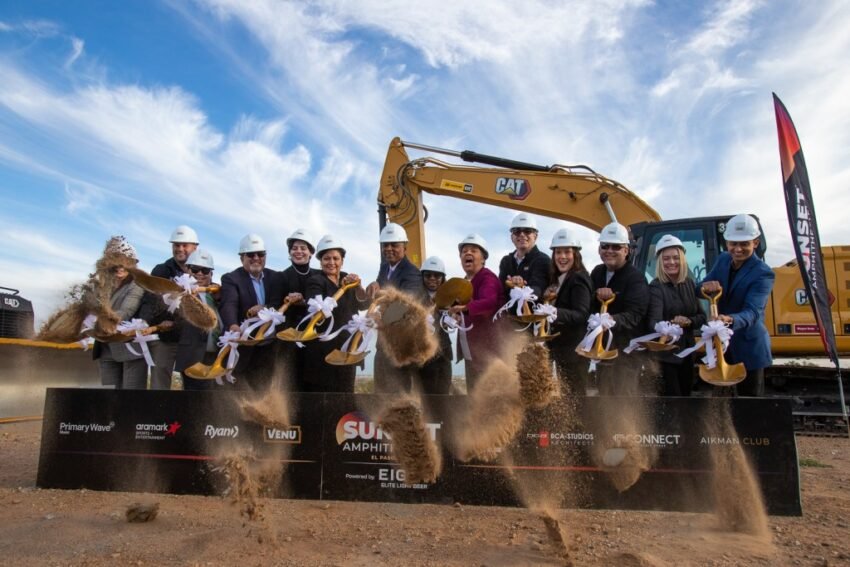
When Venu held a ceremonial groundbreaking in November 2025, the company’s president at the time said the opening date remained uncertain.
“This is a journey, and we’re going to have a lot of fun along the way,” William Hodgson, then the company’s president, told attendees at the ceremony.
Hodgson said at the time that the venue could open in 2027. He departed the company earlier this month, according to SEC filings.
In June, Venu said the El Paso project’s opening had been delayed partly by plans for parking. Under its agreement with Venu, the city is responsible for ensuring at least 3,600 parking spaces are available, but some of the land needed belongs to El Paso Community College. EPCC trustees this summer approved a preliminary agreement to negotiate a lease with the city.
Venu’s August securities filing pushed the estimated opening to early 2028.
A company expanding faster than its revenue
Venu is attempting to develop a network of large entertainment venues across several states.
The company’s Ford Amphitheater opened in Colorado Springs in August 2024, and it operates smaller music venues, restaurants and hospitality businesses in Colorado and Georgia.
Venu also has relationships with major entertainment companies, including AEG Presents, Live Nation and Aramark.
Aramark, which provides food, beverage and other services at entertainment facilities, has invested approximately $20 million in Venu. The most recent $5 million installment closed Oct. 15, according to a company securities filing.
During the first six months of 2026, Venu reported $8.6 million in revenue and a net loss of $34.2 million. It spent nearly $133 million purchasing property and equipment over the same period.
As of June 30, Venu reported $16.3 million in cash on hand and $82.9 million in liabilities due within one year, including nearly $60 million in accounts payable.
In addition to seeking outside funding through lenders and real estate deals, Venu also raises funds by selling ownership interests through the company’s Luxe FireSuites.

In El Paso, Venu has marketed more than 200 FireSuites, which are premium seating areas with fire pits, food service and other amenities. The company’s executives have said prices range from $298,500 for a four-person suite to $597,000 for an eight-person suite.
Former Dallas Cowboys star quarterback Troy Aikman is a Venu shareholder and owner of one of its Luxe FireSuites, according to the company. He serves as a national spokesperson for Venu’s suite investments, and his Ocho beer brand is a partner at its Texas and Oklahoma amphitheaters.
The company’s stock price has fallen sharply since it began trading on the public market. Venu went public in November 2024 at $10 per share. Its shares closed Friday at $1.32, down nearly 90% over the past year.
A January 2025 report from investment firm ThinkEquity recommended buying Venu shares and assigned them a $15 price target. ThinkEquity had entered into a business relationship with Venu to help sell additional shares of the company’s stock.
Still, the research report published early last year identified development delays as a material risk to Venu’s business.
“Venu’s business model hinges on timely development and successful operation of live-music and entertainment venues, which require considerable capital investments and coordination,” ThinkEquity analyst Ashok Kumar wrote. “Delays in construction, land acquisition, and project development, often influenced by local governmental opposition, zoning restrictions, or regulatory hurdles, could disrupt timelines and escalate costs.”
El Paso among other unfinished projects
Venu has numerous entertainment projects planned and underway.
The Regent Bank Amphitheater in Broken Arrow, Oklahoma, is preparing for initial winter events before a full concert season planned for 2027.
The much larger amphitheater in McKinney – a suburb north of Dallas – remains under construction, with its opening targeted for the first quarter of 2027.
The company also has developments planned in the Houston area, Chattanooga, Tennessee, and Centennial, Colorado, as well as a recently announced project in Frisco, Texas.
The company has also abandoned at least one previously announced amphitheater development in Murfreesboro, Tennessee, where Venu entered into a municipal development partnership for a proposed entertainment complex but failed to meet certain permitting and construction deadlines.
The parties ultimately agreed in August 2024 to terminate the project, and the property was returned to the city of Murfreesboro. A separate proposed amphitheater development in Oklahoma City also failed to gain local approval in 2024 amid concerns about noise, traffic and other effects on nearby residents.
The post Amphitheater developer used El Paso property to secure $20 million loan for another Texas project appeared first on El Paso Matters.
Read: Read More