



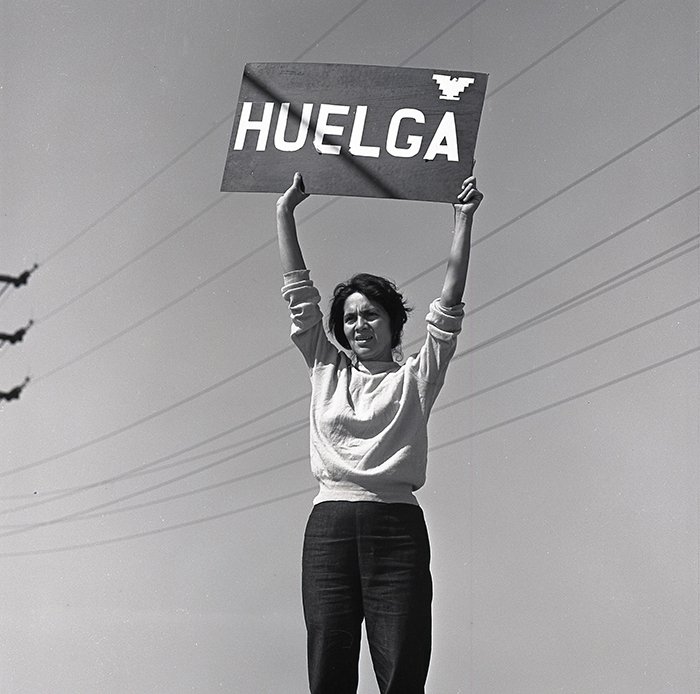
by Kent Paterson

To describe Dolores Huerta as larger than life understates the drive and determination of a woman who first gained public fame as a co-founder and steeled organizer of the United Farm Workers of America (UFW) but also joined and promoted myriad social movements. From environmental causes and immigrant rights battles to the women’s movement and LGBTQ struggles and then some, the powerful voice of petite Dolores was somehow always there.
In her remarkable life, she witnessed victories, defeats and stalemates. And in the last year of her life, Dolores demolished an icon, longtime collaborator and UFW co-founder Cesar Chavez, when she told the New York Times earlier this year that Chavez had raped her. Mindful of the ramifications of her words, Dolores justified the historic concealment as necessary to preserve the farmworker movement, something which was bigger than either herself or Chavez.
I was lucky to meet Dolores a couple of times and conduct brief interviews. The first time was in Ciudad Juárez in October 2003. Dolores had tagged along on a Congressional fact-finding delegation that was probing the Juárez women’s murders. The delegation included Democratic Representative Luis Gutiérrez of Illinois and California Representative Hilda Solis, who was a big supporter of farmworker and labor movements and later served as President Obama’s Secretary of Labor from 2009 to 2013. Dolores and Solis, who currently chairs the Los Angeles County Board of Supervisors, were kindred spirits.
The U.S. delegation arrived almost on the second anniversary of the discovery of the bodies of eight murdered young women in a cotton field located in a heavily transited area of the border city’s so-called “Golden Zone.” Like others who were stunned by how a crime of such magnitude (and many others) could be hidden and then exhibited in such a public place, Dolores was outraged. But she was already thinking strategically, pondering how to achieve justice.
“This is going to be a priority for all the Latinos in the United States and especially the women’s organizations. There’s been an interest there but I think we’re still searching for that button you push, you know, how to stop this,” she said.
“And this is what I referred to a little while ago. As you know, when we started the farmworkers’ union we finally found out that the boycott was the magic button to be able to get laws, etc. There’s got to be…all of the trade between Mexico and the United States, with all the appropriations, etc., we’re going to find that area where we just put that pressure and to say, look, either you straight out this problem or X doesn’t happen.”
In 2026, however, many in Juárez still wait for someone to push that “magic button.” The second time I interviewed Dolores was in April 2017 at the National Hispanic Cultural Center in Albuquerque as she was preparing to deliver a speech to the then annual Cesar Chavez Day celebration in the Duke City. When I asked about her readings of and responses to the first Trump administration’s policies, she couched them as a certain continuation, or reemergence of you will, of reactionary policies that had been stewing for decades and must be challenged.
“It’s very overt what’s going on. It was happening with Nixon and Reagan, but it was covert. It’s visible. In a way, I think it’s good because we can attack it,” Dolores said with the grit and spunk that carried her through so many ups and downs over the years.

A New Mexican at Heart
For Huerta, New Mexico held a special place. She was born Dolores Clara Fernández on April 10, 1930 in Dawson, New Mexico, a mining town near the Colorado border. Huerta’s father, Juan Fernández, was a union activist and leader who was elected to the New Mexico State Legislature in 1938. Like the singer Loretta Lynn, Dolores considered herself a “coal miner’s daughter.”
In Mexico, Dolores’ birthday, April 10, is remembered as the day the great revolutionary Emiliano Zapata was assassinated in 1919.
Abandoned in 1950, Dawson achieved a grim status in the annals of U.S. mining history and worker safety. The northern New Mexico community was the scene of a 1913 mine explosion that left 263 workers dead. Mostly, the victims were Mexicans and immigrants from Europe.
According to a 100-year anniversary article published in the Santa Fe New Mexican, the death toll ranked as the second deadliest mining disaster in U.S. history. If the first catastrophe wasn’t enough, a second explosion that shook the Dawson mine in 1923 killed 132 miners, including sons of the 1913 victims. Labor rights were in Dolores Huerta’s blood like a mighty river descending from mountains where eagles soar.
In 2024, Dolores was the main speaker at a Dawson reunion attended by former residents and relatives of mine disaster victims, reported blogger and journalist Nick Pappas, author of Crosses of Iron, an award-winning book about the Dawson mine disasters.
Dolores’ parents divorced and her mother Alicia took her six-year-old daughter to California. Yet with a big family and many friends in New Mexico, the indomitable organizer and activist never stopped calling herself a New Mexican.
“I’m always glad to come back to New Mexico. People should always come back to get humanized,” she told this reporter in 2017. The transplanted Californian proudly proclaimed culinary loyalty to the Land of the Zia Sun.
At a 1991 hearing in Las Cruces of the U.S. Commission on Agricultural Workers, of which she was a member, the increasing globalization of the chile pepper industry and its relationship to farmers’ costs and workers’ wages was hotly discussed (pardon the pun), touching on the quality and market preferences of green chile varieties grown in Mexico vs. New Mexico, a debate which continues to this day and likely forever.
“For all us New Mexicans living in California, we can tell you that all of us in California send for New Mexican chile every year,” Dolores told a panel at New Mexico State University. “So I think you have a very good point here, that you are not going to be able to grow this product in Mexico. It’s not going to have the same flavor..”
A woman of a thousand battles, Dolores connected with innumerable people across the globe, but New Mexico stands out as one place where she was especially beloved. Smiles, songs and laughter always greeted her visits. She was del pueblo, of the people.
A park in Albuquerque’s South Valley, Dolores Huerta Gateway Park, bore her name even before she passed on. On Friday summer nights, park visitors find themselves in a vibrant community space of joy and renewal where artists, musicians, dreamers and growers gather while viejitos dance to cumbias and oldies.
On April 5, 2025, Dolores addressed two rallies in Albuquerque held to celebrate farmworkers as well as oppose policies of the second Trump administration.
It was only five days before her 95th birthday and, attired like a Black Beret from the Chicano movement days, the legendary woman still exuded a fighting spirt. After nearly a century of existence and struggle, it wasn’t surprising that Dolores Huerta took the long view. She had lived through the Great Depression, World War Two and Korea, rampant racism and discrimination, the upheavals of the 60s and 70s, the Cold War, and much more. She was with Robert F. Kennedy when the presidential candidate was assassinated in Los Angeles in 1968.
Ever the eternal optimist, Dolores reminded Burqueños that good things can come out of bad times, citing as examples the New Deal which was born from the Great Depression and the Chicano, women’s and myriad social movements that came to life in the 60s and 70s.
Taking the stage during an era that might be referred to by historians as the Terrible Twenties, Dolores nevertheless envisioned a bright future- if the people struggle:
“And we’re gonna make it happen. It’s not rocket science. It happens in other countries where they have universal health care, universal day care, free college education, where workers’ rights are really respected so that when they win an election for representation they could actually get a collective bargaining agreement. We’ve got to fight really hard remembering workers. The population of our country are working people, not the millionaires and billionaires. We can’t give up…”
Also see: https://elchuqueno.com/dolores-huerta-still-inspiring-the-fight-for-a-new-society/
Read: Read More