



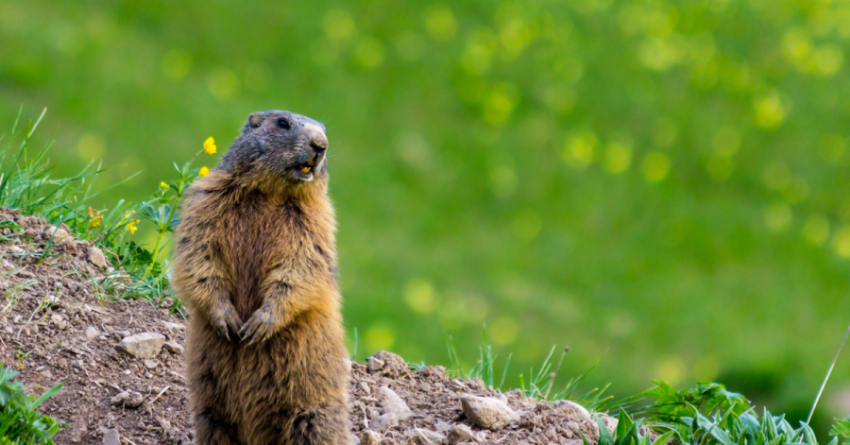
PUNXSUTAWNEY, Pa. (KTAL/KMSS) – Groundhog Day is on Feb. 1, but the yearly tradition of watching a groundhog one day a year is about much more than predicting the timeliness of spring. Punxsutawney Phil emerging from the ground is also about Americans seeing or not seeing the shadow of the oldest known indigenous tribe in the United States. The tradition is about fusing ancient legends, including the Delaware Nation’s great groundhog Wojak, with Christian and Celtic traditions of Candlemas that trace back to at least the fourth century.
Native American ties to Groundhog Day
The Delaware Nation is said to be the oldest indigenous tribe in North America and the originator of Punxsutawney, Pennsylvania’s original name. Ponkis Utenink, which means land of the ponkis, was settled by members of the Delaware Tribe known as the Lenni-Lanape.
And in case you were wondering, ponkis are sand flies. Extra mean sand flies were said to have plagued the first European settlers in the land-of-the-ponkis circa 1772, until those earlier European settlers finally lost the desire to establish a settlement between the Allegheny and Susquehanna Rivers.
In 1818, settlers tried again. The swamps were drained, the insects were exterminated, and in 1840, Punxsutawney officially became a European-style village. Ten years later, the population had swelled to just over 250 people.
But the village would not go down in history as a place where sand flies attacked. Instead, it became famous because of a little critter that couldn’t even chuck wood, despite its name.
The groundhog also goes by woodchuck, whistle-pig, wood-shock, whistler, marmot, thickwood badger, red monk, land beaver, weenusk, monax, groundpig, and some folks even call it a siffleaux. Scientists, however, call it a Marmota monax.
And it’s a rodent, in case you’re curious.
Old World ties to Groundhog Day
Calendars and candles united old-world cultures through Candlemas, a Christian holiday that began in the fourth century and celebrated the return of light after the darkness of winter. Candlemas occurred on Feb. 2 and helped neatly divide the Roman calendar into eighths. Candles were blessed on the day, which has many other symbolic meanings to the Christian faith. The day may also be an adaptation of Februalia, a holiday celebrated before the Christianization of the Roman empire.
The German tradition of Badger Day (Dachstag) is based on the belief that badgers see their shadows while coming out of hibernation on Feb. 2 will predict that winter will last longer.
Then there’s Imbolc, a Celtic word that symbolizes the day halfway between the winter solstice (Yule) and spring equinox (Ostara). Imbolc means in the belly of the mother, in case you were curious.
Generations later, in the United States, kids taught one another the tongue twister: “How much wood would a woodchuck chuck if a woodchuck could chuck wood?” Little did/do most kids today know that a woodchuck is a groundhog, or that in Punxsutawney, Pennsylvania, on Feb. 2, 1887, a groundhog came out of its hole at Gobbler’s Knob in Punxsutawney and began a tradition that has been going strong for the past 136 years even though the reasons why have mostly been forgotten.
But it is no accident that Candlemas, Groundhog Day, Badger Day, and Imbolc fall on the midpoint between the winter solstice and the spring equinox. This particular time is considered a cross-quarter day, the day halfway between winter and spring.
Great-groundhog Wojak is said to have been both a groundhog and the ancestral great-grandfather of the Delaware Nation who came from within the earth. Hence the name woodchuck may very well be a corruption of great-groundhog Wojak’s name. But the groundhog was important to many native nations that lived on these lands for centuries before the arrival of peoples from the Old World. The Deleware Nation’s neighbors from long ago, the Cherokee Nation, have a legend that seems to explain why the groundhog’s tail is so short, as told by James Mooney in Cherokee Origin of the Groundhog Dance.
A pack of seven hungry wolves once caught Groundhog. But he was wise, and Groundhog tricked the wolves into letting him sing a song so they could learn a new dance.
“…I’ll sing for you,” Groundhog said. This is a new dance entirely. I’ll lean up against seven trees in turn, and you will dance out and then turn and come back as I give the signal. At the last turn, you may kill me.”
The wolves agreed, and Groundhog leaned against a tree. Ha′wiye′ĕhĭ′, he sang, and all the wolves danced until he said Yu! and began with Hi′yagu′wĕ. They danced back in line, and Groundhog went to the next tree.
Ha′wiye′ĕhĭ′, he sang, and all the wolves danced their best until he said, ” Yu! ” and began with Hi′yagu′wĕ. Groundhog encouraged them, but each time he moved to a different tree, he was closer to his hole under a tree stump. When he reached the seventh tree, Groundhog told the wolves, ” When I say, ” Yu! ” You all turn and come after me; the one who gets me may eat me.
And so he sang the song and then said, Yu! And jumped for his hole.
But one of the wolves caught him by the tail just as he was diving into his hole, and the wolf bit Groundhog’s tail so hard that his tail broke off. And that, my friends, is why Groundhog’s tail is short today.
And so, on this Groundhog Day and on the ones that follow, think of the legends that predate our lifetimes. Remember the tales of the great groundhog Wojak, wolves that danced around seven trees, and tribes that lived on these lands long before we were born?
But most of all, remember the changing of the seasons. For a whistling, red-monk’d woodchuck does not need to see or not see his shadow or even use words to tell us something important, and that something important is calendrical. The lesson is of moon and sun cycles, equinoxes, solstices, and cross-quarter days, and there’s nothing magical or spooky about it—such is simply math. This is but one of the ways farmers once knew how and when to grow crops, how ancient astronomers predicted planetary alignments, how sailors navigated, and how latitudes and longitudes were measured.
No, it isn’t absolutely necessary to believe that the prediction made by a furry little creature in Pennsylvania may or may not be correct about spring’s arrival.
But once upon a time, celebrating cross-quarter day was very important to humans as they prepared to plant early spring crops. And when you stop to think about it, those days were not so long ago.
The first Groundhog Day was celebrated in Punxsutawney, Pennsylvania, in 1887.
Now that you know the history behind this unusual holiday, will you pay closer attention to the groundhog’s prediction this year?
Read: Read More