



There’s been a lot of confusion—and misinformation—around migration numbers at the U.S.-Mexico border. Was 2023 a historic year for migrant arrivals? How and why has the flow of asylum seekers changed over the years? Customs and Border Protection, which includes Border Patrol, reported 2.5 million “encounters” at the border during the agency’s 2023 fiscal year, which spanned from October 1, 2022, to September 30, 2023.
According to CBP, an “encounter” can mean one of two things: either (1) an apprehension in which migrants are taken into temporary custody under Title 8 of the U.S. code in immigration law, or (2) an expulsion in which they are immediately sent back to their home country or Mexico, which was the case under Title 42, implemented by the Trump administration and continued by President Biden until May 2023.
Throughout 2024, The Border Chronicle will be reaching out to experts for a deeper understanding of migration numbers and of the root causes for migration to help our readers (and listeners) better understand what’s happening at the border, and cut through the misinformation and noise, which will be constant this presidential election year. (And along those lines, please let us know if you see something that is factually incorrect or needs correction at theborderchronicle@protonmail.com. Immigration policy is incredibly complex, and we want to be as accurate as possible).
Adam Isacson is a longtime expert on Latin America and U.S. policy. Isacson directs the Defense Oversight Program for the nonprofit Washington Office on Latin America, in Washington, DC. He also contributes to WOLA’s Migration and Border Security program, which tracks the impact that policies have on migrants’ human rights, including their access to asylum.
There’s a lot of misinformation about migration numbers from 2023. Was it historic? Meaning the most people who have ever arrived at the U.S.-Mexico border? Can you break it down for us?
Certainly, in terms of the number of Border Patrol apprehensions, which includes a lot of double counting, 2023 was larger than any year they’ve reported since the 1920s. Border Patrol only reports apprehensions, which are people they’ve apprehended between ports of entry. So, if the same person is apprehended seven times, they count that as seven apprehensions. They’re not transparent about how many actual people it is. Border Patrol will sometimes give a monthly report, and they do issue an annual percentage of recidivists.
How have migration arrivals changed since the end of Title 42?
After Title 42, there was a sharp decline in single adults. We also saw a big jump in families, especially families from Mexico and from other countries, including El Salvador, Honduras, and Nicaragua, because they couldn’t turn themselves in to request asylum during Title 42 and were expelled to Mexico. The reason why the number of single adults was so much higher during Title 42 was they were being expelled, and they would just cross again. So, we were getting a lot more repeat crossings of single adults. After Title 42, there’s been a higher number of actual people arriving, and fewer repeat crossers.
In the late 1990s, after the passage of the North American Free Trade Agreement (NAFTA), we saw many people arriving at the U.S.-Mexico border. How does 2023 compare with that period?
In the 1990s the population was almost all Mexican, almost all adults, and almost all males. As late as, I think, 2009, more than 90 percent of all migrants apprehended were Mexican. And the idea of families and children coming was very unusual.
And back then, there were fewer Border Patrol agents to process migrants, right?
Yes, the number of apprehensions per agent was far higher in the 1990s. In 1999, there were 199 apprehensions on average per agent per year. In 2022, there were 95 single adult apprehensions per agent, and 38 families per year.
What happens when a person is apprehended? How does that process work?
If they’re apprehended, and Border Patrol does not consider them to have asked for asylum or to be an asylum seeker—especially if they’re a single adult or Mexican—they’ll be deported. Some will be deported on a plane to their home country. If they do ask for asylum, and they’re a single adult, they could be detained by Immigration and Customs Enforcement if there is bed space. But otherwise, if they’re an asylum seeker, or a parent with a child or an unaccompanied child, they’re going to be given an asylum case. And they’ll be given a notice to appear and let go.
Does Border Patrol check for criminal backgrounds when they are processing migrants at the border?
Yes, they do criminal background checks. They’ll see if they’re on any terror watch lists. They also do health checks to make sure nobody has communicable diseases. In some cases, they also use DNA tests to verify that a parent and a child are parent and child. And then, of course, they’ve got to start the asylum paperwork and alert the immigration court or ICE in the city that they’re sending the migrant to.
When they get the notice to appear at an immigration court, is it usually one or two years in the future, because of the huge asylum court backlog?
Yes, I was just reading a New York Times article where someone interviewed from Colombia was given a court date for February 2026, which I think is typical right now.
Yes, I recently spoke with a man from Africa who arrived in the U.S. in January 2024 and was given a court day in April 2025. For the people who don’t get asylum in the end, what happens to them?
There’s a lot of misinformation that people seeking asylum are just scammers who don’t have strong asylum cases, and we shouldn’t even bother to try their cases. But of the cases that make it to a verdict in immigration court, 50 percent are granted asylum or some other legal protection. And even when you count the cases that get closed, 25 percent of people do get some protection in the United States. One in four is not a needle in a haystack. That’s a huge argument for having due process.
For those who don’t get asylum, they don’t get physically put on plane and deported. If they don’t go home, they end up living in the shadows, because they don’t get a work permit. They’re undocumented.
You do a lot of work in Latin America. What are the reasons that people cite for migrating to the United States?
There are many root causes. There are more than 23 million people, according to the United Nations High Commissioner for Refugees, migrating in the Americas right now. The United States has only received 3 million of them. Often, causes for migration include gang and organized crime violence, and authoritarian or dictatorial turns in some countries. There’s the effects of climate change. There’s also a chronic inability to halt domestic abuse and violence against women. And there’s poverty, especially after the pandemic. There are cratered economies around the region, and people have fallen out of the middle class and into poverty and actual hunger. And so they’re leaving.
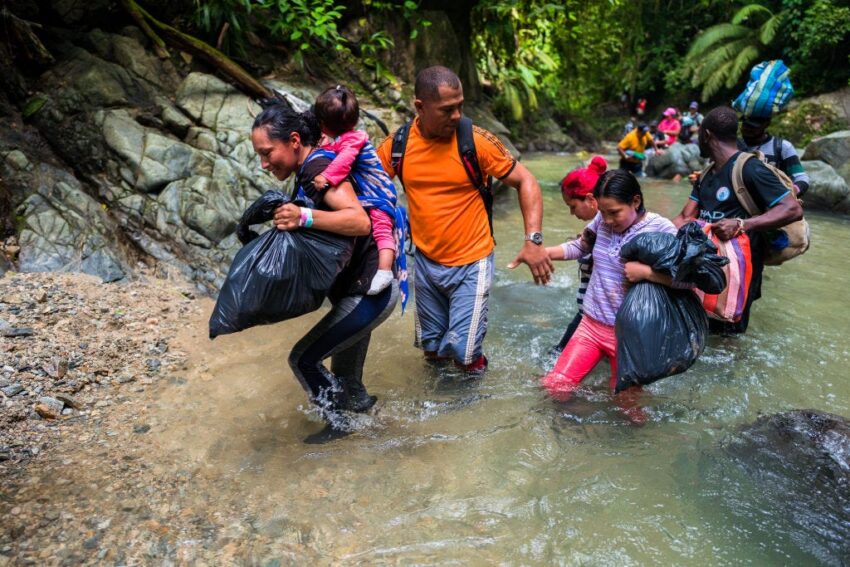
The Darién Gap used to be a barrier for migrating. But now it isn’t, and people from South American countries who never thought of migrating to the United States as an option are now attempting it through the Darién Gap. There’s also a new route through Nicaragua, which doesn’t require visas from most countries. People from all over the world are flying to Managua and starting their route there. So there’s new possibilities for getting here. Also everybody’s got a smartphone now and can find out about these routes more easily.
How do they find out? From their community? Or is it from human smugglers advertising?
In the Guatemalan highlands, it’s often the community. Via WhatsApp, people find out from friends, neighbors, and others who have left and how they’re doing once they’re in the United States. There’s also social media, especially TikTok, where smugglers or just people on the migratory route are making videos. This has become super popular. To some extent, YouTube and Instagram also, but TikTok and WhatsApp seem to be the most used of the platforms. Some people who are doing videos make it look easy, like an adventure, and others really make it clear how horrible it is. You’ll see body parts and things like that, that people are finding on the migratory trail.
But people still come anyway.
Yeah, you hear about how bad it is. But you also hear about somebody who’s now in Houston working construction and able to feed his kids so they don’t go to to bed hungry. I mean, it makes a difference.
And if you ruled the world, what would be your top three solutions? What do you wish Congress would do?
I would invest a lot more in our asylum system. And I’d get rid of the 1990-era caps on who can come from which country to get residency here. I’d also vastly expand the temporary work permits. So, people can come work, and not just for farm labor but also for other skilled work. I’d also end corruption, which is a huge part of why people migrate. If I were doing foreign policy, we can certainly do more to uphold and give resources to the people fighting corruption and fighting impunity, and justice systems and NGOs and even the reformers inside the military. They should have our most high-profile backing, but so often they don’t.
This Q&A has been condensed and edited for clarity.
Read more: Read More