



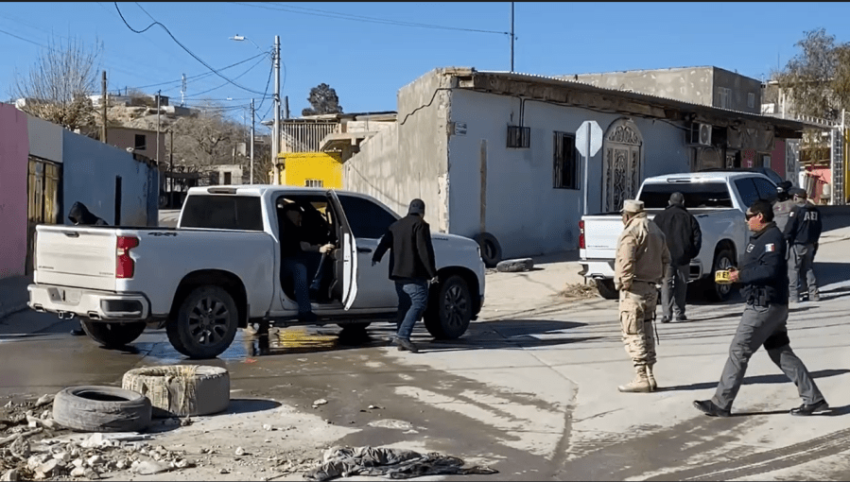
EL PASO, Texas (Border Report) – The Chihuahua Attorney General’s Office initiated a search Wednesday morning at a home where authorities suspected up to 30 bodies could be buried.
Twelve plainclothes officers arrived at the property on the 1100 block of Calle Cafeto shortly before 10 a.m. on Wednesday armed with a search warrant and a canine unit trained to sniff out cadavers. The officers suspended the search a few minutes later for unknown reasons. They left the premises about an hour later.
The home and adjacent blocks have been guarded by Mexican soldiers since a banner was hung from a northwest Juarez overpass on Tuesday warning of the impending release of a suspected murderer and gang leader, and accusing him of burying 30 bodies at the home. The sign – one of several narco-mantas, or narco-banners that have appeared in Juarez over the past few years – provided the exact address of the home.
Border Report on Tuesday interviewed neighbors who expressed surprise at the allegations and watched soldiers stop cars and search them. The neighbors said the home used to house a grocery store years ago, and that they’ve seen construction going on in recent years. Residents say police installed a security camera at the intersection about a year ago.
Mexican authorities were tipped to the narco-banner minutes after discovering four bodies in a pickup abandoned on the Pan American Highway, which is the main entrance to Juarez from the interior of Mexico.
Soldiers on Feb. 13. 2024, took control of a neighborhood in north Juarez after a sign left on a bridge alerted authorities to a home where 30 bodies allegedly are buried.
The man at whom the banner was directed was arrested in Coahuila in December and is jailed in Juarez’s Cereso prison. Mexican authorities have only identified him as Martin G., a.k.a. “El Pitufo” (The Smurf), one of the targets of the binational Se Busca Información (Information Wanted) border’s most-wanted fugitives campaign.
The finding of mass graves is not unusual in Juarez, across the border from El Paso, Texas. The city has been a battleground for rival drug cartels since the early 1990s. The killings peaked in 2009-2010, with the annual body count in the thousands.
Homicides have spiked again the past four years, as cartels splinter and fight each other for territory and as Juarez criminal organizations have expanded their activities from just ferrying drugs to the United States to trafficking migrants and peddling drugs in every working-class neighborhood in the city.
Last September, residents of the Portal del Valle neighborhood about a mile from the U.S. border wall at San Elizario, Texas, alerted police to a clandestine landfill where they found human remains. Juarez police pulled eight bodies from the landfill. The incident was featured in Border Report’s three-day series “Cartels: Death, Denial and a Region Under Siege.”
In 1999, at least six bodies were recovered from a ranch called La Campana, and in 2004 a dozen cadavers were found in a home in Las Acequias neighborhood, according to the Juarez news portal Norte Digital. In 2008, an estimated 36 sets of skeletal remains were recovered from a home in La Cuesta, and in 2009, nine bodies were found in the desert south of Juarez, according to the portal.
Read: Read More