



McALLEN, Texas (Border Report) — The Laredo City Council has revised its drought contingency plans to include levying fines on residents who misuse water as punishing heat and a lack of water payments by Mexico are taking a toll on the South Texas border region.
The Laredo City Council on Monday night voted to approve changes to the border city’s Water Conservation and Drought Contingency Plans, which will take effect if water levels at a regional dam and city consumption reach certain levels, Councilwoman Melissa Cigarroa told Border Report.
The revised plans call for developers to offer xeriscaping on new homes; require all schools, federal, state and local buildings, parks and libraries to xeriscape within five years; require homeowners to address faulty backflow devices; and restrict carwash fundraisers.
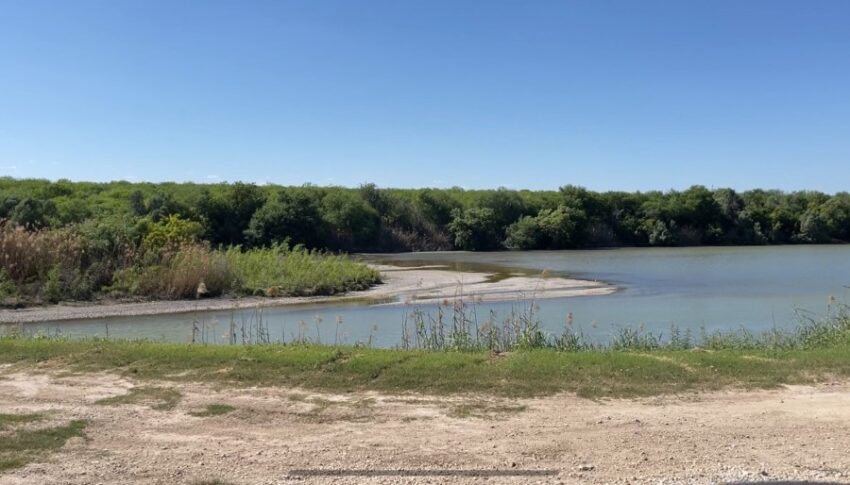
Laredo, Texas, depends on water releases from Amistad Dam to keep its section of the Rio Grande flowing. The city relies on all its drinking water from the Rio Grande. (Sandra Sanchez/Border Report File Photo)
The drought plans will take effect if levels at Amistad Reservoir fall below 25% capacity, or below 453,352 acre-feet.
“This phase consists of mandatory restrictions of the use of water and imposing of penalties and sanctions for violations of set restrictions,” according to the plan.
On Tuesday, Amistad Reservoir, upstream outside of Del Rio, Texas, was hovering just above the trigger mark — at 27.8% full, or 504,344 acre-feet, according to the Texas Water Development Fund.
The state agency reported that water levels at Falcon Reservoir — farther south in Zapata County and providing water to the Rio Grande Valley, including McAllen — were just 9% full on Tuesday with less than 140,000 acre-feet.
(Texas Water Development Board Graphic)
Bright red dots show how dire the water situation is on Texas’ border with Mexico, according to Tuesday’s water levels graphic on the agency’s website.
Mexico is woefully behind in its water payments to the United States under a 1944 international water treaty.
Mexico has barely paid one year’s worth of water during the current five-year cycle, which ends in October 2025. And experts don’t believe there is enough time for the country to catch up within the next 17 months before the deadline.
As of Saturday, the U.S. Section of the International Boundary and Water Commission, which oversees the Rio Grande, reports that Mexico has paid just 384,046 acre-feet of water during this cycle. Mexico should have paid over 1.2 million acre-feet of water at this time, according to the international agency.
(USIBWC Graphic)
As a result, several South Texas municipalities have started enacting water restrictions, and Hidalgo County has declared a drought disaster declaration.
Laredo’s revised drought contingency plan is just the latest in steps that local governments have to make to adjust to a lack of water in the region when temperatures exceed triple digits and water demand is growing.
“What we understood is we’re supposed to be prepared for it to happen,” Cigarroa said. “It’s going to be a rough summer.”
Homeowners and businesses face a class C misdemeanor and the following fines after receiving two written warnings:
Fine of $50 to $100 for first offense.
Fine of $200 to $300 for second offense.
Fine of $400 to $500 for third and additional offenses.
“Each day an offense continues shall be considered a new violation,” the drought plan states.
Residents are urged to report neighbors who violate drought restrictions once they go into effect.
Sandra Sanchez can be reached at SSanchez@BorderReport.com.
Read: Read More