



EL PASO, Texas (KTSM) – Eastern Research Group (ERG), which is the firm contracted by the New Mexico Environment Department (NMED) to perform a Comprehensive Performance Evaluation (CPE) of the Camino Real Regional Utility Authority (CRRUA), completed its site visit Thursday, May 30.
Evaluation team members Tom Brown and Janet Cherry with ERG review daily log sheets at the Sunland Park Arsenic Treatment Facility.
ERG engineer Tom Brown takes a water sample for arsenic testing at the Sunland Park Arsenic Treatment Facility. The sample was below the federal limit of 10 parts per billion (ppb.)
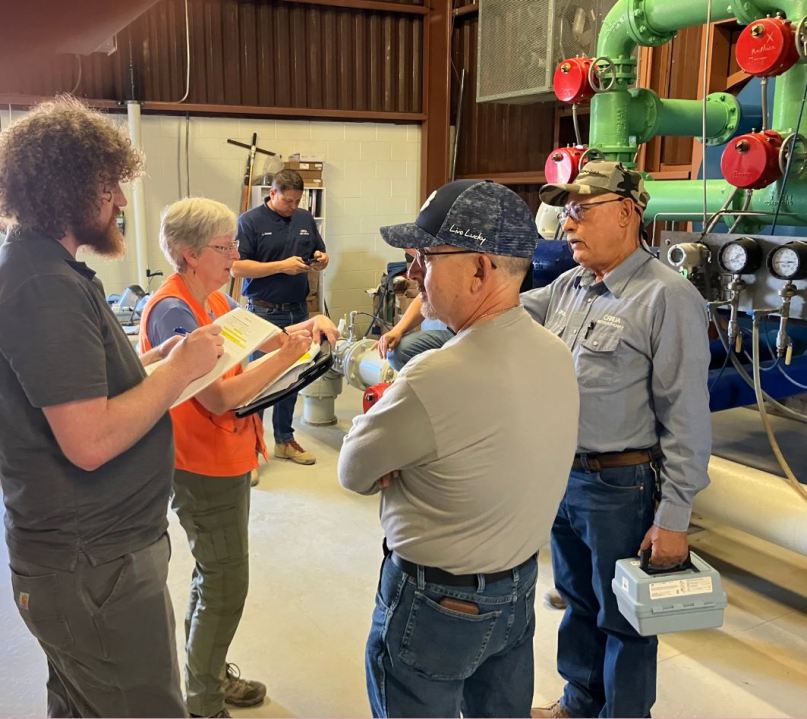
Tom Brown and Janet Cherry (left) with ERG discuss operating procedures with members of CRRUA staff at the Sunland Park Arsenic Treatment Facility.
Photos courtesy of CRRUA
CRRUA provides water service to Sunland Park and Santa Teresa.
ERG engineers Janet Cherry and Tom Brow spent two and a half days inspecting CRRUA’s four arsenic treatment facilities and interviewing staff, according to a press release sent by the utility.
“Cherry emphasized that the CPE is not an audit, but a process to identify Performance Limiting Factors (PLF) that can hinder CRRUA’s abilities to achieve optimized performance. Once a prioritized list of factors is identified, CRRUA staff can initiate corrective actions,” read the press release.
The utility said that during visits to the arsenic treatment facilities, the ERG engineers took independent water samples for both pH and chlorine residuals. All samples were in alignment with the values recorded by CRRUA’s instrumentation.
Arsenic samples using CRRUA’s portable arsenic analysis kit (PAAK) indicated that all treated water was below the federal limit of 10 parts per billion (ppb) at each of the four arsenic treatment facilities, according to the utility.
The utility said CRRUA conducts voluntary arsenic tests three times weekly using the PAAK as part of its standard operating procedure.
“CRRUA also sends water samples to an NMED certified water testing lab every two weeks as a self-governance practice to verify arsenic levels meet EPA standards. NMED conducts its own quarterly arsenic water sample tests,” read the press release.
Cherry said the team reviewed daily log sheets and found the information gathered was “outstanding.”
She also mentioned that constraints facing CRRUA include limited revenues associated with the current rate structure.
According to NMED data for water rates, CRRUA is 50 percent below the statewide average. She said other areas requiring immediate attention are the filling of vacant positions with qualified staff and formalizing administrative policies, according to the utility.
The engineers examined CRRUA’s administrative practices, plant operations, standard operating procedures, recordkeeping, staff training and finances.
“In a concluding comment, Cherry complimented the CRRUA board of directors and staff for doing what she called, ‘a great job,'” read the press release. “However, she emphasized that NMED and CRRUA jointly develop a task list with measurable outcomes to address the performance limiting factors. NMED said it can provide non-financial resources to assist CRRUA in the form of training, validating data and professional expertise.”
Additionally, Cherry said the final report should take approximately 45 days to complete.
It will be submitted to NMED for review then presented to the CRRUA board at a regular meeting.
As we previously reported, the utility has been under fire for months over concerns about water quality and discolored water. Some residents have told KTSM that the issues have been going on for years.
Read: Read More