



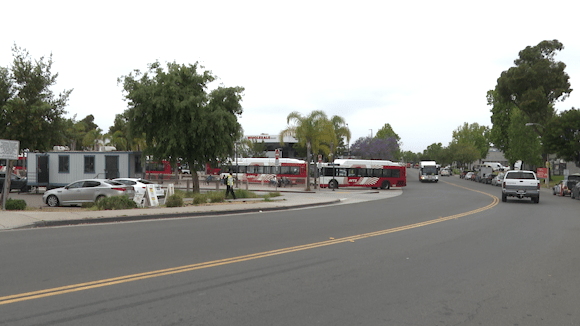
SAN DIEGO (Border Report) — Benny Reyes sells burritos out of his Burrito Factory vehicle across the street from the Iris Avenue Trolley station in South San Diego.
He is there six days a week starting at 6 a.m.
Reyes brings out six to eight different options daily.
“Potato and chorizo, bean and cheese, meat and cactus, chicken chipotle, and others,” he said in Spanish.
For the past few months, he has witnessed a daily parade of Border Patrol buses dropping off asylum-seekers at the trolley station.
“I’ve counted as many as 12 buses in a five-hour period.”
The vendor says his business is not dependent on the migrants who are getting dropped off, but on people who frequent the transit center, commuters looking for a quick and convenient snack.
“Most migrants are from different nationalities and aren’t familiar with Mexican cuisine so they don’t know about burritos and won’t seek us out when they get off the bus.”
However, he’s noticed that in the past few weeks, the number of buses dropping off migrants has plummeted significantly.
“Lately, I hardly see any,” Reyes said.
This started happening before last week when President Biden issued an executive order restricting asylum.
Many, like Reyes, have lingering questions about the president’s new guidelines for asylum.
“I don’t know what’s going on.”
Even people in the news media have struggled to understand the new policies.
As a way to clear things up, the Department of Homeland Security hosted a conference call for reporters explaining the new procedures.
A DHS spokesperson said Mexico has agreed to take in as many as 30,000 migrants per month from countries such as Cuba, Haiti, Nicaragua, Venezuela as well as other Central American countries.
During the media call, DHS also confirmed thousands of migrants have already been expelled, but an exact number was not given.
And according to DHS, most migrants from Mexico and Central America will be sent back almost immediately after being apprehended.
It’s all contingent on the number of encounters with migrants along the southern border.
If the daily average exceeds 2,500 per day over a seven-day period, most migrants will be turned back and not allowed to seek asylum.
Unaccompanied children, those facing life-threatening emergencies and people with CBP One appointments will be exempt.
Many, especially from African countries, the Middle East and China will continue to be given an opportunity to get asylum after they cross the border.
They will be released on their own recognizance or given court dates to start their asylum cases.
The ones processed in the San Diego Sector will continue to drop off at the Iris Avenue Trolley station.
It’s expected these releases won’t be as frequently and people like Reyes will likely see even fewer buses coming by.
Read: Read More