



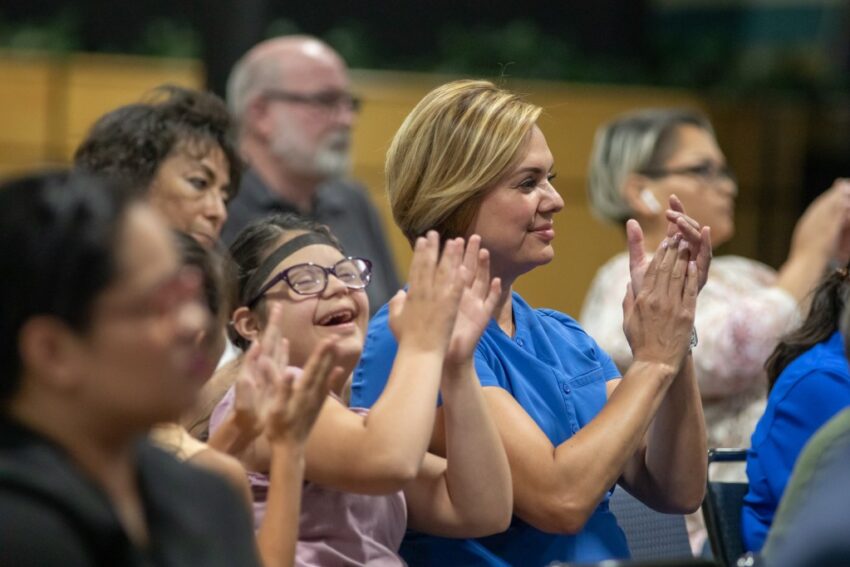
Community members gathered Thursday at the El Paso Community College Administrative Services Center to take part in a discussion about the challenges Texans with intellectual developmental disabilities, or IDD, and their families face.
The event, hosted by El Paso Matters, was sponsored by the El Paso Community Foundation and Emergence Health Network — El Paso’s largest mental health and IDD service provider.
The panel featured:
State Rep. Joe Moody.
Kristi Daughtery, CEO of Emergence Health Network.
Armando Salas, retired clinical supervisor and parent/caregiver to Angelica — an adult with Down syndrome.
Demi Castrillon, nurse practitioner and parent/caregiver to Vincent — a nonverbal teen with autism.
During the event, caregivers shared their experiences navigating the education and health care systems, and the obstacles they faced along the way.
Panelists discussed how inadequate state funding has contributed to the issues, and how lawmakers can take action during the upcoming state’s 89th Legislature scheduled to start in January 2025.
Here are five challenges Texans with IDDs and their loved ones face:
Limited access to services and programs
Caregivers of people with IDD, such as Salas and Castrillon, sometimes struggle to find the programs and services their loved ones need.
As children, they may need to travel outside their neighborhoods to get the services they need. As adults, they may need to leave the state just to continue their education.
Demi Castrillon, whose 15-year-old son has autism, speaks about her family’s experiences during the “A Time to Care” panel sponsored by Emergence Health Network, El Paso Community Foundation, and El Paso Matters, June 11, 2024. Castrillon believes that families need earlier access to help and a safe place to socialize with children who have difficulty being in public places. (Corrie Boudreaux/El Paso Matters)
Castrillon said she struggled to find a school with a sensory room for her son Vincent, who is now 15. These specially designed rooms, furnished with therapeutic toys and equipment, are meant to help students with autism and other IDDs stay calm and focused.
“It was like nobody in El Paso had a sensory room,” she recalled.
Eventually, Castrillon moved her son to another school district across town with a better special education program.
Salas said his daughter Angelica, 36, also struggled to find the right school for her as a child. As an adult, she needed to travel to Roswell, New Mexico, to participate in a vocational training program specializing in teaching students with disabilities.
“We found out that at the time there were only three programs in the United States that specialize in Down syndrome, or IDD services. It was in Roswell, Connecticut and in New York,” Salas said.
A limited workforce and long wait times to get services
Though Texans with IDDs can qualify to get support from the state through the Home and Community Based Services (HCS) program, many have to wait up to 15 years for their applications to be accepted.
Kristi Daugherty, CEO of Emergent Health Network, speaks on the on the challenges of staffing and inadequate state funding during the “A Time to Care” panel sponsored by Emergence Health Network, El Paso Community Foundation, and El Paso Matters, June 11, 2024. (Corrie Boudreaux/El Paso Matters)
Daughtry said the lack of state funding and workforce needs were some of the main contributors to that long wait time.
Lawmakers raised the state-funded wage for community-based caregivers who work in people’s homes, group homes and day care centers from $8.11 to $10.60 an hour during the 2023 legislative session. At the same time, legislators raised the pay for caregivers working at state-supported living centers to $17.50 an hour.
Though organizations such as Emergence Health Network can use other funding sources to pay caregivers more, Daughtry said they still struggle to attract enough employees.
“The problem we’re having is the rates that the state wants to pay for these services, which are so critical. When they believe that a living wage is $10.60 … that’s ridiculous,” Daughtry said. “The rate is so important to where we can pay individuals more to want to do this job.”
Higher incarceration rates
While only about 3% of Texans have an IDD, they make up 10% of the state’s jail and prison population, Moody said.
Joe Moody, state representative for District 78, shares how he has seen his sister, who has Down syndrome, excluded from opportunities that she could excel at if given the chance, during the “A Time to Care” panel sponsored by Emergence Health Network, El Paso Community Foundation, and El Paso Matters, June 11, 2024. Moody advocates for a “moral” state budget that would include better funding for people with intellectual development disabilities. (Corrie Boudreaux/El Paso Matters)
Besides pushing for more state funding for IDD services, the state legislator said he plans to support policies that would address that trend.
“When we talk about support, services, education, job training, life skills, and all those things, we also want to make sure that we don’t get it wrong to the extent that we are doing real damage to people,” Moody said.
“Does law enforcement know how to interact with individuals with IDD? Because right now, it’s seven times more likely that an individual with IDD is going to be a victim of crime,” he continued. “We need to recognize those realities and make those policy changes, too. It is dollars and cents, but it’s also recognizing those deficits that we’re running in every segment of our society.”
Advocating for loved ones
Because of the state’s limited resources, many caregivers also take on the role of an advocate for their loved one with an IDD.
Castrillon said she began advocating for her son at a young age pushing his doctor for additional evaluations after she noticed he wasn’t progressing as quickly as his brother, who is only 11 months older.
“Pretty much since day one we are advocates for our kids with special needs,” Castrillon said.
As Vincent got older she continued advocating for him when his condition worsened and he needed crisis intervention services from Emergence Health Network.
“Eighth-grade year was probably the worst year for us where he was very violent, and the teachers didn’t know what to do with him. They kept calling me to pick them up,” Castrillon said. “Things had to get worse before we could get any help and I think that’s where parents need to be advocates.”
Limited career opportunities
Even after finding care and education programs that work for them, some people with IDDs, such as Angelica, still face limited career opportunities as adults.
Though Angelica attended Eastern New Mexico University and got an Animal Care Specialist certification, she struggled to get a job.
After graduating she began volunteering for the El Paso Zoo, but Salas said they would not employ her because of her condition.
Emergence Health Network, El Paso Community Foundation, and El Paso Matters sponsored a panel discussion on Texans with intellectual development disabilities and state funding for their support at El Paso Community College, June 11, 2024. (Corrie Boudreaux/El Paso Matters)
“My intention was to have her volunteer for the purposes of maybe at some point hiring her. ‘Well, no, that’s never gonna be the case,’” Salas recalled being told. “So all this experience she’s gaining here, what is it for? At some point it becomes exploitation, you know. You’re using her services, you’re assigning her tasks, but you’re not willing to pay.”
After leaving the zoo, Angelica got a job at Jolly Jim’s Pet Store before the business closed down. She eventually went to the Northeast Veterinary Clinic where she has worked ever since.
View more photos from the event below.
The post 5 challenges faced by Texans with intellectual developmental disabilities, their families appeared first on El Paso Matters.
Read: Read More