



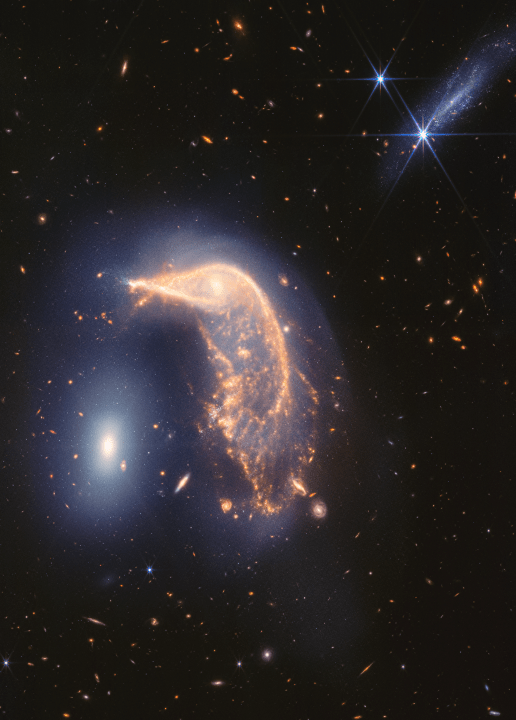
EL PASO, Texas (KTSM) — Celebrating the second anniversary of the James Webb Space Telescope beginning science operations, the National Aeronautics and Space Administration (NASA) has released new images of two interacting galaxies.
For its second birthday, the Webb Telescope took photos of Interacting Galaxies Arp 142, or also known as the “Penguin and Egg” galaxies on Friday, July 12.
Interacting Galaxies Arp 142, also known as the “Penguin and Egg Galaxies”. Photo courtesy to NASA
The first spiral galaxy is at the “eye” of the penguin and the second elliptical galaxy is the “egg” to the left, according to NASA.
Interacting Galaxies Arp 142, also known as the “Penguin and Egg Galaxies”. Photo courtesy to NASA
“In just two years, Webb has transformed our view of the universe, enabling the kind of world-class science that drove NASA to make this mission a reality,” said Mark Clampin, director of the Astrophysics Division at NASA Headquarters in Washington. “Webb is providing insights into longstanding mysteries about the early universe and ushering in a new era of studying distant worlds, while returning images that inspire people around the world and posing exciting new questions to answer. It has never been more possible to explore every facet of the universe.”
Comparison of Arp 142 taken by the Hubble Telescope and the Webb Telescope. Photo courtesy to NASA.
“Since President Biden and Vice President Harris unveiled the first image from the James Webb Space Telescope two years ago, Webb has continued to unlock the mysteries of the universe,” said NASA Administrator Bill Nelson. “With remarkable images from the corners of the cosmos, going back nearly to the beginning of time, Webb’s capabilities are shedding new light on our celestial surroundings and inspiring future generations of scientists, astronomers, and explorers.”
The James Webb Space Telescope launched on Dec. 25, 2021 and is currently taking photos of stars and galaxies much like its predecessor, the Hubble Space Telescope, according to the NASA website.
Unlike the Hubble Telescope which orbits the Earth, the Webb Telescope is actually orbiting the sun, over 1 million miles away, according to NASA.
According to NASA, the galaxies are estimated to be about 100,000 light-years apart and roughly 326,000,000 light-years from Earth.
Read: Read More