


We’re back! We’ve got loads of new border coverage in store for you, and an upcoming discussion thread on the presidential election. We also have several online and in-person community events coming up. If you’re in southern Arizona, Todd and I will be in Nogales on Saturday, September 7, at 3:00 p.m., at the Wittner Museum for a panel with longtime border residents, talking about how the border has changed in the last two decades. The panel is sponsored by the Sierra Club and Voices from the Border. And on Tuesday, September 10, at 5:00 p.m., I’ll be participating in a panel called “Reclaiming the Border Narrative” in Tucson, sponsored by the Ford Foundation and the University of Arizona’s Confluencenter for Creative Inquiry. We’ll have more details on these events and more in the coming days.
Also, if you haven’t already, please consider supporting our work with a paid subscription. With less than three months until the presidential election, we’re being inundated with disinformation about the border. We’re pushing back on this by reporting directly from border communities with context and analysis. But we need your help to continue.
We’re very disturbed by the role of social media platforms in spreading disinformation and in suppressing news. Especially, leading up to one of the most consequential presidential elections in U.S. history. Our August 1 article by Texas correspondent Pablo de la Rosa “Weaponizing Immigration” was pulled down by Facebook for violating community standards. The platform still hasn’t explained specifically what it took issue with. We filed an appeal but there’s been no response, so far.
Increasingly, it’s clear that we can’t rely on these platforms, especially as AI becomes more prevalent. Which is why we’re leaning into old fashioned on-the ground reporting and community events. You can support our work for just $6 a month, or $60 a year, and you’ll get access to our full archive. Your subscription dollars will provide vital support for our in-depth reporting. We can’t do this without you!
Many Asylum Seekers Are Being Expelled, But Not Before Giving Up Their DNA
CBP’s sweeping DNA program places asylum seekers’ genetic profiles in a massive criminal investigations database without their knowledge.
Marco, 16, was in the United States less than 24 hours before he and his family were expelled from the country. But the U.S. government took something from him that it will hold on to indefinitely—his DNA.
“They said there’s no asylum right now,” Marco’s mother, Angelica, told me at the Nogales port of entry in the state of Sonora in late July. “We signed some papers, they took our fingerprints, and they took a sample of our saliva.”
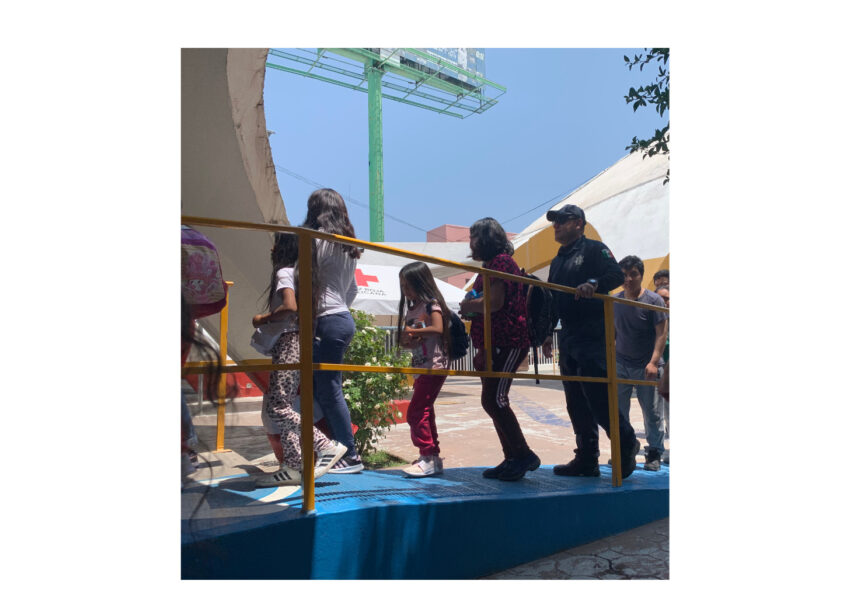
The family was part of a group of 100 people, all of them Mexican, deported that morning through the Nogales port of entry, after Biden’s executive order restricted how many people can request asylum. Angelica said Border Patrol agents took the saliva samples from her and her husband and both of her sons, ages 16 and 17. “We thought maybe it’s a COVID test,” she said. “No one explained what it was.”
What the family didn’t know was that their DNA profiles will be added to the nation’s most powerful criminal investigations database, run by the FBI: the Combined DNA Index System, known as CODIS. Customs and Border Protection’s DNA-collection program was quietly started in 2020 by the Trump administration and has been continued by the Biden administration. Under the program, Border Patrol can collect DNA from anyone it processes over the age of 14.
This means that people who may never set foot in the United States again, and who committed no crime, have handed over their genetic material to U.S. law enforcement. Their DNA profiles are housed in an index labeled “offender” in the CODIS database, “where they become permanently searchable by law enforcement,” according to a recent report, Raiding the Genome, by the Center on Privacy and Technology at Georgetown Law.
In July, I spoke with at least a dozen people in the Mexican border cities of Nogales and Agua Prieta who said Border Patrol swabbed the inside of their mouths for saliva samples before deporting them, but didn’t explain they were taking and keeping their DNA.
The program disproportionately targets people of color, who are already overpoliced and oversurveilled by the criminal justice system, said Stevie Glaberson, a coauthor of the report and director of research and advocacy at the Center on Privacy and Technology. Even worse, she said, it’s mostly noncitizens who are giving up their DNA before being expelled from the country, meaning they have no control over what happens with their genetic information, which is stored indefinitely by the FBI. This could lead to future dystopian uses by private industry and police, she said, including projecting what someone looks like based on a DNA sample. “Private corporations and their technology, they are all over the field of policing right now,” she said. “The retention of the sample itself is incredibly dangerous, given modern technology.”
Since the program started in 2020, Border Patrol has contributed more than 1.5 million DNA profiles to CODIS. Another 600,000 samples are backlogged and waiting to be entered by the FBI. The Department of Homeland Security, which oversees Border Patrol, is now the largest agency contributing to CODIS, with millions of DNA samples of noncitizens.
Before 2020, the database contained mostly profiles of U.S. citizens charged with serious crimes, such as murder and rape. If DHS continues at the current rate of collection, by 2034 one-third of the DNA profiles in CODIS will be of noncitizens whose DNA was taken without any suspicion of criminal wrongdoing or probable cause, as is required under the Fourth Amendment, according to the report.
The very existence of the rapidly growing database exerts a gravitational pull for law enforcement, said Glaberson. DHS argues that the only limitation on its DNA collection is that the person must be “detained” by them, even if only for a few hours. This genetic information is then shared with law enforcement, circumventing normal police protocols for collecting DNA. “Of course, you can understand why police would want to use DNA to solve serious, violent crimes,” she said. “But it’s now moving down the food chain in terms of criminal investigations, where it’s being used to solve petty theft or even vandalism cases.”
Before starting the program, the Trump administration argued that DNA collection was needed to identify people crossing the border, which Glaberson called “total nonsense.” “There are so many better ways to identify people, and so much information already given over, including fingerprints, when people are processed,” she said. “You can see it’s nonsense when you look at what the program is actually doing. They’re mailing the DNA swabs to the FBI where they sit in a backlog waiting to be entered into CODIS. It’s not being used for identification. It’s being used for future crime solving, which is not a permissible reason under the Fourth Amendment.”
In Agua Prieta, Sonora, 23-year-old Yesenia said she fled the border state of Coahuila with her six-year-old son and two-year old daughter after an abusive partner threatened to kill her. Desperate, she crossed the border and requested asylum in late July, she told me. “They said, right now, there is no asylum,” she said of the Border Patrol agents who processed her and her children. They were sent back to Mexico within hours. “I signed some forms and they took my fingerprints,” she said. “They also took my saliva, but only me, not the children.”
When told that the saliva swab was to collect her DNA, Yesenia frowned. “I don’t like that,” she said. “But they make you feel like you have no choice but to do what they say.”
Indeed, under DHS policy, said Glaberson, Border Patrol can use reasonable force against anyone who refuses the DNA swab, and it’s a federal crime to refuse. Despite this, she said, they recently received a FOIA document from CBP that says in 2024 at least 174 people refused to hand over their DNA as of July 14. The report does not say, however, what happened to those people who refused, she said. “We’ve heard that people have been told if they don’t give a sample, they will be detained.”
CBP did not respond by publication time to a list of detailed questions about its DNA program.
A 26-year-old man from the state of Jalisco, recently deported to Nogales, said Border Patrol agents accused him of being in a gang because he has tattoos. They also took a DNA sample. “It was humiliating, to be honest,” he said. “The way my family and I were treated. We were forced to sign papers that we didn’t understand, and then kicked back into Mexico. My cousin was kidnapped and disappeared in Jalisco, so we can’t go back. I don’t know what we’re going to do now.”
Glaberson and the report’s other authors said the DNA program should be stopped immediately, and the profiles and genetic samples destroyed. She acknowledged, however, that it’s unlikely that the federal government will act anytime soon on their recommendation. As a result, they list several actions in the report that communities can take to minimize harms, from requesting oversight hearings on the program to calling for the removal of DHS’s authorization to collect DNA from people held on civil immigration charges. “People who were detained then expelled from the United States might never step foot in this country again,” she said. “But their DNA will still be here. And right now, there’s nothing they can do about it. That’s really troubling.”
(Names of asylum seekers in this article have been changed at the request of the people interviewed, due to their vulnerable situation.)
Read more: Read More