



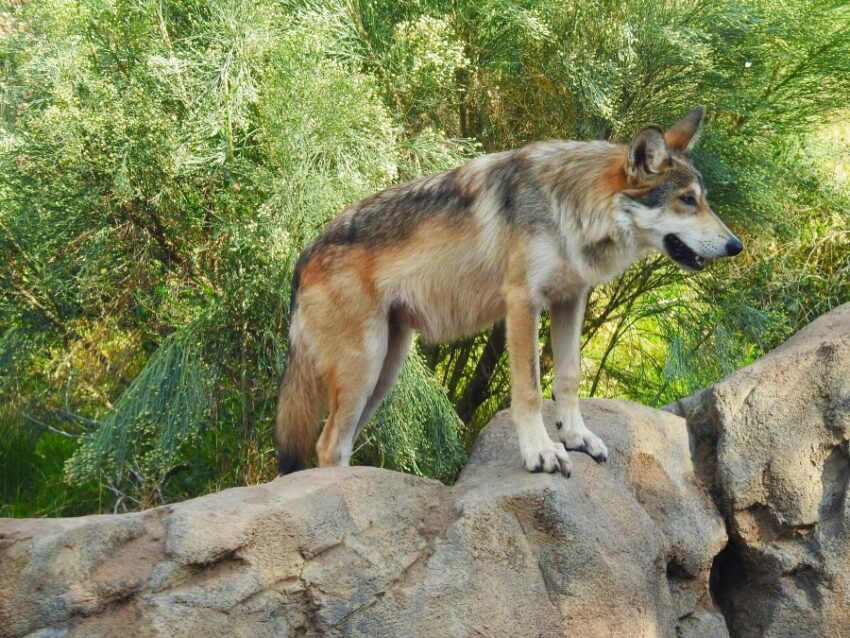
EL PASO, Texas (KTSM) — Rick LoBello has never seen a Mexican gray wolf in the wild, but has spent the past 46 years trying to help restore the animal as an apex predator into the wild landscapes of West Texas, after it disappeared from the region.
“I went to Sul Ross State University and worked on my master’s degree and right across the street from my dorm was a Mexican wolf. A few months later, it was poisoned by someone that didn’t like wolves,” LoBello said.
“It’s important that we value everything in nature, and that we all get involved in some way to make sure that we keep this ecosystem intact. Because if we don’t have a healthy environment, it’s not going to be good for people,” he added.
Today, LoBello is part of the Texas Lobo Coalition’s (TLC) Board of Directors, which is committed to the cause of restoring the wolf to its West Texas home.
Photos courtesy of Ricky LoBello
According to the TLC’s website, the Mexican wolf was “extirpated” from West Texas due to hunting, government-sponsored predator control programs, and habitat loss.
LoBello said the last time a Mexican wolf came close to roaming the landscapes of Texas, was in 2017, when a collared wolf from a recovery program in Mexico was detected traveling through Mount Cristo Rey.
“It came right over the edge of the Mexican side of Mount Cristo Rey. So that’s emotional for me because it came so close to Texas,” LoBello said.
LoBello explained that the wolf’s absence in West Texas has negatively impacted the ecosystem by allowing outside exotic species to thrive, and indigenous species to become accustomed to unhealthy patterns.
“The ecosystem in the Chihuahuan Desert (is) really messed up. We have a very unhealthy deer herd because wolves would help keep the prey species healthy by getting them to move around so they don’t get too close to each other and get diseases that can wipe them out. We have a very unhealthy, pronghorn herd in West Texas,” LoBello said.
“We also have a really big problem in West Texas with exotic species like aoudads and wild boars. They’re messing up the environment,” LoBello added.
He also said that these animals compete with the indigenous species.
LoBello explained that the Mexican wolf has remained a critically endangered species since he committed himself to these decades-long efforts back in the 1970s, but that it has come a long way.
“All we have to do is give the wolf a chance and we can learn to live with it again. People in New Mexico and Arizona are living in harmony with the wolf and it can happen in Texas as well,” LoBello said.
The Arizona Game and Fish Department has been reintroducing Mexican wolves into the landscapes of Arizona and New Mexico since 1998, according to their website.
Their efforts sprung from a captive breeding program for the Mexican wolf that was launched in the early 1980s to save the endangered species.
LoBello recalled that in 1978, he captured footage of the last wild-caught Mexican wolf on 8 millimeter film, as part of the captive-breeding program.
Don Diego was the name of the wolf, and would become one of the founders of the populations of wolves that today roam the desert in New Mexico and Arizona, and that live at the El Paso Zoo.
The El Paso Zoo, where LoBello has worked for years, has also launched a cross-fostering program. In 2022, a male Mexican wolf born at the El Paso Zoo but later released through the program found an uncollared mate in the wilderness of New Mexico.
But despite the progress made so far, LoBello said there is progress to be made in Texas, and the biggest obstacle is convincing the Texas Parks & Wildlife Department, landowners, ranchers, and other communities who have concerns about reintroducing the Mexican wolf to West Texas, that together they can make things work.
“One of the ways that it could look like would be using technology to collar the wolves so that we put them in areas where there’s no conflict with cattle. There’s an area called Big Bend National Park, 1,100 square miles.,” LoBello said.
“Right across from (Big Bend) are areas in Mexico that could sustain wolves going back and forth across the border,” he added.
LoBello said that the Sierra Club in El Paso sent over 20,000 letters signed by El Pasoans to the Texas Parks & Wildlife almost six years ago, petitioning them to help restore the Mexican wolf to the wilds of West Texas.
LoBello said that to this day, they have yet to receive a response from the TPWD, but is confident that the Borderland is the community that can help keep pushing things forward.
“There’s no city in Texas that has done more to help save this critically endangered species than El Paso. We’ve formed organizations like the Texas Lobo Coalition. We’ve gathered thousands and thousands of letters sent to Texas Parks and Wildlife,” LoBello said.
“We have people who live here who are on the species survival plan for the Mexican wolf. And now we’re breeding Mexican wolves at the El Paso Zoo, helping put wolves back out into the wild,” LoBello said.
The TLC has launched a GoFundMe campaign to fund efforts to initiate collaboration with concerned communities on how this could work out. You can find the page by clicking here.
To learn more about the Texas Lobo Coalition, you can visit their website by clicking here: https://texaslobocoalition.wordpress.com/
Read: Read More