



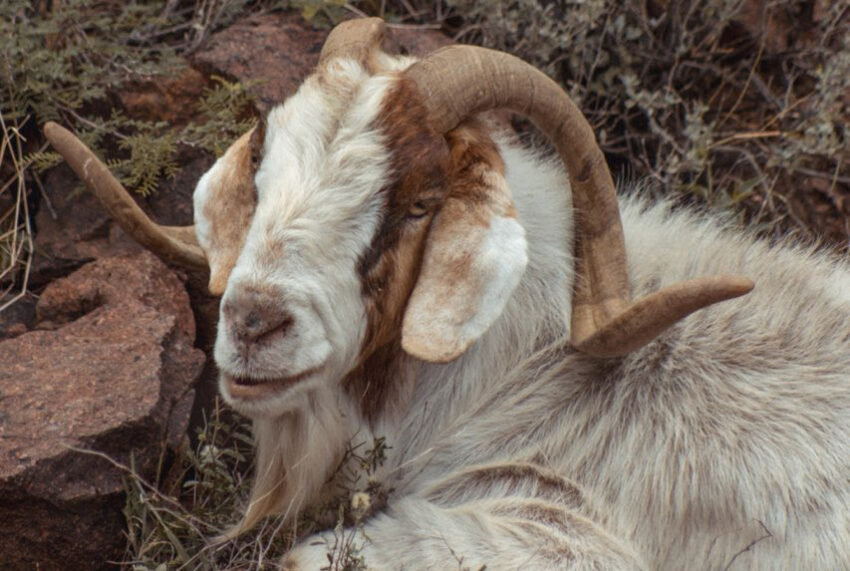
More details have emerged about “Bob the Goat,” a beloved fixture in the Franklin Mountains, who Texas Parks and Wildlife officials said may have died from stress during a relocation attempt in August.
The move was part of efforts to repopulate native sheep that are vulnerable to disease carried by domestic and exotic goats and sheep.
Wildlife workers roped the feral goat Aug. 13 with the intention to rehome it at Licon Dairy in San Elizario. There, the elderly goat could live out his final days and still receive visitors, officials said. But those plans were dashed when the goat died during capture.
Tissue samples taken from Bob did not determine the goat’s actual cause of death, Lerrin Johnson, spokesperson for the Texas Parks and Wildlife Department, wrote in an email Wednesday.
César Méndez, superintendent of Franklin Mountains State Park, said he was not present for the goat’s capture, but suspected a combination of factors contributed to Bob’s death: stress from the relocation efforts and poor health, caused by old age and possible malnutrition. The goat had lost teeth in its old age and may have had trouble eating, Méndez said. He did not rule out heart attack from stress as a possible contributor to the goat’s death.
Bob was at least 9 years old, based on his first recorded sighting at the Franklin Mountains in 2015. But Texas Parks and Wildlife estimated the goat to be significantly older. The typical lifespan of domestic sheep and goats in free-range settings is about 10 to 13 years.
Original story: Franklin Mountains ‘Bob the Goat’ dies after capture
Méndez said wildlife workers got close enough to rope the goat after previous attempts with other methods – including tranquilizing the goat with a dart gun – failed.
He did not know more details about where or how the goat was roped, and could not say whether asphyxiation contributed to the goat’s death. Méndez said he did not have more direct information.
“There’s always good intentions, but sometimes the outcome we want isn’t there,” Méndez said.
Who was Bob the Goat?
Bob was a male goat with white fur, a beard and curling brown horns. He appeared to be a Boer goat, Johnson wrote, a South African breed raised for meat.
“We don’t know exactly how he ended up in the mountains,” Méndez said. “Most likely, in my opinion, it was somebody’s pet that started growing up and they decided, we can’t have it anymore.”
Méndez said it’s common for people to leave behind their pets in the mountains – dogs, cats, fish and “everything they don’t want anymore.”
Bob sometimes roamed and foraged not far from Transmountain Road. Over the years, El Pasoans have delighted in spotting the goat on their drives, hikes and cycling trips.
“Every time you pass by, you expect him to be there,” said Carlos Martínez, an avid hiker and photographer in El Paso.
Martínez saw the animal for the first time three or four years ago, but captured the now famous photos of the goat in July of this year.
He was driving on Transmountain Road when his lucky stars aligned: Bob was resting lower than usual on the slope and Martínez had his camera with him. He pulled over to hike up to the famous figure, who was slow to rise, maybe because of his old age, Martínez recalled.
State park prepares to welcome native sheep home
After Bob’s death, wildlife workers collected tissue samples from lung and nasal swabs to test for Mycoplasma ovipneumoniae, or M. ovi, the bacterium that kills desert bighorn sheep, Johnson wrote. The Washington Animal Disease Diagnostic Laboratory did not detect the bacterium in the samples.
Texas Parks and Wildlife plans to repopulate desert bighorn sheep in the Franklin Mountains in El Paso in October 2024. The project is part of efforts to restore the native sheep to their historic habitats. (Courtesy of Texas Parks and Wildlife)
“The reality is, the best intention was to relocate the goat to a place that is safe to spend the rest of its life, like retirement if you will, in order to remove the potential risk of bacteria being transmitted to bighorn sheep,” Méndez said.
There were no attempts to relocate the goat after its initial discovery because it didn’t pose a danger to native wildlife then, Méndez said. Bob became a risk after Texas Parks and Wildlife announced plans to repopulate desert bighorn sheep in the Franklin Mountains next month.
The repopulation project is part of a decades-long effort to restore the native sheep to their historic mountain ranges. Domestic and exotic goats and sheep can spread respiratory disease that is fatal to desert bighorn sheep and catastrophic for restoration efforts.
By the 1950s, livestock disease, hunting and habitat fragmentation nearly cleared the desert bighorn sheep out of Texas.
Texas Parks and Wildlife is scheduled to begin moving desert bighorn sheep from Elephant Mountain Wildlife Management Area to Franklin Mountain State Park on Oct. 1, Johnson wrote. The public is invited to watch the sheep being released Oct. 2.
The post Stress during capture likely killed Bob the Goat, Texas parks officials say appeared first on El Paso Matters.
Read: Read More