



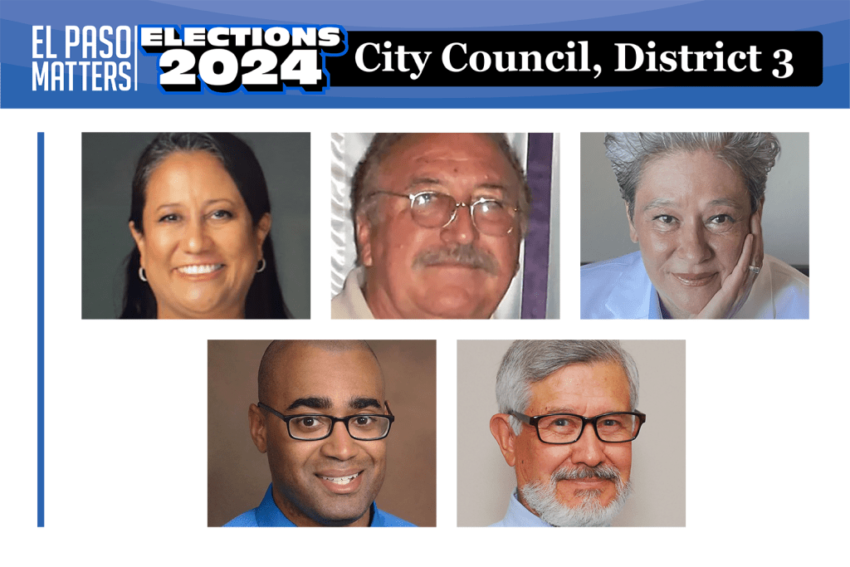
Five candidates are running in the Nov. 5 election to represent District 3 after city Rep. Cassandra Hernandez served the maximum two terms and entered the mayoral race.
District 3 stretches from El Paso International Airport to the border, encompassing Cielo Vista, Pebble Hills and Lower Valley neighborhoods.
Candidates spoke to El Paso Matters about a variety of issues, including increasing wages and auditing economic incentive agreements. These contracts between a developer and local government offer incentives for promoting economic development, such as tax breaks. A recent audit found the city improperly tracked millions of taxpayer dollars in business agreements.
All the candidates pointed to state and federal grants as a source of funding instead of bonds and certificates of obligation, which raise property taxes.
City representatives are nonpartisan positions and can serve up to two four-year terms, receiving an annual salary of $63,038. Six of the eight City Council seats are open this election.
Here are the District 3 city council candidates:
Fabiola Arellano
Arellano, 57, is working as a non-licensed attorney in the El Paso District Attorney’s Office. She is working to obtain her Texas bar license after moving home to El Paso from New York, where she worked as an immigration attorney, hedge fund auditor, and intelligence analyst. Arellano also served in the Army, National Guard Reserve and Army National Guard after she graduated from high school in El Paso.
She would resign from her job at the District Attorney’s Office if elected, Arellano said.
Arellano wants city government to be more transparent to the public, even if it puts city officials in a negative light. Most of what she learns from outside city government comes from the news and the city does not hand documents to the media until they’re forced to, she said.
“There is so much voter apathy because people have already lost trust and confidence in elected officials,” Arrellano said.
On funding city improvements: Arellano said she would push for an audit of all city departments. She also wants an audit of all Chapter 380 business agreements, not just the seven reviewed by the Financial Oversight and Audit Committee. Findings from that recent audit found six agreements did not meet compliance and two did not include a recapture clause – meaning companies that did not complete their jobs did not have to pay their incentives back to the city.
“This isn’t just misuse of funds,” Arellano said. “This is fraud and corruption.”
The city’s auditor’s office develops an annual audit plan, which must be approved by the council, on which departments it plans to audit each year, including any special projects or tasks. The department then issues quarterly reports to the council and the Financial Oversight Advisory Committee.
Instead of relying on bonds that put the burden on taxpayers to fund projects, there’s millions of dollars that could be saved by reviewing business agreements and contracts, including who’s writing and approving them, and auditing the departments, Arellano said.
As one example, Arellano pointed out former City Manager Tommy Gonzalez’s contract. An audit found Gonzalez improperly used taxpayer money for his travel expenses, but Gonzalez was not required to pay back the city because of a hold harmless clause in his contract. The city manager of El Paso also should not have a higher salary than the mayor of New York when the cost of living is not comparable, she argued.
Arellano said her experience as an auditor and an attorney has given her an eye for detail that will be helpful for weeding out unaccounted for funds and risky contracts.
On which areas to prioritize street repairs: Arellano said the fairest way to prioritize street repairs is by neighborhoods with the worst streets, whether it’s in her district or someone else’s. The city uses a pavement condition index based on national standards to prioritize street maintenance, and in 2022, voters approved a $237 million bond proposition for street improvement projects.
On increasing wages: Arellano said city representatives need to work with state representatives to increase the minimum wage. Texas has not passed legislation to increase the state minimum wage from the federal minimum of $7.25 an hour. While the county attorney’s office handles wage theft, cases of deceptive business practices start with the El Paso Police Department taking the complaints. Further research would need to be done if people are not making, or police are not taking, wage theft complaints, she said.
On economic development: Small businesses are the backbone of the El Paso economy, Arellano said. Instead of giving more than a million dollars in incentives to one company, why not spread that out to 15 smaller businesses, she asked. She supports increasing mixed zoning in District 3 to attract diverse businesses.
Other interests: Arellano said public safety is a priority and she wants to see an increase in police presence in areas with nightclubs and most DWIs. She also wants to increase funding for the city’s overwhelmed animal shelters and access to preventive health care, such as coordinating mobile cancer screenings with the public health department.
Kenneth Bell
Bell, 39, is a campaign organizer and co-founder of the Justicia Fronteriza, a political action committee that supports campaign contribution limits and progressive candidates. Bell moved to El Paso while enlisted in the Army. Later in the Army Reserve, he served a nine-month stint in Guatemala coordinating humanitarian projects with the U.S. Embassy.
In 2020, delegates from the Texas Democratic Party elected Bell to represent Senate District 29 in the Texas State Democratic Executive Committee.
His campaign will cap individual contributions at $1,000, Bell said. Candidates running for City Council should work on getting contributions from as many people as possible, not just from a handful of wealthy developers, he said.
His campaign finance reports show Bell has not received more than $750 in donations from a single person.
On funding city improvements: Lack of financial oversight is the biggest challenge to improvements in El Paso, causing the city to hemorrhage money, Bell said. He supports auditing every department and business agreement, as well as city management positions. He criticized Gonzalez’s lucrative employment contract, which had benefits that cost taxpayers $269,000 annually.
Incentives to bring companies to El Paso should be based on metrics that are written into the agreements – how many jobs it will create, how much workers will get paid, what percentage of jobs will be set aside for El Paso workers and not out of state contractors, he said. Business agreements should have a recapture clause for the city to get their money back if the companies do not deliver on their promises, he said.
On which areas to prioritize street repairs: Bell said the Ranchland neighborhood south of I-10 needs street repairs, as well as an area near Hunter Drive that residents call “patch street” because it’s covered in pothole patches.
On increasing wages: Bell said the city should work on educating El Paso workers on their rights, which will help increase wages. There are workers who got their wages stolen, were improperly hired as independent contractors instead of employees, or were misclassified as lower-paid general workers instead of trade workers, he said. A person could be paid $15 an hour for general work, but they’re doing trade labor such as electrical work or plumbing which have higher starting salaries, he said.
City Council should work with the County Attorney’s Office, which combats wage theft, to ensure the city does not contract companies that are committing labor violations.
On economic development: Bell said he would like to increase walkable, mixed-use development in District 3. To ensure small, local business owners and residents get the first shot at moving into these spaces, the city can use a right of first refusal, a policy that prevents displacement of businesses and tenants during gentrification.
There are also car lots and other properties on Alameda Avenue that have gone out of business, he said. Those properties could be auctioned off and that area rezoned so District 3 can have new, more diverse businesses, he suggested. The city can only auction off private, vacant property if the property is delinquent on taxes.
Other interests: Bell supports limiting the amount an individual can donate to a candidate per election, a policy implemented in other major cities in Texas already. City Council can determine what the cap can be, but this will level the playing field so candidates are not beholden to the wealthy minority, Bell said.
“People are not donating thousands of dollars out of the kindness of their heart and because they believe in your cause,” Bell said. “They’re doing it because they want something in return. … You’re going to be in their pocket for something whether you realize it or not.”
Deanna Maldonado-Rocha
Maldonado-Rocha, 51, works as a capacity analyst for Accolade, a health care technology company. She previously worked at AT&T for nearly three decades. She served as president of HACEMOS, the nonprofit Hispanic/Latino Employee Association of AT&T that coordinates volunteer activities.
Maldonado-Rocha said she became engaged in local government by attending District 3 community meetings and participating in the city’s Neighborhood Leadership Academy, a program that educates El Paso residents on how city government operates and works with residents to improve their neighborhoods.
She said City Council members should be able to have productive conversations with each other even if they do not get along and she does not like seeing representatives take jabs at each other in public.
“As a capacity manager I feel confident in my conflict resolution and communication skills,” she said. “I feel those are necessary in order to be able to have conversations where people may not agree with me.”
On funding city improvements: Maldonado-Rocha said the city needs to do a better job at finding funds that don’t require raising taxes, whether through grants or uncovered in audits. She pointed out a recent internal audit that found a balance of more $4.5 million unspent in the Sun Bowl Game account. The audit didn’t find any irregularities in the collection or spending of funds, which are generated through car rental taxes collected by the city for the Sun Bowl Association for game team payments and other operational costs.
Maldonado-Rocha said she felt slighted as a citizen when Gonzalez was fired, requiring the city to pay out $890,000 in his severance. She questioned a process where a city manager can get a “raving review and contract,” only for the City Council to fire them.
“When I see those items take place, to me there’s no fiscal responsibility and that’s the frustrating part,” she said.
On which areas to prioritize street repairs: Maldonado-Rocha said the Pebbles Hills and Pico Norte area between Yarborough Drive and Lee Trevino Drive floods and is approved for repair. After a project is approved and funded, six months to a year is a reasonable timeline for completion, she said.
On increasing wages: Maldonado-Rocha said El Paso should bring high-paying manufacturing, engineering and architecture careers to El Paso so college and technical school students can remain and work in El Paso.
Living wages should start with the city government, one of El Paso’s biggest employers, she said. Minimum hourly wage for city employees is $12.11, but the City Council passed a resolution to raise the wage to $15 by 2026. A living wage for a single adult in El Paso with no children is $18.09, according to the MIT Living Wage calculator.
The city should also scrutinize its business agreements, pointing out that El Paso’s Amazon fulfillment center has more robots than people working there. Maldonado-Rocha said she supports hiring more auditors to review the city’s business contracts and determine if they are following through with agreements, from number of workers to worker salaries.
On economic development: Maldonado-Rocha said establishing a grant program for residents and business owners could revitalize Alameda Avenue and help people pay for cleaning up their businesses, especially if they’re elderly can’t do the manual labor themselves. These funds can be used for adding a fresh coat of paint and clearing weeds, she gave as an example. She didn’t say how the grants would be funded.
Maldonado-Rocha also wants to bring a family-friendly anchor to south of I-10, the way north of the highway has The Fountains at Farah shopping center, Cielo Vista Mall and the airport. She would like to start a business association for the district and neighboring districts.
While it would be ideal for people local to District 3 to be the main investors in the area, it’s not realistic and the business association could work with developers coming from outside, she said. People want affordable housing, a grocery store and a pharmacy, as well restaurants outside of fast food chains, perhaps similar to the Five Points neighborhood, she said. District 3 residents need to be included in any development plans so they don’t get pushed out by gentrification, she added.
Other interests: Maldonado-Rocha said she wants the city to support school districts and organizations that are setting youth up for careers and adults up for new skills so they can advance in their careers. The Borderplex Alliance and Ysleta Independent School District offer apprenticeships and internships to students at small and large businesses with subsidized pay, she said. The school districts also provide free classes to adults and vocational programs for students that don’t want to go to college.
Jose Rodriguez
Rodriguez, 78, is a Realtor who ran unsuccessfully for District 3 representative in 2020. Rodriguez said he’s semi-retired and volunteers his time at Fort Bliss. As a volunteer he has taught conversational Spanish at the base and at El Paso Public Libraries.
On funding city improvements: Rodriguez said the current property tax system is not fair and he supports higher property tax rates for the wealthy. The Texas Constitution prohibits income taxes, and any effort to link property taxes to income would require approval by the Legislature and statewide voters.
On which areas to prioritize street repairs: Rodriguez did not discuss specific streets or neighborhoods, but said funds should be diverted from the Downtown sports arena to continue funding street projects. By law, however, the voter-approved bonds could not be used for any other project other than the arena or similar project. Voters on Nov. 5 will decide whether to revoke the city’s authority to issue the remaining unused bonds for the arena – dictating whether the city could move forward with the project.
On increasing wages: Rodriguez said El Paso should attract high-paying industries such as in semiconductors and manufacturing. At the moment, companies have warehouses that can only hire so many people while manufacturing is mostly done in Juarez, he said. If El Paso is going to give land and financial incentives to companies, there should be higher requirements for the number and type of jobs they will bring, he said.
On economic development: Rodriguez said he prioritizes working with the El Paso Chamber to increase tourism as a way to add revenue, such as creating something similar to San Antonio’s pedestrian-friendly Riverwalk. This could be funded instead of building an arena because the city already has arenas and entertainment venues, he said.
El Paso should take advantage of its Mexican heritage by continuing to fund cultural centers and in its tourism campaign, showcase El Paso as a combined attraction with Juarez and the Tigua Reservation, he said. The city’s Mexican American Cultural Center, a project under the voter-approved 2012 bond, is slated to open later this year.
“People just drive right through, they don’t have a reason to stop,” Rodriguez said.
Other interests: Rodriguez said the city should establish a whistleblower incentive and protection program to encourage more people to submit tips, such as the tip that led to the city discovering former city Rep. Claudia Rodriguez and city Rep. Cassandra Hernandez were using their city-issued fuel card to put gasoline in the vehicles of campaign workers and for personal trips. He did not clarify what the incentive would be. Texas has multiple laws that protect whistleblowers, including the Texas Whistleblower Act. El Paso’s longtime chief internal auditor filed a whistleblower lawsuit against the city because of alleged retaliation after he audited fuel card usage by elected officials. (Both Rodriguez and Hernandez are running for different offices this election.
Jesus “Jesse” Romero
Romero, 71, is a Realtor who’s held various past jobs, including security at El Paso International Airport, a bus driver for Sun Metro and in construction. He also served in the U.S. Navy. His real estate license is inactive, according to the Texas Real Estate Commission. Romero has served as a board member on the El Paso Mission Trail Association and lived in San Diego, Houston and other cities, before resettling in El Paso. Romero said he became interested in city government after attending District 3 community meetings.
On funding city improvements: Romero said he would have voted against the Northeast El Paso amphitheater, for which entertainment company Venu is receiving $31 million in economic incentives as part of a Chapter 380 agreement. He questioned the contract’s no-compete clause, how much revenue the amphitheater would bring, as well as the agreement to bring 40 national touring acts a year when the city already has the Don Haskins Center and El Paso County Coliseum.
Romero said El Paso’s free museums, such as the El Paso Museum of Art and El Paso History Museum, should start charging a small entrance fee – such as $5 for adults. Public attractions in other cities, such as the Museum of Fine Arts in Houston, charge admission – why not El Paso, he asked.
El Paso can also raise the rate on the Stanton Street Bridge by a few cents to generate more revenue, he added.
On which streets to prioritize for repairs: The city should prioritize working with the Texas Department of Transportation on various incomplete highway expansion projects. The state, not the city, is in charge of maintaining highways in El Paso. Instead of focusing on the Downtown deck plaza over Interstate 10, the city should have encouraged TxDOT to create a two-tier I-10 with traffic on the bottom level going one direction and traffic on the upper level going the other direction, Romero said.
Sunset Heights residents have voiced concern about congestion and air pollution the I-10 lane addition would bring. Romero said the city should incentivize people to trade in their old cars to get newer, more fuel-efficient vehicles such as a “Cash for Clunkers” program that federal and state governments in the United States have offered.
On increasing wages: Romero said the city needs to start with its own employees, including contract workers, when it comes to raising wages. He noted the city sometimes contracts outside companies that employ local workers. All companies contracted by the city should be required to pay higher living wages and other labor protections, such as a guaranteed amount of sick leave, Romero said.
The city should also ask companies to bring the manufacturing component, not just warehousing, to El Paso because manufacturing jobs pay more, Romero said.
On economic development: Romero said he supports the city creating a master plan for tourism to support and bring visitors to attractions in and around El Paso, such as the Rio Bosque Wetlands and Hueco Tanks State Park. The city contracts with Destination El Paso to provide tourism and venue management services.
Romero said District 3 should also increase senior housing. Seniors who are unable to afford upkeep of their homes could then sell their houses to move into public housing. This allows seniors to have savings in addition to Social Security, while allowing younger families to stay or move into District 3 where their children could then attend local school districts. Public housing decisions in El Paso are made by the Housing Authority, not the City Council.
Other interests: Romero said the city should establish a minimum 35 hours a week time commitment to serving as a representative. Representatives cannot prioritize their work on City Council if they have another full-time or part-time job that takes up their time, Romero said.
Early voting runs from Oct. 21 to Nov. 1. Election Day is Nov. 5.
The post 5 candidates vie for El Paso District 3 city representative seat appeared first on El Paso Matters.
Read: Read More