



The eight candidates for mayor have different ideas on how to fund street repairs, expand public safety and improve quality of life for El Pasoans – including imposing road usage fees, privatizing some police and fire functions, implementing crime prevention programs, and taking more bond proposals to voters.
While the mayor is not a voting member of the City Council, the person serving in the role can have a lasting impact on key decisions and policy recommendations. The mayor can break tie votes and veto legislation approved by the City Council, but cannot veto the hiring or firing of the city manager or city attorney.
The mayoral candidates include three sitting members of the City Council – Reps. Cassandra Hernandez, Brian Kennedy and Isabel Salcido. Other candidates include businessman Renard Johnson, magazine owner Elizabeth Cordova, restaurateur Marco Antonio Contreras, mediator and consultant Ben Mendoza and Army retiree Steven Winters.
Candidates for El Paso City Mayor speak to voters at a forum hosted by the League of Women Voters and the Community First Coalition, Oct. 5, 2024. (Corrie Boudreaux/El Paso Matters)
The candidates talked with El Paso Matters about their plans on parks, recreation and other quality of life issues, street funding and repairs, and public safety issues as they work with an annual budget that now stands at $1.3 billion, down slightly from $1.4 billion in 2021.
Street repairs
The city has a $7 million pay-go fund for streets, but needs $40 million on an annual basis to keep up with necessary street maintenance, city budget officials have said.
In recent years, the city has largely funded repairs with certificates of obligation, which don’t require voter approval, and with voter-approved general obligation bonds. Most recently, voters in 2022 approved a community progress bond which allocated $237 million for repaving and reconstruction of roads and streets, and included some safety improvements such as lighting.
Kennedy and Johnson both said the funding for streets should come out of the city’s existing budget.
Kennedy, 68, an attorney and events and entertainment consultant, said the city has a good streets department, but they are only as good as the tools they receive.
“We’re tens of millions of dollars a year short every year from just keeping our streets as crappy as they are right now,” Kennedy said.
Kennedy said the city needs to allocate funding for street repairs out of its current budget, but did not give specifics on where the money would come from or if it would require cuts to other city departments. Almost three of every five dollars in the general fund budget currently goes to public safety expenses, including police and fire.
“That’s an ongoing discussion with our CFO (chief financial officer) on how we can fund this correctly, and we’re working on that as we speak,” Kennedy said. “We have to see what programs we think we can run more efficiently and we’re doing that on an ongoing basis.”
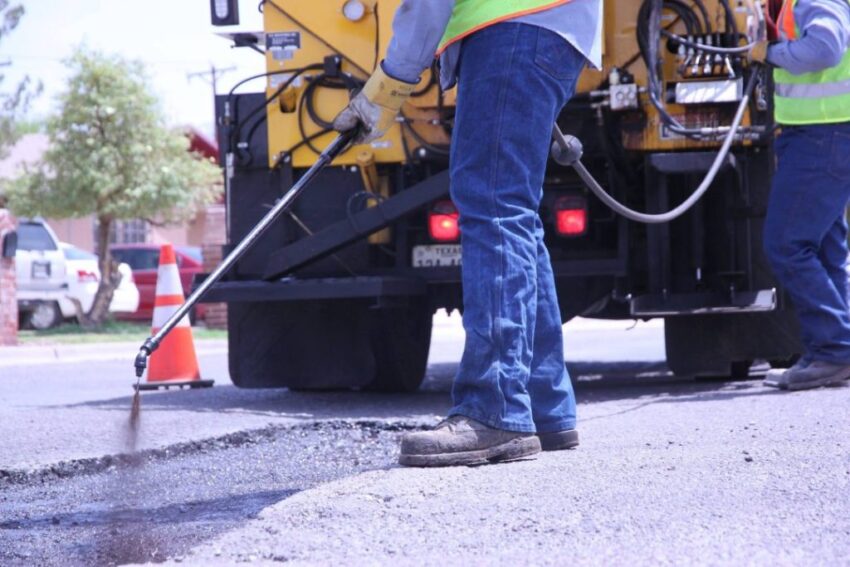
City of El Paso crews repair potholes on streets citywide. (Courtesy City of El Paso, 2017)
Johnson, a 58-year-old businessman, also said the city needs to allocate funding from the budget, but did not say from which funding source or if spending would need to be cut from other departments.
“Once we get into the budget, we’re going to find some areas that are having duplication of services. We’ve got to go in there and really look at what we can do to trim the budget and find the additional revenue,” Johnson said.
The city in August adopted its budget for the current fiscal year that runs through Aug. 31, 2025. If he is elected, Johnson said, he will focus on the next budget cycle.
Johnson said he does not want to impose a fee on taxpayers, but if that was the only way to have a consistent revenue stream, voters would have to approve it.
“The voters are saying they don’t want their taxes raised, so these (fees) are disguised as taxes, and if the voters want to add an additional fee to fix their roads, that’s something we need to go out to the voters with and let them decide whether or not they want to do it,” he said.
Hernandez, 37, a full-time elected official, said she has a three-pronged approach to addressing streets – including possibly implementing an impact fee.
She said the first part of her strategy would be to work with developers that have a funding mechanism in place such as municipal management districts. The districts allow developers to work together to supplement city and county services such as roads.
“There’s an opportunity to work with private developers to build new housing developments, I’m going to encourage that so that long term, we can remove that responsibility (street repairs) from the taxpayer and re-divert that into master plan community responsibilities,” she said.
Candidates for El Paso City Mayor speak to voters at a forum hosted by the League of Women Voters and the Community First Coalition, Oct. 5, 2024. (Corrie Boudreaux/El Paso Matters)
Hernandez said the second part of her plan involves putting the newer streets in the outer lying areas of the city on a long-term 20-year maintenance plan so that they are on a schedule and do not end up falling by the wayside. She did not identify a funding source for those repairs, however.
“We really need to treat new streets a little bit differently and give them a little bit more maintenance so that we can extend the lifeline of those streets,” she said.
The third part of her plan is to address the existing inventory of street repairs by exploring a street maintenance impact fee by using a “trip generation model” that would be assessed for each property owner in the city, including commercial developments.
“Their fee would be generated based on the amount of traffic that they generate as a result of the land use of the property,” Hernandez said, adding commercial properties would likely pay more, easing the burden on residential property owners.
Hernandez said she realizes a fee could be controversial, but it should be explored.
A district court judge in August ruled that the city’s environmental services franchise fee charged on garbage collection supposedly used to pay for damages to streets caused by the city’s own sanitation trucks bills is “unconstitutional and should be discontinued.” The city is appealing the ruling.
Mendoza, 69, said he would like to find partnerships to fund street repairs such as reaching out to the Phillips 66 Foundation.
The foundation makes charitable contributions to nonprofit organizations involved with education and literacy, health and safety, but does not specify projects with municipalities for street repairs.
“I would like to get a hold of them and talk to them about doing some work in El Paso. They have a special type of asphalt that would help the life of the streets and roads that we have here,” Mendoza said. “I would work with them, to see if they would work with us and fund that (type) of project.”
Cordova, 57, said street funding needs to be evaluated and hiring an expert to do analysis of how money is being spent would be part of her plan to address street repairs.
“There’s always a solution to something,” Cordova said, adding she would explore whether there is any state or federal funding available for street repairs and maintenance.
Winters, 57, retired Army sergeant major, did not have a specific plan to address streets, but said street expenditures and funding need to be audited.
The city has an office of internal auditing that conducts various audits of city departments and expenditures.
Contreras, 50, a political newcomer and restauranter, said street projects should be done one at a time and completed before starting other projects.
“(The city needs to be) working on them in certain zones of the city, and try not to obliterate all our roadways creating chaos,” Contreras said. Contreras did not say how street repair funding should be addressed.
Salcido, 39, did not respond to an interview request by El Paso Matters to discuss her views on streets, quality of life and public safety.
Addressing public safety needs
The city also has an obligation to fund public safety pay increases approved by the City Council through collective bargaining agreements and issuing voter-approved bonds for public safety projects such as new police stations and fire houses.
Since 2015, the city’s public safety budget has increased by about $127 million, to about $340 million this fiscal year. Public safety expenditures have been the primary reason city budgets – and property taxes – have risen in the past decade. Public safety expenditures are about 58% of the city’s budget.
Training for the El Paso Police Academy’s 137th Class started Sept. 9, 2024. (Courtesy city of El Paso / EPPD)
Plans to add 300 officers to the police force started in 2016, and additional costs and expenses include expanding the crisis intervention team, an increase in 911 communicators and additional firefighters, as well as equipment replacement out of the city budget.
Johnson said he would want to meet with police and fire leaders to evaluate department spending and ensure they have the resources they need.
“I think for right now we’re doing good – you can always do better, but I think right now, we’re doing good, and we’ll have that discussion once I become mayor, to see what we can do better,” Johnson said.
Hernandez said the city needs to consider proactive approaches to policing rather than being in a reactive state by identifying the root problems of crime and putting programs in place to address them.
Hernandez said she would evaluate the police and fire departments by doing an inventory of the services being provided and evaluate which can be privatized or issued out to civilian employees. Hernandez voted in favor of the collective bargaining agreement that was negotiated under former City Manager Tommy Gonzalez.
“That we can have non-uniform employees doing these services, and also looking into the administration internally (to determine) how many sworn officers are doing administrative duties versus patrolling duties,” she said.
She added that she is not proposing defunding the Police Department, but finding ways to ensure the officers can better perform their duties.
She said she wants to continue to increase the number of police officers, ensure they have competitive benefits to attract and retain them, and reduce response times.
Kennedy said strengthening public safety is being addressed through the recent collective bargaining agreements with the police and fire unions, as well as the public safety bond. Kennedy also voted in favor of the collective bargaining agreement.
“There’s always room for improvement (and) we should always look for ways to be better, but I will tell you we’re on the right path, and our performance shows that,” Kennedy said.
The collective bargaining agreement approved unanimously by the City Council in March 2023 stipulated pay raises for police officers over the next four years. The financial impact to the city’s budget was about $15 million for the first year. In fiscal year 2026, the estimated increase for salaries is $12 million, and $14 million in fiscal year 2027, according to the city’s five-year financial forecast.
“We needed to be competitive with other cities, and we are,” Kennedy said.
Cordova said public safety is a top priority, but did not have a specific plan for how to address any changes or improvements.
“I need to get together with them – that’s part of being the mayor – meeting with them, not on a daily basis, but at least once a week, seeing what we can do, what we can change, how we can work together,” Cordova said. “I know that we need to ensure that the city stays safe, because we never know – we think we’re safe, but an emergency or something can happen, and we need to be prepared.”
Contreras said he gives credit to the El Paso Police Department for the work it is already doing, but also the residents.
“We’re very lucky in the nature of the people that live in El Paso,” Contreras said.
He said he would like to see a larger police force with adequate pay and officers who respect the community. He said he would like at least a three- to four-year commitment from officers to stay with the department.
Winters said the city needs to continue to grow the police force, but should partner with Fort Bliss for a transition program for soldiers to become peace officers.
“We’re not taking advantage of (that) there are men and women that are qualified to be peace officers that are probably going to go somewhere else,” Winters said.
Winters said he also wants to review spending with the police and fire departments and find ways to make operations more efficient.
Mendoza said he does not see any issues with the way public safety is being addressed.
“I think with the work with the police force that we have now – we’re doing an admirable job since there is a shortage of officers,” Mendoza said. “I think considering what we have to work with we’re doing fine.”
Quality of life priorities
As the city completes most of the 2012 quality of life bond projects, the candidates discussed how they would approach future projects.
The only remaining bond project is the Downtown arena, which is on the November ballot that asks voters whether to revoke the city’s authority to issue the remaining funds for the long-stalled venue.
Hernandez said the city needs to begin planning for the future.
“There should be a second reiteration to plan for the next 20 to 40 years with these types of bond initiatives – which is primarily our only source of revenues to make these types of public improvements,” Hernandez said.
She said voters have told her they want to see more park improvements, dog parks, swimming pools and projects like splash pads in the outer-lying areas of the city.
“There is a need to do an update to the parks master plan so that we can identify the existing maintenance needs and then put a long term, five- to 10-year capital plan by way of a potential quality of life bond 2.0 so that we can address the gaps within the city,” Hernandez said.
She also said the city needs to approach improvements incrementally to ease the burden on taxpayers.
Candidates for El Paso City Mayor speak to voters at a forum hosted by the League of Women Voters and the Community First Coalition, Oct. 5, 2024. (Corrie Boudreaux/El Paso Matters)
Johnson, while he has said he wants to focus on economic development projects, said the city needs more quality of life programming such as events for families and youth.
“We need to look at more opportunities of bringing in live entertainment to our existing venues,” Johnson said.
He said part of that includes improvements to the Judson F. Williams Convention Center to draw larger-scale conventions.
“I don’t think our spaces are adequate enough,” Johnson said, adding a feasibility study for improvements to the convention center should be done.
He also said he does not want to further burden taxpayers so the city could look for state or federal grant funding for potential improvements.
Mendoza said the city should not fund any more quality of life projects and that an audit needs to be done of existing facilities and how they are being managed and maintained.
“The city should tighten its belt (on spending),” Mendoza said, adding if he is elected he wants to put an immediate freeze on spending, or will lobby the City Council to freeze spending. “We can’t afford to be spending anymore.”
Kennedy said he sees the future of quality of life projects aimed at creating walkable areas throughout the city, including Downtown. He said part of that plan is to use bollards to allow for pedestrian access in the streets and have economic development draw small businesses to participate in events.
“That’s not very expensive and it does (positively) affect quality of life, and you can then use that model to be continued for pods or other entertainment and family areas in various parts of the city,” Kennedy said.
He said the city could use funds from the tax increment reinvestment zones in certain areas such as Downtown to help fund creating the walkable areas without directly impacting taxpayers.
Kennedy said other quality of life facilities need to be maintained and he also wants to draw sports tourism to the region. Kennedy previously served as CEO of the El Paso Sports Commission that organized events for the El Paso County Coliseum.
Winters said he wants to do a 90-day evaluation with constituents in each district to determine how to move forward with any quality of life projects. Contreras said he does not support another bond initiative for quality of life projects.
He said his idea for a second Downtown area “project metropolis” is what he would want to prioritize as a quality of life improvement. He said the new downtown in West El Paso will improve quality of life by way of helping shift the tax burden from homeowners to commercial property owners.
Cordova said the city needs to prioritize fixing streets and drawing new businesses rather than build out more quality of life projects.
Early voting begins Monday, Oct. 21 and ends Friday, Nov. 1 ahead of the election. A runoff election would be held Dec. 14, if needed, with the elected mayor and council candidates taking office in January.
The post El Paso mayoral candidates talk streets, public safety, quality of life appeared first on El Paso Matters.
Read: Read More