



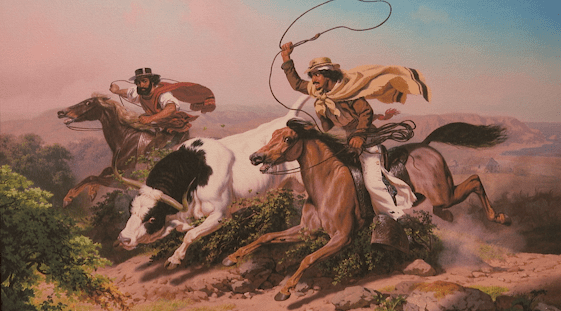
SAN DIEGO (Border Report) — The San Diego History Center in San Diego has unveiled “Aloha Vaqueros,” an art exhibition highlighting the history and connection shared by cowboys from Spain, Mexico, California, Texas and Hawaii.
The exhibit details the lasting impact on the way land and livestock are cared for, emphasizing how vaqueros (cowboys) helped shape these regions’ identities.
“It’s the weaving of multiple cultures,” said Bill Lawrence, president and CEO of the San Diego History Center. “The vaqueros are the basis for the American cowboy, so Texas is absolutely part of this story.”
The exhibit includes artifacts, historical documents and interactive multimedia displays, Lawrence said.
“It’s not just about roping and riding and those types of things, that’s absolutely critical to the story, but it’s such a wide cultural breadth,” he said. “We talk about the music of the vaquero and the paniolos (Hawaiian cowboy), saddle making, the vaqueros made saddles one way, but the process has been refined by the paniolos and really is an art form.”
Lawrence said they also look at the music and different guitars used by these cowboys.
“It’s the classical guitar to the slack guitar.”
People who visit the exhibit will also learn how the American cowboy ended up in Hawaii.
“Cattle were gifted to Hawaiian royalty by the British, and they actually became feral, so when King Kamehameha came to California and saw the vaqueros, he needed help in being able to wrangle these cattle that were really overrunning the islands.”
Lawrence says the king sought the help of Joaquin Armas, a cowboy who had been born at the San Diego mission.
“He was invited by King Kamehameha to come over and actually teach the Hawaiians how to wrangle cattle.”
“Aloha Vaqueros” will be open to the public through May 2025 in San Diego.
“One of the unique things about the San Diego History Center is that we’re a donation-based museum, so you don’t need to pay admission, you can just come in to see this exhibit.”
After its six-month run in San Diego, the exhibit will be moved to Texas and then Oklahoma.
The original exhibit was created by the Museo del Vaquero de las Californias in El Triunfo, Baja California Sur, Mexico.
Read: Read More