



On a sweltering evening in late May – the kind of day when you can hear air-conditioning units hum as heat radiates from the asphalt – Hilda Villegas stood alongside dozens of organizers in the shadow of the shuttered Beall Elementary School in the Chamizal neighborhood.
Locals view the defunct school as one of many signs of city leaders’ neglect; of the neighborhood’s forgotten status. And they were there to draw attention to what they see as compounding issues in this corner of El Paso: low wages, closed schools, industrial fires and above all, pollution spewed by the hundreds of diesel semi-trucks that traverse the nearby Bridge of the Americas to haul goods to and from Mexico every day.
What’s followed since then is a fight over what commerce in El Paso should look like, and who should bear the burden of the economic activity here – the flow of goods – that reverberates throughout North America.
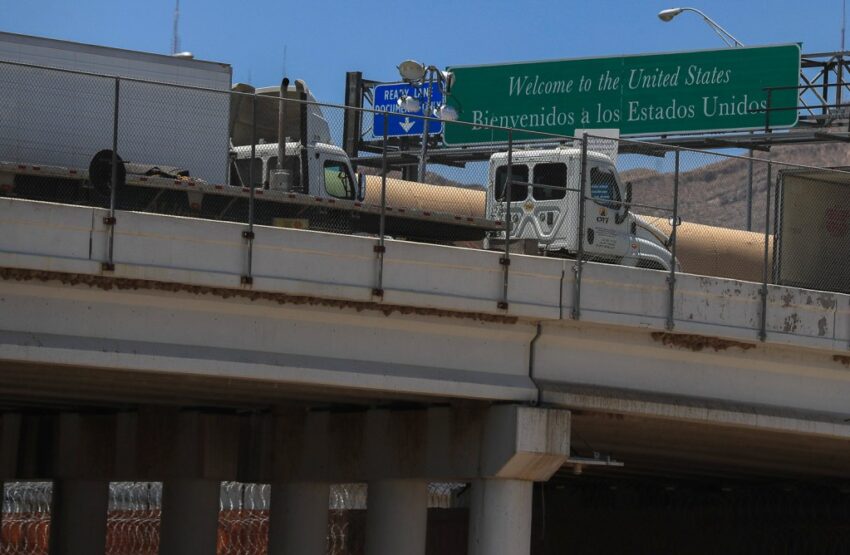
Commercial trucks entering El Paso from Ciudad Juárez at the Bridge of the Americas pass through a Customs and Border Protection inspection. (Corrie Boudreaux/El Paso Matters)
As the federal government is preparing to spend $650 million to renovate BOTA, or Puente Libre, the agency overseeing the project has said it has heard residents’ concerns and prefers to ban commercial trucks from crossing at that port of entry as part of its overhaul. The city and county of El Paso have backed that idea.
On the other side, companies tied to imports or exports say eliminating cargo trucks from BOTA would create minimal, if any, environmental benefits, and would only shift pollution to other neighborhoods. It would also complicate businesses’ logistics, boost transport costs and make El Paso less attractive to outside firms looking for a place to invest.
The BOTA renovation is expected to begin in 2026 and run through 2029. And while the federal government said its preference is to remove the trucks, it’s still possible commercial traffic will continue in the future at a renovated BOTA.
‘Right to exist’
Villegas and the group walked through the sun-beaten barrio that summer evening, passing out literature with data showing residents in South-Central El Paso, from Segundo Barrio east to the Chamizal, live with elevated pollution that they say stems largely from the vehicles that cross the nearby port of entry daily.
Claudia Alvarez, 16, places flyers in mailboxes along San Marcial Street with information about pollution levels in South Central El Paso on May 23. Alvarez, a student at Silva Magnet High School marched with organizers in the Chamizal. (Diego Mendoza-Moyers / El Paso Matters)
Data from the Centers for Disease Control and Prevention show almost 14% of residents in Segundo Barrio and Chamizal experience chronic obstructive pulmonary disease, a respiratory illness that’s often caused by cigarette smoking or air pollution. That’s more than double the rates of COPD across El Paso County and the U.S. as a whole. And the percentage of people with asthma in those two neighborhoods that abut the border and host international bridges is about 20% higher than the countywide rate, according to CDC data.
“When it comes to diesel contamination, it’s super, super horrible for a child’s development,” Villegas said, standing just outside the school’s abandoned basketball court. “It’s the smallest fibers, particles that go inside and get embedded in the bloodstream.”
Villegas and her group’s solution has been to pressure government officials to regulate industries such as local recycling facilities more stringently – something the city has taken steps to do. But, far more importantly, Villegas said, the trucks that cross BOTA must cross elsewhere, closer to the periphery of El Paso and not in the historic, low-income heart of the city.
Each day, around 760 semi-trucks drive across BOTA to transport goods in and out of Mexico, according to estimates from the El Paso Metropolitan Planning Organization, the region’s top transportation planner.
Villegas blames the pollution in Chamizal on companies that want to avoid transporting goods along longer, costlier routes through farther-away crossing points. The port of entry in Santa Teresa, New Mexico, is 25 miles to the west of BOTA, while the county-owned bridge in Tornillo sits about 45 miles to the southeast.
“They want to stay here so that they can cross their product, and put the burden on a community like ours,” Villegas said. She pointed out that after the closure of Beall Elementary in 2019, kids in the neighborhood have to go to school at Zavala Elementary directly adjacent to BOTA, or to Douglass Elementary less than a mile from an industrial recycling facility.
Earlier this month, the El Paso Independent School District proposed closing Zavala as part of a districtwide consolidation.
Just over 9,300 people live in the Chamizal area, according to the U.S. Census.
Five days after Villegas in late May led the march to generate awareness about pollution in the Chamizal, huge plumes of light gray smoke billowed from a cardboard recycling facility near Paisano Drive and Coles Street, about a mile from Beall Elementary. The fire burned for hours while as many as 200 firefighters battled the massive, three-alarm blaze – one of the largest in El Paso’s history, according to the city’s Fire Department.
Firefighters battle the blaze at a recycling facility near Paisano Drive and Coles Street on May 28, 2024. The three-alarm fire was one of the biggest blazes in El Paso’s history. (Diego Mendoza-Moyers / El Paso Matters)
Chamizal residents argue other segments of El Paso don’t have to face as many challenges and sources of pollution at the same time. Days before the fire, Villegas highlighted the recycling facility as a source of pollution in the area.
“We have a right to exist in a place where we are free of all these environmental stressors and environmental injustices,” Villegas said. “Industry has always been considered before us, the residents.”
Feds call to remove trucks
After more than two years of organizing, Villegas and her Chamizal group have scored wins in their fight to move diesel trucks out of the neighborhood.
The General Services Administration that’s leading the renovation of BOTA spent years sketching out different scenarios for how to modernize the port, which was built in 1967. But the federal government wasn’t initially considering banning commercial trucks from the bridge.
Villegas and other Chamizal residents have been regular fixtures at the otherwise mostly dull informational meetings the GSA has held in recent years – the group usually holding signs and flags and chanting “Fuera las trocas” or “Get the trucks out.”
The GSA in September said that it prefers to eliminate commercial trucks from the bridge going forward.
El Paso County Commissioners Court in early October unanimously voted to tell the GSA it supports the idea of removing trucks at BOTA.
The next day, El Paso City Council did the same thing and told the GSA it unanimously approved of the plan. That came after a vote in January in which a 6-2 majority of city representatives declined to back the removal of trucks at the bridge.
Truck enter the American inspection area after crossing the Zaragoza Bridge from Juárez into El Paso. (Luis Torres/El Paso Matters)
Still, companies and business groups in the region have said the move will inevitably eat into profit margins and make El Paso less productive as a region. And there’s a debate about whether other bridges – including Santa Teresa and Tornillo but also the larger Ysleta-Zaragoza bridge – can squeeze additional trucks through without costly infrastructure upgrades.
The director of the city’s department that oversees international bridges said earlier this month that removing trucks from the Bridge of the Americas could mean El Paso “may lose competitiveness” economically relative to other border towns.
“Most communities along the U.S.-Mexico border are trying to expand their ports of entry,” Roberto Tinajero, head of the international bridges department, told City Council. “Now, in this case, in our community, we’re trying to close one (for commercial traffic) without having a viable alternative.”
U.S. Rep. Veronica Escobar has been a strong advocate for removing the commercial trucks from BOTA, citing health concerns in adjacent neighborhoods. “We would not have supported the removal of commercial traffic if the other ports of entry in the region could not absorb commercial traffic that will no longer go through the Bridge of the Americas,” Escobar told reporters after the GSA’s announcement.
Shift to other ports?
The amount of trucks crossing BOTA southbound into Mexico isn’t entirely clear, because those figures are tabulated by Mexican customs officials, while U.S. Customs and Border Protection maintains northbound crossing numbers. Tinajero said Mexican officials haven’t shared southbound crossing data with the city, but local companies estimate around 2,000 cargo trucks pass southbound across BOTA every day. Tinajero said between 500 and 700 trucks cross BOTA northbound into the U.S. daily.
However, data published by a consortium of groups – which includes CBP, the city of El Paso and the MPO – shows that BOTA has seen an average of just 360 cargo trucks crossing northbound daily so far this year, an increase from last year. But well over 1,000 trucks used to cross northbound at BOTA each day during the mid-2000s.
Trucks that currently cross north into the U.S. at BOTA “can easily be absorbed through other ports of entry,” Tinajero said.
“The southbound part is where we are more concerned,” he said. “We’re not going be able to handle that capacity.”
The actual numbers on southbound commercial truck crossings are elusive, but the MPO estimates around 425 cargo trucks cross BOTA into Mexico each day – a big difference compared with industry estimates of 2,000 southbound trucks crossing at BOTA daily. Field counts conducted by the MPO in April 2022 found 358 trucks crossed southbound at BOTA each day on average.
Trucks wait in line to access the commercial lanes of the Zaragoza Bridge as they travel from Juárez into El Paso. (Luis Torres/El Paso Matters)
The Ysleta-Zaragoza bridge, meanwhile, has averaged 1,815 cargo trucks crossing south each day this year, and just under 1,800 trucks passing north over the bridge daily.
If commercial traffic is banned from BOTA, the GSA’s computer models predict that 300 additional trucks would shift to cross into the U.S. at the Ysleta-Zaragoza bridge every day, and 50 would cross at the port in Santa Teresa.
Southbound, the GSA expects about 400 additional trucks each day to enter Mexico at the Ysleta-Zaragoza port, and about 30 trucks would cross south at Santa Teresa.
“These numbers are not considered significant and would not be anticipated to have an adverse effect on the local transportation network at these ports,” the GSA wrote in a document that details the project.
No trucks would go from BOTA to cross instead at Tornillo, according to the GSA’s modeling.
Economic hit to El Paso?
Removing truck traffic at BOTA may increase the time and cost of transporting goods – and cut into businesses’ profit margins – for shipments going west, especially while construction is ongoing near the intersection of Artcraft Road and Interstate 10, according to Tom Fullerton, a professor of finance and economics at the University of Texas at El Paso’s Woody L. Hunt College of Business.
Fullerton said improved air quality in the Chamizal and Washington Park neighborhoods, as well as directly across the Mexican side of the border, is “likely to be achieved” by removing trucks from BOTA.
The Guadalupe-Tornillo Port of Entry connects Tornillo, Texas, and Guadalupe, Chihuahua. (Luis Torres/El Paso Matters)
However, goods that are bound for warehouses in the center of El Paso may face longer transport times. The Ysleta-Zaragoza bridge could become overly congested, and highway links on the Mexican side of the Tornillo port of entry “are not fully built,” Fullerton said.
“The overall economic effects will be manageable, but it is not clear that the regional environmental effects will be noticeably better,” he said. The level of regional pollution in the future would depend on how many miles vehicles have to travel after the renovation of BOTA, and whether there’s more or less congestion at ports of entry, he said.
“Ysleta-Zaragoza may already be close to capacity,” Fullerton said. “The Santa Teresa and Tornillo ports of entry will require infrastructure upgrades in their respective traffic feeder systems to handle larger traffic volumes.”
To Tanny Berg, who heads the El Paso Central Business Association, eliminating commercial traffic at BOTA “is an ill-advised reaction to a problem without really looking at the ramifications.”
“There’s no upside,” Berg told El Paso Matters.
He said Chamizal residents calling to remove diesel truck traffic aren’t considering the thousands of passenger cars that also idle in line at the nearby bridge.
Commercial trucks entering El Paso from Ciudad Juárez at the Bridge of the Americas pass through a Customs and Border Protection inspection. (Corrie Boudreaux/El Paso Matters)
Burning a gallon of diesel fuel releases about 15% more carbon dioxide into the air than burning a gallon of gasoline does, according to the EPA, and a diesel truck on average produces significantly more pollution than a passenger vehicle. Still, both gasoline and diesel-powered vehicles produce air pollutants such as particulate matter and volatile organic compounds.
Since the start of 2023, an average of 10,000 passenger vehicles have crossed BOTA north into the U.S. every day. Over the same time, fewer than 300 diesel trucks crossed that bridge northbound each day on average, according to crossing statistics.
If commercial traffic is halted from crossing at BOTA, the GSA’s computer models predict the number of passenger vehicles crossing north and south at BOTA annually would increase to 15.5 million each year from about 10.2 million currently. That’s because drivers that currently cross at other bridges, including the Stanton and the Paso del Norte bridges in Downtown, would likely shift to cross at BOTA and take advantage of lower wait times at the toll-free bridge, according to the MPO.
Chamizal residents are “going to continue breathing the air as long as the cars are coming across that border,” Berg said.
Other than the increase in northbound passenger vehicle traffic at BOTA, “all other traffic remains relatively unchanged” if cargo trucks are removed from the bridge, the GSA wrote in its environmental impact statement draft.
To Paul Dipp, president of Economy Wholesale Grocers, which imports and exports to Mexico and has customers across the border, preventing cargo trucks from crossing at BOTA would result in far longer lines at ports of entry and increase the cost to move goods.
Mexico, he said, isn’t prepared for the shift, and neither are companies who were unaware the federal government would make the move to ban trucks from the port of entry. Like Berg, he said pollution in the Chamizal would likely remain unchanged because more personal vehicles would cross at BOTA.
Businesses are also concerned about security on the roads near the Mexican side of the international crossing in Tornillo. Mexican National Guard troops recently engaged in a shootout with suspected drug cartel gunmen along a highway near the Tornillo port of entry. Following the gunfight, Mexican law enforcement seized over 30 firearms and tactical gear such as ammunition, helmets and bulletproof vests, according to the El Paso Times.
“The economic impact, the pollution, the safety, the wear and tear on our road systems and infrastructure – it doesn’t sound logical to me,” Dipp said. “It’ll increase everyone’s cost.”
Dipp said he hopes pushback from businesses in El Paso and Juárez will prompt the GSA to rethink its preference for the BOTA renovation. Instead, he said he’d like the GSA to “stage” construction on BOTA over time, so that commercial traffic isn’t disrupted.
For now, regardless of whether the GSA bans cargo trucks from BOTA permanently or not, the plan is to halt all traffic from crossing at the bridge during the three-year construction period.
“We’re hoping our voices will be heard, and we’re hoping that there’ll be an economic analysis that will reflect the positions that we’re taking on this,” Dipp said.
The reason that border towns want to ensure a smooth, fast movement of goods through local ports of entry is because that will mean the town’s economy is likely to be more productive compared with areas on the border where it’s slower or costlier to move goods through.
Higher productivity in a region often translates to higher wages and more jobs available for workers, said Jesus Cañas, a senior business economist with the Federal Reserve Bank of Dallas and a graduate of the University of Texas at El Paso.
“That’s why we want (efficiency) instead of wasting resources and spending two or three hours crossing the bridge,” Cañas said. “And then, because of that, you need to invest in additional cooling systems for your trucks.”
El Paso’s competitiveness could be affected if, for example, the crossing times in McAllen, Texas, become 15% or 30% lower than in El Paso-Juárez, he said.
“If your company puts a lot of value on that variable, maybe instead of coming to Juárez, we go to Matamoros,” Cañas said.
“But it’s not the only variable that (companies) consider,” he said, adding that other big factors businesses look at before investing include the availability of labor, electricity costs and long-term water supply.
When Cañas and his colleagues analyzed the impact the Juárez maquila industry has on El Paso’s economy, he said they found that a 10% increase in manufacturing production in Juárez translated to a 2% rise in employment here.
That’s in part because large-scale trade and an efficient flow of goods to and from Mexico supports relatively high-paying jobs in El Paso that service cross-border commerce, Cañas said, such as accountants, consultants and commercial real estate agents.
Commercial trucks entering El Paso from Ciudad Juárez at the Bridge of the Americas pass through a Customs and Border Protection inspection. (Corrie Boudreaux/El Paso Matters)
Air quality in El Paso, Chamizal
In El Paso County, levels of the air pollutant ozone exceed air quality standards that the EPA implemented in 2015. When nitrogen oxide (NOx) reacts with volatile organic compounds (VOCs) in the air and also with heat and sunlight, it forms ground-level ozone, a respiratory irritant.
But even though ozone levels in El Paso exceed federal standards, exposure to ozone is not even across the city. Among 12 locations with air quality monitoring stations throughout El Paso and Juárez, ozone was most concentrated in the Chamizal, according to EPA data shared with a committee of U.S. and Mexican officials.
The EPA figures also show that levels of particulate matter in the air this year exceed federal standards in the Chamizal, especially larger particles that can come from smoke, dust and vehicle exhaust.
Researchers with the MPO have studied how air pollution might change under different scenarios at the region’s border crossings. One of the scenarios tries to predict what would happen if the U.S. banned commercial trucks from crossing at the Bridge of the Americas.
Compared with three other scenarios – such as opening a crossing in Sunland Park – removing trucks from the Bridge of the Americas led to the highest citywide pollution of any future scenario, including continuing with the status quo, according to the MPO’s analysis.
The area immediately adjacent to BOTA would see daily emissions fall by about 7% if trucks were banned from that crossing. But the El Paso-Juárez region as a whole would see daily pollution increase by nearly 2%, according to the MPO’s study.
That’s because trucks coming into or out of Juárez that would normally cross at BOTA would have to drive dozens of additional miles to the crossings in Tornillo, Santa Teresa or Ysleta, and then back to warehouses closer to the city center, Eduardo Calvo, executive director of the MPO, said in an interview.
“I don’t disagree with the activists from the Chamizal,” Calvo said. “You have a school (Zavala Elementary) right there in front of the bridge, and you have all the trucks not only northbound but also southbound.”
“But by moving those trucks somewhere else, you’re just moving those emissions to somewhere else,” Calvo said. “It’s not a net gain.”
For its part, the GSA estimates citywide NOx and VOC pollution would decline after banning cargo trucks from BOTA.
To the MPO’s researchers, it’s not enough to just ban commercial truck traffic at the Puente Libre. To be effective, the six crossings in and around El Paso – which have different owners – must coordinate together, Calvo said.
“If we really worked as a system, then the ideal scenario or scenarios could be shut down (truck traffic at) Bridge of the Americas, but then improve the infrastructure at Zaragoza and make another crossing only for fast lanes for trucks, or add SENTRI lanes, northbound and southbound,” Calvo said, referring to fast-pass lanes for pre-approved travelers.
Trucks line up in Juárez to cross the Zaragoza Bridge into El Paso. (Corrie Boudreaux/El Paso Matters)
The city is applying for a $20 million federal grant – which requires a local match of $5 million – from the U.S. Department of Transportation to improve the Ysleta-Zaragoza Port of Entry as well as some roads near the bridge, such as Pan American Drive, Winn Road and Rio del Norte Drive.
Closing off BOTA to commercial traffic could have some negative impact on El Paso’s ability to attract companies to the area. But by applying for grants to improve other ports of entry, the city “can be ready for the shift,” said Karina Brasgalla, interim director for the city’s Economic and International Development Department.
“I’m not going to say there’s going to be a net-zero impact (on economic development), but we can mitigate that,” Brasgalla told City Council on Oct. 8.
“There is opportunity here to make sure that we capture that traffic, that we minimize the impact on commercial vehicles, on industry, and really take advantage of re-shoring and near-shoring opportunities,” she said, referring to the trend of companies moving production to North America from Asia or elsewhere.
Chamizal organizers say the pollution they experience takes a big toll on neighborhood childrens’ health. And banning commercial trucks, they argue, would signal that El Paso’s elected officials aren’t condemning low-income residents to unhealthy lives lacking dignity.
“It’s meaningful. But the battle is not done,” Villegas said of winning support from the county and also city governments.
Removing commercial semi-trucks from the Bridge of the Americas “is going to be beneficial for the entire city of El Paso,” she said. “Not just the familias de Chamizal.”
The post Residents near Bridge of the Americas demand action on truck pollution; businesses warn of economic impacts appeared first on El Paso Matters.
Read: Read More