



To many in the Paso del Norte region, the holidays mean celebrations with favorite foods to include pan dulce, or Mexican sweet bread. More and more of those pastries are being made, refined and/or originated by graduates of the El Paso Community College Culinary Arts Program.
Since 2009, the program has offered an associate of applied science degree or certificate of completion in pastry. Both prepare students to create, concoct and present baked goods, and expose them to the field’s business side.
The program is led by Chef Jesus Lugo, an EPCC professor of culinary arts. He estimated that the college’s program has influenced about 80% of the people who fill pastry positions in El Paso to include hotels, restaurants and mom-and-pop bakeries, as well as teaching positions in high schools and colleges.
“They’re pretty much everywhere,” said Lugo, an executive chef and executive pastry chef certified by the American Culinary Federation.
One of the program’s more popular courses is “Mexican breads and pastries” offered during the fall semester. Lugo, a 2003 graduate from the Art Institute of Houston, believes its popularity is partly due to the number of Mexican bakeries in the area.
A student cuts swirls into uncooked conchas in the Mexican Bread and Pastries class at EPCC on Nov. 20, 2024. (Corrie Boudreaux/El Paso Matters)
The course focuses on authentic preparation of breads and pastries from the borderland and into Mexico. Each week classes focus on different regional cultures, ingredients and preparation methods that go into everything from simple dinner rolls to celebration breads such as the Rosca de Reyes.
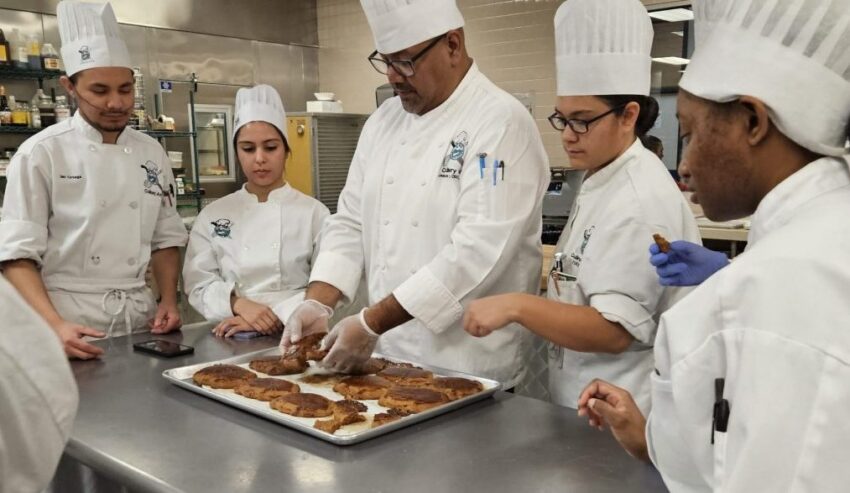
During a recent class, students moved around a large kitchen-classroom as they prepared different treats to include jamoncillo, a type of fudge, and mazapán, a peanut-based candy. In one corner counter, several Rosca de Reyes breads were being decorated. On a cooling rack was a large sheet pan with 11 marranitos, a pig-shaped gingerbread cookie. The classroom is in EPCC’s Administrative Services Center, 9050 Viscount Blvd., Building B.
At the mazapán station, Lugo pulverized some roasted peanuts and added powdered sugar. Students used white plastic mini spoons to taste the confection, and shared their reactions. Some students suggested additions of other ingredients. Lugo encouraged them to be creative to enhance the products.
“That’s where their interest lies,” he said during an interview. “They want to learn how it is made and then they want to put their own spin on it.”
SEE ALSO: Masa magic: El Paso tortilla maker connects people to local corn
The students, dressed in their white chef’s toques, coats and aprons, observe, take notes and snap photos of Lugo with their cellphones as he displays how a pastry could look.
The chef shows the desserts at different steps and slices them so students can experience them with their sight, smell, taste and touch. He tells them how simple additions could add to the taste, look and sales price of an item. For example, add a filling or a topping to a marranito or a cuernito, a sweet bread shaped like a horn that is similar to a croissant.
Students in EPCC’s pastry course in the Culinary Arts Program learn to make roscas. (Daniel Perez / El Paso Matters)
LEARN MORE: Home-made roscas teach people to bake, meaning behind holiday pastry
Desserts that are deemed worthy are sold outside the program’s Thirteen 09 restaurant in the same building. All tips go to student scholarships and 100% of the money made on meals and pastries goes back into the program, Lugo said.
The professor said he began to teach classes in breads and pastries after EPCC hired him in 2004. He said that representatives from hotels, restaurants and bakeries as well as members of the culinary arts advisory board expressed the need for more skilled bakers. He began to work with bakers on both sides of the border and well into Mexico to learn more about the craft.
The history of Mexican sweet breads could date back as early as the time of the Spanish Conquistadors in the early 1500s. Their popularity rose during the French occupation in the 1800s. The breads are known for their shapes, textures and creative names. Some scholars believe there could be approximately 2,000 variations of sweet breads.
Among the 15 or so students in that day’s class was Dayanara Reyes, a 23-year-old native of Dodge City, Kansas. She enjoyed baking as a child because her desserts brought joy to others. As Reyes got older, she became more interested in the science behind baking and began to experiment with recipes.
“I liked how someone could turn simple ingredients into a work of art,” Reyes said. “You could put a masterpiece on a plate.”
She also wanted to learn more about the culture behind the cuisine. While researching which institution to attend, her family in El Paso suggested the EPCC program. A conversation with Lugo convinced her to move to the Sun City. She said her experience has been fun, informative and worthwhile.
Reyes expects to graduate in fall 2025 and eventually return to Dodge City, get a job at a bakery to learn other aspects of the business, and then open her own shop.
The 60-hour AAS degree includes required core courses in math and English. The college has online transfer agreements with New Mexico State University in Las Cruces and Texas Tech University in Lubbock for a bachelor’s degree in hospitality management. The 30-hour certificate includes some core courses, but most class time is hands-on in the kitchen and mainly helps those who want to boost their job prospects.
Jasper Romero and Ian Ortega wonder if their team’s cream cheese rolls are overcooked as they complete a test in their Mexican Bread and Pastries class at EPCC on Nov. 20, 2024. (Corrie Boudreaux/El Paso Matters)
Students learn about nutrition, food safety and pastry techniques, but they also hone communication skills and attention to details in recipes and decorations. That, along with what they learn about different cultures, ingredients and preparation methods will make program alumni more marketable, Lugo said.
The next closest place to learn what is taught at EPCC is the Culinary Institute of America in San Antonio, about 550 miles from El Paso. It offers a Latin Cuisines certificate program that touches on many aspects of the EPCC curriculum, but not specifically about breads and pastries.
READ MORE: How kermés gorditas became a cherished El Paso tradition
According to the U.S. Bureau of Labor Statistics, the job outlook for bakers will grow by about 5% through 2033. The median pay nationally in 2023 was about $35,000, but the top earners made around $47,000. Texas has the second-highest employment level of bakers in the country behind California.
Among the EPCC program’s alumni is Briana Adriana Paredes-Vasquez, executive pastry chef at the Hotel Paso Del Norte. The El Paso native grew up in Ciudad Juárez and graduated with an EPCC pastry AAS degree in 2018.
While a student, Paredes-Vasquez prepared desserts at Café Central, one of El Paso’s premier fine dining restaurants. Her confidence rose during her three years there and she began to add her own touches to established desserts.
The EPCC graduate worked at other restaurants and bakeries around town before the Hotel Paso Del Norte hired her in 2022. In turn, she employed two EPCC pastry alumni as her assistants. She said she knows many who have gone through the program and trusts their abilities to multitask, be creative, and work with urgency and efficiency.
Aside from the academics and hands-on training at EPCC, Paredes-Vasquez said that the border is a perfect place to learn about Mexican breads and pastries because of the influences from both sides. She said the quality of baked goods made in El Paso are as authentic as those made in Juárez.
“I think that’s amazing,” she said.
The post EPCC’s pan dulce course combines culture, cuisine, creativity appeared first on El Paso Matters.
Read: Read More