



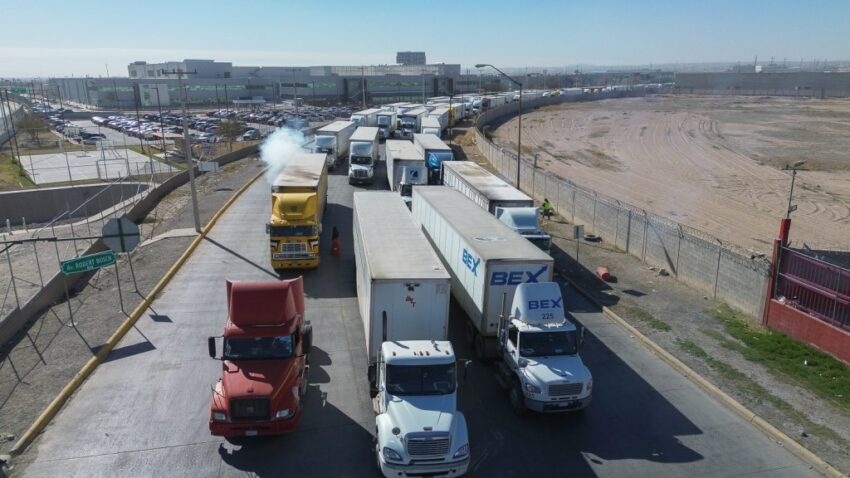
The wide-ranging tariffs that President-elect Donald Trump has threatened to impose on all foreign goods could cost the average U.S. household as much as $2,600 annually in the form of higher prices, and could “cripple” El Paso’s economy, according to the leader of a local business group.
Economists and El Paso executives said that new tariffs, especially on Mexican imports, without a doubt would raise prices that average El Pasoans pay for goods at the grocery store and elsewhere. But whether the Trump administration actually levies the tariffs that Trump has suggested is the big question.
Trump throughout his presidential campaign said he would target China with a tariff of 60% on all imports from that country, and a tariff of 10% to 20% on imports from anywhere else. Last week, Trump said on his first day in office he would place 25% tariffs on all imports from Canada and Mexico until the countries do more to stop migrants and drugs from crossing into the U.S. He also threatened a 10% levy on Chinese goods unless China cracked down on shipments of fentanyl.
“What is said during an election campaign is seldom reality once the campaign is over,” Alan Russell, CEO of Tecma Group, said in an interview with El Paso Matters. “Let’s think about this logically. If a 10% tariff was put on all Mexican imports into the United States, that means the American people will be paying 10% more for a whole lot of products.”
“The U.S. and Mexico are tied together like Siamese twins,” said Russell, whose company operates dozens of factories in Mexico. “You can’t produce a car, a television, a household appliance, you can’t build a house without Mexico, because of the vast amount of products, from light bulbs to wiring, are coming from Mexico.”
Trucks enter the United States from Juárez on the Bridge of the Americas. (Corrie Boudreaux/El Paso Matters)
Over $64.7 billion worth of goods have been imported from Mexico into El Paso this year through September, and in 2023, nearly $73 billion of goods from Mexico were shipped into the U.S. through El Paso, according to the U.S. Census Bureau. Electric machinery and vehicle parts make up the bulk of products imported through El Paso.
Closing China’s back door
Rather than a tariff on all imported goods, the Trump administration may instead look to impose tariffs on key goods from China, as well as on products that companies in China ship into Mexico and then into the U.S. to circumvent U.S. tariffs, Russell said.
“Do I see tariffs on imports from Mexico? As a broad statement, no. With the exception of dealing with China,” he said.
“Trump put tariffs on China imports and Biden left them in. China started seeking a backdoor entry through Mexico,” he added. “Those products get into the U.S. without any duty. So that’s where I think the administration will focus. They will stop that backdoor.”
Who pays the price on tariffs?
When a tariff is in place, it means that companies that import goods from outside of the U.S. pay an extra percentage on top of the exporters’ price, and that extra fee goes to the U.S. Treasury.
For example, if a 20% tariff on imports were in place, a product that a foreign exporter would charge $100 to ship to a company in the U.S. would actually cost the importer something like $120 to buy. And so the importing company would likely then raise the price for the product that it sells to its final customer, according to economists.
The actual impact of a tariff could be more diffuse: It’s possible an exporting company in a country such as Mexico or China could lower the price of the product it’s shipping to ease the tariff impact and keep the importer as a customer. It’s also possible the importer – say, Walmart or Target, for example – would shave off some of its profit margin and absorb a portion of the extra cost of the tariff.
But most likely, economists said, the importing company would raise the price of the product it imported and pass the extra cost from the tariff onto the end buyer.
“Because they act as sales taxes, tariffs will raise prices for all goods on which they are applied,” said Tom Fullerton, a professor of finance and economics at the University of Texas at El Paso’s Woody L. Hunt College of Business.
Trump has said his motivation to implement a blanket tariff is that by making foreign-made goods more expensive, companies are more likely to build the product in the U.S. And if U.S. companies build more products domestically, that means more jobs for American workers, and also more local supply chains that are less disrupted by big global catastrophes such as a pandemic.
And tariffs – essentially, import taxes paid by importers – could raise some extra money for the federal government to help offset tax cuts the Trump administration has said it plans to enact.
Making important products such as semiconductors domestically could also head-off the risk that another country stops selling semiconductors or other vital goods to the U.S.
Truck enter the American inspection area after crossing the Zaragoza Bridge from Juárez into El Paso. (Luis Torres/El Paso Matters)
That’s at least part of the thinking behind putting tariffs on foreign goods. Most economists, however, dislike tariffs because they raise costs that average consumers pay and lead to less consumption and economic growth.
If the Trump administration imposes a blanket tariff on all foreign goods, the Peterson Institute for International Economics calculated that middle-income U.S. households could pay between $1,700 and $2,600 extra per year, depending on the size of the tariffs.
Experts: Tariffs could cripple border economy, jobs
Tariffs on Mexican goods could lead to less trade with Mexico and fewer goods flowing through ports of entry here, which could hurt industries in El Paso that service cross-border commerce such as jobs in warehousing and transportation.
“If tariffs were imposed on Mexican imports, they would be crippling to all sectors of the Borderplex regional economy,” said Jon Barela, CEO of the Borderplex Alliance, an economic development and business advocacy group.
Barela said that doing less trade with Mexico would also lead to job losses among workers in Juárez, which would mean fewer people crossing into El Paso and spending money here.
“Because of the (U.S.-Mexico-Canada trade pact) and the increased trade and increased wages across our region, you have a burgeoning middle class in Mexico. And they are coming across the border to our restaurants, shop in our stores and stay overnight in our hotels,” Barela said.
“So, our service sector would be crippled because those manufacturing jobs would be killed overnight almost. And of course, our warehousing and logistics jobs on the U.S. side would also be devastated,” he said. “So be careful, from a Washington standpoint, about killing the golden goose.”
Fullerton and other economists said imposing tariffs would probably not actually entice companies into investing to build more products in the U.S. Instead, Fullerton said, tariffs could lead to “stagflation,” where there’s high price inflation and minimal economic growth.
“There’s not the capacity in the United States to move all of this business and re-shore it into the United States,” Russell said. “We’ve got to have Mexico.”
Countries may respond with retaliatory tariffs
The other problem is that Mexico or other foreign countries could respond to U.S. tariffs by imposing their own retaliatory tariffs, which would make U.S. goods less attractive for other countries to purchase.
When the U.S. and China got in a tariff tit-for-tat in 2019, China stopped purchasing U.S. farm goods and Texas farmers saw their storage bins swell and crops go unsold. The U.S. provided tens of billions of dollars in subsidy payments to farmers to help them weather that trade war.
However, economists and business people acknowledge there is a major difference between the Trump administration putting tariffs on China – a rival and U.S. adversary – versus levies on goods from Mexico, an ally and the U.S.’ biggest trading partner.
Traffic at the Bridge of the Americas stalls on a daily basis. (Cindy Ramirez/El Paso Matters)
The U.S., Mexico and Canada have been knitted together through large-scale trade agreements that eliminated import duties since the North American Free Trade Agreement (NAFTA) was ratified in 1994 and then updated as the U.S.-Mexico-Canada Agreement (USMCA) that the three countries adopted in 2020.
Under the USMCA, components such as car parts bounce back and forth across the U.S.-Mexico border until the final product – a vehicle, in this case – is assembled in a factory in one of the two countries.
So, a tariff on Mexican imports “makes it more expensive to get the parts you need to finish your product,” said Raymond Robertson, a professor at Texas A&M University and director of the Mosbacher Institute for Trade, Economics and Public Policy.
That could lead to American job losses as companies here face higher prices for components they need, such as wire harnesses, he said.
“If the price of wire harnesses goes up, we’re going to buy fewer of them. And if we have fewer wire harnesses, we don’t need as many workers to be putting them in,” Robertson said. “Why can’t we make the wire harnesses? We definitely could do that, but the price of the wire harnesses are then going to be double or triple what they are now.”
Because of the USMCA, U.S. and Mexican workers generally don’t compete with each other – Ford, General Motors and other U.S. automakers operate massive factories within Mexico.
Instead, workers in the U.S. and Mexico together “compete with Japan, they compete with Germany, they compete with Europe. They’re going to be competing with China,” Robertson said.
“And, so, we need the support of the Mexican workers to complete the supply chain in order to compete more effectively with other countries,” he said.
Fullerton said tariffs probably wouldn’t generate enough revenue for the federal government to offset tax cuts that the Trump administration plans to enact.
The Peterson Institute estimated that extending the Tax Cuts and Jobs Act that Congress passed during Trump’s first term in 2017 would increase the U.S. budget deficit by $5 trillion over the next 10 years. An estimate from Bloomberg Economics suggests new tariffs under the Trump administration could generate $250 billion in annual government revenue, roughly half of what’s needed to pay for the administration’s planned tax cuts.
And if tariffs do induce companies to shift production back to America, the incoming Treasury Secretary Scott Bessent has said new domestic factories or production facilities could generate additional tax revenue for the U.S. government.
Tariffs a tool to curb migration, drug flow
Some in El Paso’s business community see the Trump administration’s threat of import tariffs on Mexican goods as the first move in a negotiation to ultimately get the Mexican government to curb migration and the flow of illegal drugs – mainly the opioid fentanyl – into the U.S. Trump in 2019 similarly suggested the U.S. should place tariffs of 25% on Mexican imports. The U.S. adopted the USMCA trade deal just months later.
“(Trump) didn’t really mean the things he was saying (in 2019). He was just saying them to get people off their center – to unbalance people,” Robertson said. “That works the first time. That doesn’t work the second time.”
The Southwest border has seen a significant decline in unlawful border crossings since June when President Biden issued an executive order that severely restricted asylum. Migrant encounters between ports of entry at the U.S.-Mexico border have decreased more than 55% from June to mid-November, U.S. Customs and Border Protection reported. Encounters at the northern border with Canada dropped 64% from June to October, CBP said.
Trump has threatened mass deportations of immigrants lacking permanent legal status in the U.S., though how those would be managed and what impact they would have on attempted illegal crossings also remains to be seen.
Mexican President Claudia Sheinbaum responded to Trump’s tariff threat by saying Mexico could place tariffs on U.S. exports shipped into Mexico. The U.S., Mexico and Canada are set to renegotiate the USMCA in 2026.
The past round of tariffs that Trump’s administration implemented in 2019 – mostly on goods from China such as steel, aluminum and washing machines – didn’t revive U.S. industries that were harmed by low-cost Chinese imports, according to a study published in January by researchers at the National Bureau of Economic Research.
“The trade-war has not to date provided economic help to the US heartland: import tariffs on foreign goods neither raised nor lowered US employment in newly-protected sectors,” the authors wrote. “Retaliatory tariffs had clear negative employment impacts, primarily in agriculture.”
Still, the view among conservative thinkers such as Robert Lighthizer, the U.S. trade representative during Trump’s first term, is that lower-priced foreign imports hollowed out the economies of U.S. towns that employers left to set up shop overseas in order to capture bigger profit margins. Since then, cheap imported televisions and T-shirts have done little to help displaced American workers and revitalize emptied towns, the thinking goes.
Americans who lost their jobs amid a flood of imports from countries such as China “could not quickly shift to other jobs, though many did shift onto ballooning disability rolls or slide into drug addiction,” Oren Cass, an economist who leads American Compass, a conservative think tank, wrote in an anti-free trade essay.
Despite signs of a potential trade war on the horizon, Russell of Tecma Group said he sees trade and the exchange of goods between the U.S. and Mexico continuing under virtually any circumstance.
“Nothing’s going to stop the trade,” Russell said.
“If you implemented duties and tariffs on products coming from Mexico, the American public is going to pay more for those products. You’re still going to buy your coffee maker. You’re still going to buy your car,” he said. “You’re not going to like it. It will slow the U.S. economy down, and it will slow everything down. But it’s not going to stop.”
The post How Trump tariffs could affect El Paso’s economy appeared first on El Paso Matters.
Read: Read More