



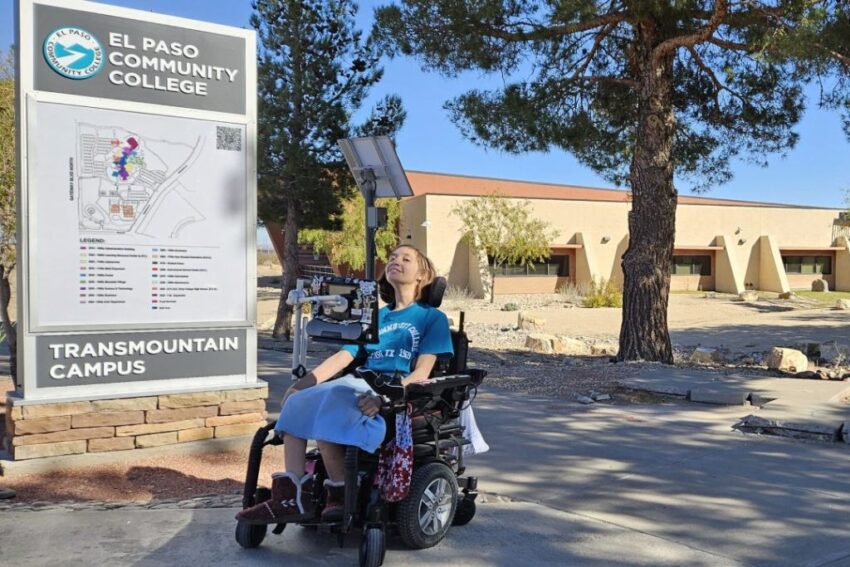
A young woman with big dreams graduated from high school last spring with a desire to continue her education at El Paso Community College. Her first semester went well academically, but her main disappointment was the social isolation she felt.
To Monica Rodriguez, her observation was more a statement than a complaint.
Monica, who has cerebral palsy, got around EPCC’s Transmountain Campus in an electric wheelchair and talked through a Tobii Dynavox speech generating device.
Her plan for the spring semester is to ace her classes – Public Speaking and Mathematics for Business and Social Sciences – and to work harder to make friends.
Monica, 18, understands that the devices she uses might be off-putting to other students initially, but those who work with her in class quickly discover that she can offer keen observations and a wry sense of humor.
“The hardest adjustment I had to college was the lack of friends I had during the semester,” Monica wrote during an email interview a few days after her last class. “I’m a very sociable person with people that I know well, but I didn’t get to know other people (at college) as much as I would have liked.”
While the multidisciplinary studies major saw the past semester as a growth opportunity, a recent national study showed that loneliness is a factor that can negatively affect college students.
Monica Rodriguez uses a Tobii device to deliver a speech to her classmates at the seniors’ award night at Young Women’s STEAM Academy, May 30, 2024. (Corrie Boudreaux/El Paso Matters)
A survey on college students’ mental health published in Inside Higher Ed last February found that successful students often had healthy habits: They ate well, got enough sleep and socialized. Students who struggled dealt with more stress and loneliness, the 2023 survey by the College Student Mental Wellness Advocacy Coalition and the Hi, How Are You Project found. The survey involved almost 30,000 students.
The solution for students such as Monica is to initiate more contact with peers, staff and faculty, said Lolo Mercado, an EPCC counselor at the Transmountain Campus.
“Sometimes you have to force yourself to be part of campus,” Mercado said.
The counselor said some students go from the parking lot to the classroom to the parking lot. Many times this is due to jobs and family responsibilities, but he tries to impress on students that campus involvement leads to retention and graduation.
He encourages students to introduce flex time into their class schedules to allow them to visit campus services and programs such as the library, student clubs, campus activities, tutoring centers, the financial aid office and the police department.
Mercado said that he knows that people with disabilities could feel ignored by their peers, and that the recent pandemic made some students less interested in interactions.
Monica said that she found it harder to connect with her classmates because they did not share her personal interests such as reading, texting family and friends through Facebook Messenger and Instagram, and her Avon business.
While initially shy in class, Monica quickly became an eager participant, said Vanessa Rojas, an academic resource specialist in the Transmountain Campus’ Center for Students with Disabilities. She was Monica’s note taker in her Composition I class.
“Monica was not afraid to work in groups, go over (classmate’s) essays, and offer ways to improve them,” Rojas said. “Students were initially hesitant to work with her, but the process helped them get familiar with her. She can be very funny.”
Because of the transition from high school, Monica and her parents agreed that she should take only one class. She got an “A” in her course, but did not feel challenged academically. Her final was a three-page research paper about one of her passions: children affected by food insecurity.
While happy with the good grade, she missed the pace and camaraderie from her days at the Young Women’s STEAM Research & Preparatory Academy, an El Paso Independent School District campus. She went from eight classes per day five days a week to one class for a few hours three days a week.
She said a bright spot was being accompanied by her older sister, Lucy, who helped where necessary academically and personally. It helped her feel less isolated and more confident.
“A lot of people just see (Monica’s) chair,” said Heather Rodriguez, Monica’s mother. She said her family may have been overly cautious with the transition, but expects the spring semester to be a bigger challenge. “Monica was bored because we underestimated her in what she could do and how independent she could be.”
The mother said Monica thought college was going to be a social extension of high school. The reality saddened her.
Monica Rodriguez, 18, and her parents Alfredo and Heather Rodriguez search for files in her speech-generating device at their Northeast El Paso home. (Daniel Perez / El Paso Matters)
“She’s been struggling a little bit with the lack of friends,” said Heather, an educator and administrator at a private school. She and her husband, Alfredo, an EPCC math professor, are raising five daughters. “(Monica’s) a people-person. She hasn’t found her niche yet. We’re still working on that.”
To fill her time and her need for socialization, Monica scheduled visits to the Salubris Adult Day Activity & Health Services, 8434 Dyer St., and the Volar Center for Independent Living, 1220 Golden Key Circle. The topics at the weekly Volar meetings have included self-advocacy, inclusivity of people with disabilities, financial responsibility, and how to be involved in the community. She also became an Avon representative to earn money. She markets her business on social media, and takes orders by phone and emails.
Monica, who hopes to open and help operate a bakery truck, plans to apply for EPCC’s Project Higher, out of the Valle Verde Campus. The program assists people with intellectual and developmental disabilities to earn a level-one certificate and get help to find employment in their field. Level-one certificates normally require one year of coursework. Students earn them after the successful completion of specific courses industry has validated.
Monica plans to focus on business and hospitality courses, and expects the program to make her a better self-advocate in college and beyond.
In terms of advocacy, Monica said she registered for the public speaking course to raise awareness about cerebral palsy, a neurological disorder that influences the development of people’s speech and mobility. The condition affects fine motor skills, stiffens muscles and reduces range of motion. The National Library of Medicine called it one of the country’s most common childhood disorders. It is caused by damage to the brain before or during birth or in early infancy. There is no cure.
“I want to talk about cerebral palsy to people who want to learn more about people like me and how to treat us,” Monica said.
Alma Valadez, the campus’ Center for Students with Disabilities counselor, called Monica a driven, goal-oriented student with a good attitude. She said the student had the typical freshman jitters, but that she appeared to be tenacious, and that is part of what makes a successful college student.
“She knows what she wants,” Valadez said. “It will take her a little longer to finish, but for sure she’ll get there. She’s amazing.”
Valadez also mentioned the role of technology in Monica’s journey. She said advancements in the tools she uses could accelerate her time to completion and enhance her employment opportunities.
Speaking of technology, Valadez recalled one time she almost collided with Monica in a campus hallway and the student jokingly threatened to run her over.
“She’s a pleasure to have,” Valadez said.
The post ‘I want to talk about cerebral palsy’: EPCC freshman hopes classmates see past her wheelchair appeared first on El Paso Matters.
Read: Read More