



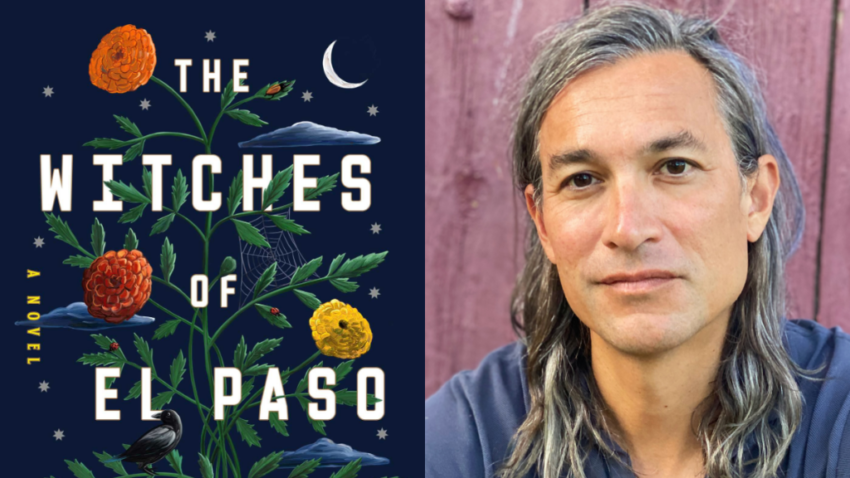

Luis Jaramillo’s latest novel, “The Witches of El Paso,” takes readers on a journey through the past and present of the U.S.-Mexico border. A tale of love, family and the unseen forces that shape our lives, the book follows Nena, a teenager in 1940s El Paso discovering her supernatural abilities, and her grandniece Marta, a present-day lawyer grappling with her own emerging powers. Together, they navigate family bonds, personal transformation, and the mystical currents connecting them across time and space. Blending historical richness with magical realism, Jaramillo captures the unique spirit of the borderland — a place where cultures and worlds converge.
The book is the latest selection of the El Paso Matters Book Club. The club will host a free writing workshop featuring Jaramillo from 1 to 2:30 p.m. Friday, Feb. 28, at El Paso Community College’s Rio Grande Campus, Building A, Room A119. The free, interactive session will take place in conjunction with “Chrysalis,” EPCC’s literary and arts journal. The El Paso Matters Book Club will subsequently host its meetup with Jaramillo from 11 a.m. to noon Saturday, March 1, at Barnes & Noble, 8889 Gateway Blvd. West No. 120. This free event includes a moderated discussion about the novel, followed by a live discussion with Jaramillo.
In this Q&A, Jaramillo delves into the inspiration behind his work, El Paso’s bicultural identity, and the interplay of realism and the supernatural in his storytelling. With its exploration of borders — both literal and metaphorical — “The Witches of El Paso” is a love letter to the region and a testament to its enduring magic.
Q: For those who aren’t as familiar with you, can you tell us a little bit about yourself?
A: Along with “The Witches of El Paso,” I’ve also published a book of short stories, “The Doctor’s Wife.” For over 20 years, I’ve taught writing at the New School in Manhattan. This is very far from where I was born, Salinas, California. When I was in first grade, my family moved to El Paso, my father’s hometown, to be close to my grandparents. My grandfather was ill, and my dad got a job as the director of El Paso Legal Assistance. It was a formative year for me — maybe the first that I can remember with clarity. The school I attended, Polk (Elementary) School, had just opened, and we lived in a new house in West El Paso on what was then the edge of the city. I remember walking across the street to play in the sand dunes. After that year, my family moved back to California, but every summer and at holidays, we would come back to El Paso to visit my grandparents and other relatives. Even though I’ve lived in New York for 25 years, I still think of home as being in the west.
Q: What are some key themes you would like readers, particularly El Pasoans, to take away from your book?
A: When writing the book, I thought a lot about borders, physical and metaphysical. In El Paso, the border between the United States and Mexico is somewhat porous. There are people who cross the border every day for work, for school, to shop, or for entertainment. It’s easy to cross into Mexico — you can walk across a bridge and be in another country within minutes. I find this miraculous, and also a useful metaphor for the other kinds of borders I write about — the border between life and death, the border between two people, the border between one stage of life and the next. I don’t need to tell El Pasoans that borders of all kinds are not as fixed as they may appear. This is a book about becoming aware of the knowledge that our lives are not bound in the ways that we may think they are.
Q: What’s your favorite line in the book and why?
A: “Then she was a flea sucking the blood of the mouse, and she was a creature even smaller that the flea, a flea’s flea, and then she was smaller, a germ, no thoughts, just a feeling of life, of living, and then she was Nena sitting up in a chair in Madre Inocenta’s office, alive, Nena, but more awake, with a new way to see and hear and smell.”
I think that writers should only use poetic language when something very important is happening in a book. I am a writer who revises a lot, but this sentence arrived fully formed. Over the course of the sentence, the character Nena’s life changes irrevocably. This is what a story is — a series of irrevocable changes.
Q: El Paso is central to the title. How does the setting influence the story? What is something unique about El Paso that inspired or is portrayed in your book? What drew you to this particular location?
A: I wrote the book in part as a love letter to El Paso. As a kid, I was fascinated by how different El Paso was from where I grew up in California. El Paso is a truly bi-cultural place. It was exciting to visit because I had a ton of family members in El Paso. Even people I wasn’t related to were referred to as cousin. That felt very rich when I was a kid. In the book, I wanted to capture that feeling of being in a place where the connections between people are deep and complex.
Q: “The Witches of El Paso” blends supernatural elements with the real-life culture and history of the border region. How did you approach weaving these two aspects together in the story?
A: When I first started writing the novel, there were no supernatural elements. The characters were based on my grandmother and her sisters, natives of El Paso who were very colorful people, great storytellers, El Pasoans from birth on. But one day, Nena, one of the two main characters, appeared in a scene. Nena throws open the door to the kitchen, marches over to the table where her sisters are sitting, and grabs an Oreo, scraping the cream out of it with her teeth before picking up a teacup to read someone’s future. At first I resisted writing about a character who could see things other people couldn’t, who could talk to the dead. After a key reader pointed out that this was where the energy was in the draft, I changed course and just went for it with the magic. But it was important to me to balance the wild place the book goes with a story that is also rooted in realism. There are plenty of very real issues that I wanted to write about: patriarchy, immigration and racism. I also wanted to write a book that would allow a reader who was less inclined to read about magic to be led into the world. The character Marta, Nena’s great-niece, is a legal aid lawyer who is Nena’s caretaker and whose main case has to do with sexual harassment. She is very practical, rational and skeptical, but she’s also in a sort of crisis, facing down middle age. It’s at these moments of transition in our lives that we are able to see that what seems like a fixed reality is more complicated, and we are called on to create something that no one else can.
Q: What kind of research went into writing the book? Did you dive into folklore, historical witch trials or local myths?
A: I did so much research! I read a ton of books — fiction, academic books, contemporaneous historical accounts, and I visited El Paso and New Mexico and Juárez and talked to all sorts of people, including a lot of relatives. My family has lived in El Paso and New Mexico for hundreds of years, so some of the stories and folklore I knew from growing up haven’t changed since basically colonial times. There’s a cultural way of storytelling in the region that acknowledges the supernatural.
There’s also a family history of second sight. The first time my grandfather visited my uncle’s house in California, he looked up in the corner of the dining room and greeted the spirits that lived there. Another time, he and my grandmother were waiting for my aunt Gloria to arrive at the airport in El Paso. Before Gloria came into view, my grandfather clutched my grandmother’s arm and said, “Gloria has a baby.” When Gloria exited the jetway, she was in fact holding a baby. That baby was me. When I was doing my research, I found that one of my ancestors from New Mexico was accused of witchcraft in 1604.
Part of the book is set in the 18th century in a convent in El Paso del Norte, current day Juárez. I knew nothing about convents in colonial Mexico until I read every book I could get my hands on. Some of the most useful books had to do with the food in convents. Another book had a lot of very practical details about what the daily schedule of a convent looked like, what work nuns did, and how convents were organized by hierarchy and architecture. I think it’s important to note here that there wasn’t a convent in El Paso del Norte then — I had to remind myself that I was writing fiction, and that I could do what I wanted with the research. At the same time, I needed to honor the place and the people I was writing about. Even as I bent the facts, I still wanted to adhere to a kind of poetic truth about El Paso and the region.
Q: The concept of witches can carry cultural, spiritual and historical weight. How do your witches differ from traditional depictions?
A: A lot of people asked me when I was writing this, “El Paso? You’re not writing about witches in Salem?” When writing about witches, I drew from books I’d read as a kid and as an adult, but I also included cultural references for a magic that is a mix of indigenous and Catholic traditions. In the novel, the characters visit the Cuauhtémoc Market in modern-day Juárez. The market is a big building with stalls selling items used in folk medicine and shamanism — maybe you’ve been? For sale are things like herbs, peyote root, Santa Muerte figurines, dried bat rays, and skunk skeletons with the black and white tails still attached, things definitely used in brujeria. Throughout the novel, characters insist that they are not witches. “Witch” is a term that, until relatively recently, has been placed on women who were healers, midwives, brewers of beer or even just women living their lives, while those in power used unjust laws to keep them in their places. The witches I write about in the novel are women who assert their power through any means available.
Q: What has been the most surprising or memorable reaction you’ve received from readers about “The Witches of El Paso?” How has the response to the book surprised you so far? Have readers reacted in unexpected ways?
A: In November, I read at Brave Books, and close to 250 people showed up. At the reading I got to talk to a lot of people who had read the book, and many told me that I’d captured something essential about El Paso. This was a huge relief — I’d wanted to give El Paso the respect it deserves. Another fun thing has been that everywhere I’ve read around the country, someone from El Paso has been in the audience. The El Paso diaspora is widespread, and they love their hometown.
Q: What’s next for you? Any upcoming projects or aspirations?
A: I’m working on a novel set in Salinas, California, where I grew up. It’s about the birth of the lettuce industry, and there’s a gay marriage plot. I’ve also been working on a novel, a thriller, set in the Caribbean featuring sailboats, class warfare and grifters.
Q: Can you recommend three books by El Paso authors for our readers?
A: “Everything Begins and Ends at the Kentucky Club,” Benjamin Alire Saenz; “Hotel Juárez,” Daniel Chacón; “Ringside Seat to a Revolution: An Underground Cultural History of El Paso and Juárez, 1893-1923,” David Dorado Romo.
The post El Paso Matters Author Q&A: ‘The Witches of El Paso’ Author Luis Jaramillo appeared first on El Paso Matters.
Read: Read More