



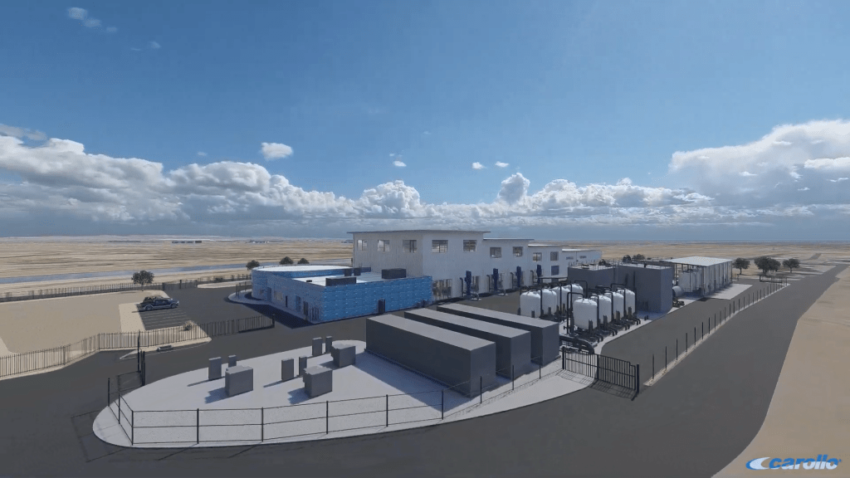

By 2028, El Pasoans will begin receiving water from a $295 million advanced water purification plant that will convert treated wastewater into drinking water, the first facility of its kind in the nation, El Paso Water officials said.
The concept of treating sewage water to drinkable standards and returning it back into a city’s drinking water system is far from new. But El Paso will be the first city with a large-scale treatment plant that treats wastewater to drinkable standards and then deposits the water directly back into the city’s drinking water system.
El Paso Water’s new facility, called the Pure Water Center, will sit next to the utility’s R.R. Bustamante Wastewater Treatment Plant in the Lower Valley, just south of the Ysleta-Zaragoza International Bridge. The plant will produce up to 10 million gallons of drinking water per day when it’s up-and-running. That’s enough to meet about 9% of the city’s demand for water on an average day.
“This is the ultimate level of water recycling,” said Gilbert Trejo, El Paso Water’s vice president of engineering, operations and technical services. “What’s the most efficient and cost-effective way to produce a drought-proof, drought-resilient water source? It’s this project.”

El Paso Water secured $23.5 million in two federal grants from the U.S. Bureau of Reclamation to help fund the project. Customers, however, are paying for most of it, and the cost of building the new drinking water plant – as well as expanding the Bustamante facility – are two of the main reasons water bills continue rising annually in El Paso.
The water utility is investing to build the Pure Water Center to make sure the city always has drinking water available, regardless of how much water flows through the Rio Grande into El Paso every year.
Rio Grande flows have become increasingly varied and unreliable year-to-year. In 2020, water from the Rio Grande supplied 38% of El Paso’s water. But in 2021 and 2022, the river supplied just 14% and 17%, respectively, of the city’s water supply. In 2023, river water provided 31%.
Many cities for decades have utilized plants that treat wastewater into drinking water, then release the water back into the environment – such as a riverbed or reservoir – and re-capture the water months or years later and place it back into the drinking water system.
“The modern practice of water recycling really got going in the United States in the 1960s and 1970s,” said David Sedlak, a professor of environmental engineering at the University of California, Berkeley.
He pointed to a water recycling plant in Orange County, California, that produces 70 million gallons of drinking water daily from wastewater, and has been recycling wastewater since the 1970s. Another treatment plant in Northern Virginia began utilizing potable water reuse technologies in the late 1970s to provide drinking water to the suburbs of Washington, D.C., amid population growth.
And since 1985, the Fred Hervey Water Reclamation Plant in northeastern El Paso County has converted millions gallons of sewage every day into potable water that’s used for industry and irrigation, but also to be pumped back into the underground Hueco Bolson aquifer that’s a key source of drinking water for El Paso.
“El Paso Water customers have known and have been supporting water recycling projects since the 1960s, when the first drop of reclaimed water reached Ascarate Golf Course. And then Fred Hervey Water Reclamation facility in 1985,” Trejo said.
The difference between El Paso Water’s new Pure Water Center – called a direct potable reuse facility – and similar indirect potable reuse water treatment plants like the Hervey facility is that this new plant in El Paso removes the “environmental buffer.” That means the treated wastewater goes directly into the city’s drinking water system instead of out into the environment first.

Sedlak said the environmental buffer has been a kind of psychological barrier that’s made indirect potable reuse acceptable to water consumers in the U.S. for years. Still, water pumped directly back into the drinking water system may be cleaner than water released into nature and later recollected, he said.
“Culturally, people feel very comfortable with the idea of putting the water in the environment and retaking it,” Sedlak said.
“Until people started thinking about, ‘Gee, you know, sometimes when we put the water out in the environment, it gets dirtier,’” he said. “You put it out in a river or lake or reservoir, and that lake or reservoir has got agricultural drainage water coming in, or it’s got housing or it’s got industry upstream, and suddenly the water gets dirtier.”
Customers often prefer the taste of recycled water because it’s more purified and has less salt than most other water sources, especially in cities in the southwestern U.S., Sedlak said.
The treatment process at the Pure Water Center will involve four steps: membrane filtration and then reverse osmosis, which is also the main treatment process at the Kay Bailey Hutchison Desalination plant. After that, the Pure Water Center will also feature UV advanced oxidation technology that breaks up contaminants, and the final treatment step is granular activated carbon filtration that removes mostly organic chemicals.

“The heart and soul of this new facility is reverse osmosis membranes, not only desalinating the water but removing everything else that we don’t want in the water. Either pathogens, viruses, emerging contaminants, everything that a lot of our customers are concerned about,” Trejo said.
The new water purification plant will feature hundreds of instruments that will measure water quality and potential contaminants in real-time at each stage of treatment. Real-time monitoring is a new feature for water treatment plants in El Paso, and it’s designed to identify any water quality problems or contaminants well before anything exceeds hazardous levels, Trejo said.
“At any point, if a pathogen is suspected by any of the tests, (it causes) automatic shutdown and it requires public notice. So, the regulators … have told us, ‘OK, we understand that there’s a need for this reuse plant.’ And not just us, throughout the country,” said Angel Bustamante, El Paso Water’s wastewater systems division manager. “However, they’re making sure that there’s a lot of safety protocols.”
It will cost El Paso Water just under $500 to produce an acre-foot of water – about 326,000 gallons – at the Pure Water Center, according to estimates from the utility.
That price is “right in the middle of the costs for our water supply, with importation being on one end, and just your normal groundwater being on the other end,” said John Balliew, El Paso Water’s chief executive. “It’s a good value.”
Pumped groundwater is the cheapest source of water for El Paso Water to produce at a cost of $254 per acre-foot, followed by surface water drawn from the Rio Grande and treated, at $342 per acre-foot.
Water produced at the Kay Bailey Hutchison Desalination Plant also costs $500 per acre-foot. El Paso Water estimates an acre-foot of water would cost $1,300 to import from outside the city.
Sedlak, of UC-Berkeley, said it’s likely other cities – especially arid, dry communities – will soon start building direct potable reuse plants similar to the one El Paso Water is building.
The science of recycling wastewater into drinking water is sound, he said.
“I can’t imagine, from what I’ve seen of the design, that there’s going to be any problem with it,” Sedlak said of the Pure Water Center. “I really think it’s a question of whether the community accepts it.”
El Paso Water is the first utility in the U.S. to take on this kind of project, and Sedlak said lighter regulations in Texas likely made it easier to move forward than it would have been in a more regulation-heavy state, such as California.
“This is a growth industry. It’s happening everywhere in the country these days. So, we’re going to see a lot more of these,” Sedlak said of direct and indirect potable reuse facilities. “The real issue is how common direct potable reuse will become. And in some ways, all eyes are on El Paso to see that this project goes well.”
The post As it seeks to drought-proof El Paso, city’s water utility breaks ground on first-of-its-kind water recycling plant appeared first on El Paso Matters.
Read: Read More