



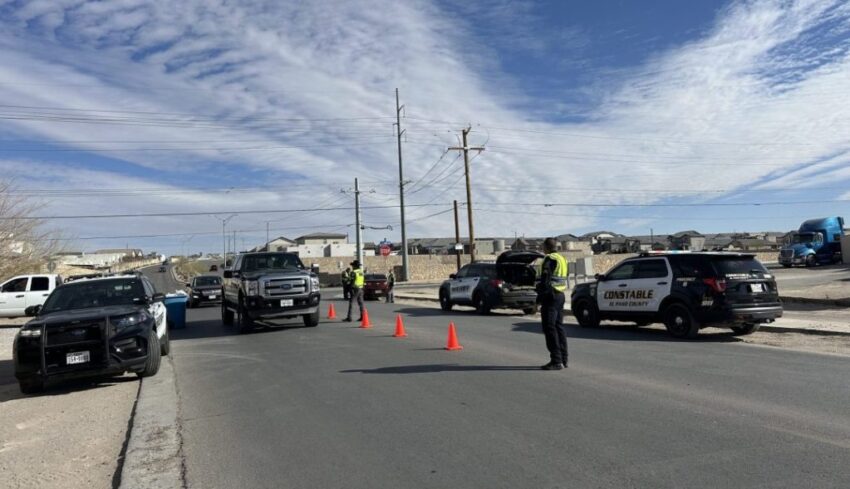

On a quiet Monday morning in the unincorporated area of Sparks, workers at the Centro Comunitario Socorro Ramirez noticed sheriff deputies pull up in the parking lot.
Shortly after, they noticed several more in the Far East El Paso region and went to ask what was going on. The El Paso County Sheriff’s Office set up a stationary vehicle check on Peyton Road in front of the center to check that drivers had valid driver’s licenses and insurance.
“I work right at the front desk,” Leticia Favela said. “At first I saw two officers then suddenly there were a lot more so I thought – this isn’t right. I went to ask them what they were doing and they said they were just checking (for) driver’s licenses.”
During the March 3 traffic checkpoint, sheriff deputies, in partnership with the Precinct 6 Constable’s Office, stopped 80 cars and issued drivers multiple citations for violations, including for not having a driver’s license or for having expired vehicle registration, a stop sign violation and illegal window tint. Two people were also arrested on outstanding Sheriff’s Office traffic warrants.
Favela said members of the center were nervous about the operation and they quickly mobilized to warn the neighborhood through social media channels and phone calls to avoid the area if they were scared.
The checkpoints have raised questions about their legality – which civil rights groups say are constitutional and permissible to check for driver’s licenses, insurance and registration. Others have expressed concern that local law enforcement officials might be conducting immigration checks since President Donald Trump issued multiple executive orders cracking down on illegal immigration. The Sheriff’s Office has said this is not the case.
El Paso County Sheriff Oscar Ugarte, who took office Jan. 1 weeks before Trump began his second term, said the checkpoints in the county are not new and reiterated that deputies do not inquire about citizenship status.
“When I did the one last month in Montana Vista, obviously a lot of the community was concerned. They were a little bit scared and I started to get a lot of questions from the nonprofits,” Ugarte said.
Federal immigration enforcement officers are not involved in the checks, Ugarte added.
The Horizon City Police Department has conducted similar traffic checkpoints, with officials also stating they’re not inquiring about citizenship status. The El Paso Police Department hasn’t conducted such checkpoints in nearly 20 years, officials said.
Deterring unlicensed, uninsured drivers
In 2024, the Sheriff’s Office under Ugarte’s predecessor Richard Wiles conducted 10 stationary vehicle checks and issued 127 citations. The majority of citations were for no driver’s license, but citations were also issued for expired registration, no front plates and no safety belts, among others.
This year, the Sheriff’s Office has conducted two checks and has issued 27 citations, 17 of which were for not having a driver’s license.
RELATED: Oscar Ugarte discusses first several weeks as El Paso County sheriff
Sylvia Mendiola, who lives in Sparks, had to drop off her child at school when she stopped in the Sheriff’s Office check. She had forgotten her purse at home and did not have her driver’s license with her.
“I think I was the first person they stopped,” Mendiola said.
She said she was not worried, but a little surprised at the stop. She provided deputies information they requested, including her date of birth and address. Mendiola said the officers confirmed her information and gave her a verbal warning. She went on her way.
Ugarte said the Sheriff’s Office is not pulling in extra resources to conduct the checkpoints.
The Sheriff’s Office generally has five patrol deputies, three traffic deputies, one patrol sergeant, one traffic sergeant, five marked patrol units and three traffic enforcement units during the operations.
“We’re using the deputies that are already working on shift, and then the additional people that help us are the traffic units, the motor traffic units, so those guys, they’re (already) out there,” he said.
Ugarte said the department hasn’t established a way to measure the initiative’s success, but said he believes it’s effective because it deters people from driving without a license or insurance. He also said that with law enforcement presence, drivers tend to follow traffic laws: They control their speed, wear their seatbelts and make complete stops, he cited as examples.

Ugarte said the checks are also not targeting low-income areas.
Rather, he said, the checkpoints are set up in areas that the Sheriff’s Office has jurisdiction over and in areas where people who are pulled over for traffic violations or who are in car accidents often don’t have driver’s licenses.
He also said the checks are generally done during the day and not on main roadways to avoid creating traffic congestion.
Horizon City Police Officer Vivian Heredia said the Horizon police officers also do not inquire about immigration status during the traffic checks. Most recently, checks were conducted on Feb. 22 and another March 1 on Darrington Road, according to a social media post by the department. Figures on how many citations were issued were not immediately available.
SEE ALSO: Is ICE allowed to carry out immigration enforcement in El Paso schools?
In 2024, the Horizon City Police Department issued 1,761 citations for no driver’s license as well as citations outside of the stationary vehicle checks for failing to maintain insurance and expired registration, according to the Facebook post. The post did not indicate whether the citations were issued at checkpoints.
Sgt. Christian Arredondo with the Horizon City police said the checks are an effective tool to ensure drivers have insurance and are financially responsible in case there is an accident.
“It gives us a tool to really help the community more so than affect them, because ultimately, anybody driving without financial responsibility – victims of car accidents that are not at fault do bear the burden of that financial responsibility when they’re involved with them,” Arredondo said.
Arredondo said the vehicle checks aim to prevent that as much as possible. He also said issuing citations is at the officer’s discretion and drivers that are in violation are also given warnings.
“It’s a preventative, proactive measure, just to ensure that everybody’s driving as safely as possible. Of course, financial responsibility in the state of Texas is a legal obligation if you are going to be operating a motor vehicle. So, we do regulate that as much as possible,” he said.
Both Arredondo and Ugarte said the checks are generally placed near intersections where drivers have the opportunity to avoid the stationary vehicle checks.
The El Paso Police Department has not conducted stationary vehicle checks for driver’s license and insurance since 2007, police spokesperson Stephanie Shields said in an email response to El Paso Matters.
Shields said she doesn’t rule them out, but said they take a lot of manpower and resources within the department.

Are the traffic checkpoints legal?
American Civil Liberties Union of Texas attorney Sarah Corning said the checkpoints are constitutional and are permissible under Texas law, adding that driving without a license in Texas is an arrestable offense.
She said the ruling was decided in Holt v. State of Texas in 1994. She said if the state followed that requirement and came up with uniform standards, it might become constitutional.
While stationary vehicle checks for driver’s licenses or insurance and registration are legal, Corning said DWI checkpoints in Texas are unconstitutional. That’s because the state has not established uniform procedures for conducting DWI checkpoints, she added.
Stationary vehicle checks could lead to an arrest if an officer has probable cause that a crime is being committed, like driving while intoxicated.
“The number one advice is to stay calm and remember your rights,” Corning said.
Corning said drivers should stop, turn off the car, turn on the internal light, open the window part way and place their hands on the wheel.
She said if you’re stopped and you’re asked for license and registration – if you have it, you need to show it. She said if you’re stopped and you don’t have your license, the officer might ask for your name, driver’s license number, residence address and date of birth (and) you should give it.
She said if you don’t have any of that – don’t lie.
“Don’t give false documents. If the officer asks to search your car, you can refuse. But if they see or believe your car contains evidence of a crime, they can search it without your consent,” Corning said.
She also said both the driver and passengers have the right to remain silent.
Passengers can also ask if they are free to leave if the stationary vehicle checks are checking for the license and insurance of the driver.
“You have the right to remain silent. You do not have to answer them, including any questions about your immigration status,” Corning said. “Everyone has these rights, regardless of immigration status: the right to remain silent, the right to refuse consent to search your car or your home. We want to make that super, super clear, because there has been confusion around what rights undocumented people have. Undocumented people have these rights, period.”
Corning said it is important to remember all of those things.
“My general advice is to act calmly in any situation with law enforcement,” Corning said.
The post Are traffic checkpoints legal? El Paso sheriff’s driver’s license checkpoints prompt concerns appeared first on El Paso Matters.
Read: Read More