



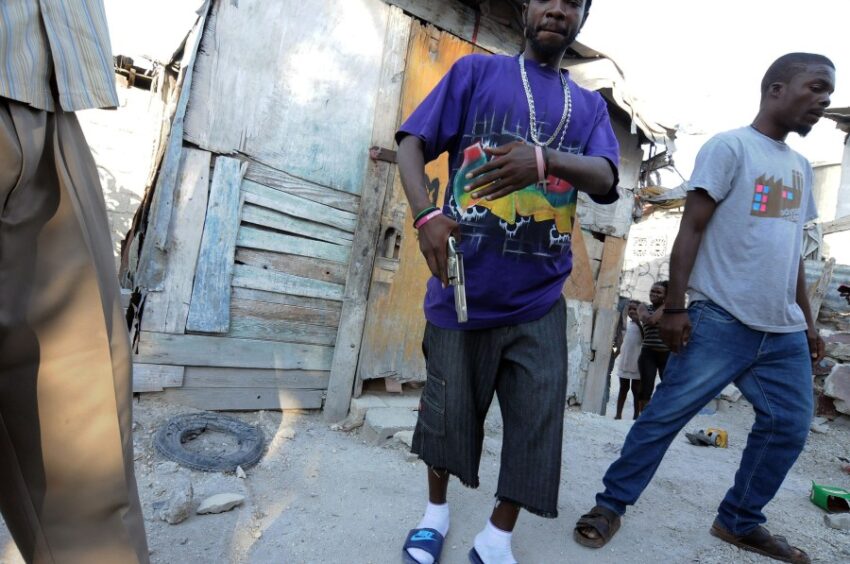
EL PASO, Texas (Border Report) – A coalition of activists wants U.S. officials to crack down on the trafficking of American guns to Haiti. They say this is exacerbating brutal gang warfare that has internally displaced tens of thousands and forced many others to migrate since at least 2020.
The organization and representatives from several others took to cyberspace late last month to expose the flow of U.S. firearms to Haiti and other Caribbean nations, and to push for passage of HR 2643 to sanction politicians and businesses with ties to Haitian gangs. They say a majority of the guns are coming from Florida.
“The plea from our Haitian partners is we need to end the flow of weapons and ammunition going into Haiti in order to stop the gang violence and so Haitians can live in peace in their own country,” said Corinne Paul, senior policy advisor for civil and political rights for American Jewish World Service.
William O’Neill, a lawyer and a United Nations independent expert on human rights, said the influx of American firearms is making Haiti’s “catastrophic” situation worse.
“The role of weapons and weapons flow into Haiti has been an exacerbating factor the commission of human rights violations. Gangs are getting their weapons and bullets primarily from the United States, and heavy weapons, too. Serious weapons of war – sniper rifles, armor-piercing ammunition,” he said.
The gangs not only use firearms to settle territorial disputes and to fight the police, but they also use them to terrorize and coerce the population.
“The number of killings by the gangs is way up […] There’s been a big spike in the last six to eight months,” O’Neill said. “They also use the guns and bullets as part of the sexual violence. Incidents of rape and sexual violence are literally off the charts. My UN colleagues have stopped counting cases because they know whatever number they came up would be misleadingly low.”
Most countries with internal strife see potential for human rights abuses when there is over policing. In Haiti, under policing is allowing abuses to fester, he said.
“The National Police is overwhelmed. There’s not nearly enough of them – any day 9,000 or so for a population of 11 million,” he said. The Dominican Republic has a similar population and almost three times as many officers.
“A huge part of Haiti is not protected in any way, and gangs are filling the void with no respect for human rights,” O’Neill said.
Weapons are primarily coming from Florida to Haiti through the Dominican Republic, other Caribbean islands and Colombia – where caches of firearms seized from leftist guerrillas a decade ago may be ending up in Haiti, the activists said.
O’Neill urged the State Department and international organizations to stymie the flow of guns into the country. That’s easier said than done with Haitian border police force having only 350 officers, five cars and a single surveillance drone. The government doesn’t have a single X-ray scanner at the border.
“A colleague was talking to gang members, and they started rationing bullets when the Dominican Republic shut the border during a water dispute,” he said. “It goes to show if the United States and the Dominican Republic were to really clamp down and they beef up inspections on the Haiti side, it could make a difference.”
The illegally imported guns also are being used to commit sexual violence, the activists said.
Carinne Jocelyn, director of the Haitian Women’s Collective, said the gangs are targeting girls as young as 10 for rape. The attacks typically occur in neighborhoods where gangs have taken over, and in internal refugee camps.
“We have stopped counting (rape) cases because they are so many,” Jocelyn said. “In some areas, service providers reported receiving an average of 40 victims of rape per day.”
Sexually transmitted diseases including HIV are up and the victims rarely have access to mental health services after traumatic attacks including rape by multiple attackers.
John Lindsey Poland, coordinator of Stop US Arms to Mexico Project, said 57% of the guns entering Haiti and other Caribbean nations were sold in Florida, while 12% come from the greater Atlanta area. Guns seized in Haiti have been traced to dealers in Miami, Orlando and Miramar.
“A lot of trafficking goes on not directly from the United States but passing through another country. That makes investigative work and prevention a lot more complex,” he said. The activists say passage of tougher gun control legislation may not go far in the current political climate. But they say they’re hopeful it will raise awareness about the humanitarian crisis a few hundred miles off the tip of Florida.
 Read: Read More