



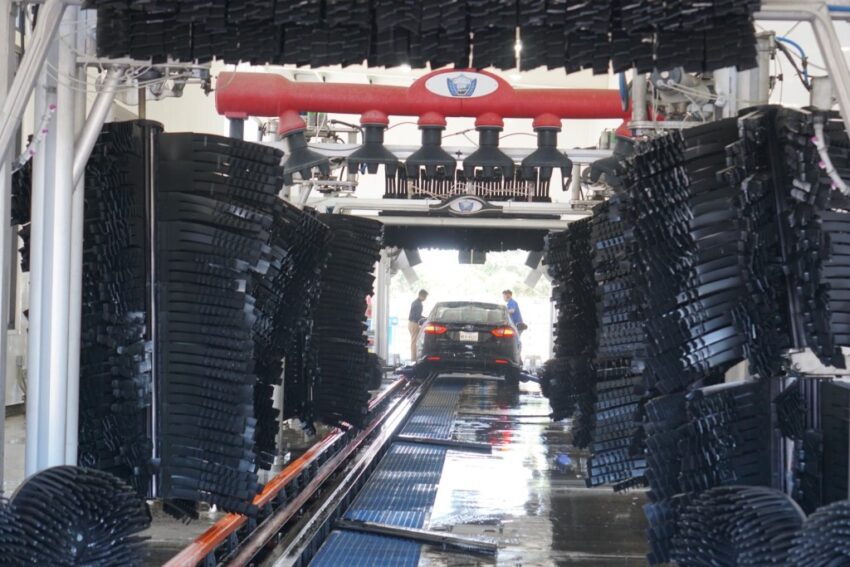

The car wash industry has boomed in El Paso since the start of this decade, and competition has increased for operators here as national chain washes have proliferated in El Paso.
Car washes regularly popping up on unused lots isn’t unique to El Paso, and has become common in cities and towns throughout the United States.
“There’s always a dirty car,” said Ethan Merchant, who with his father owns and operates Carwash City Express on Montana Avenue. “It’s one of those things that’s never going away.”
But the rapid buildout of the businesses has led some communities to push back on the construction of new car washes, with elected officials in some towns and cities throughout the U.S. arguing they don’t contribute economically because they only employ a handful of people and, in Texas, don’t pay sales taxes.
In El Paso, the car wash business boom presents an obvious question for a desert city: How much water are they guzzling up?
Commercial car washes vs car washing at home
When a new business such as a car wash applies for a water meter to receive service, the proprietor has to submit a water conservation plan to city-owned El Paso Water. And car wash owners have to share extra information proving they use less than 50 gallons of water per vehicle wash, according to El Paso Water.
A water conservation manager with the utility reviews businesses’ applications.
“All commercial car washes established since June 1, 2002, have submitted documentation showing they use less than 50 gallons per wash, with most recent applicants using approximately 35 gallons per wash,” El Paso Water said in a statement.
By comparison, washing your car at home isn’t water efficient, unless you’re using a bucket and a hose with a shut-off nozzle and redirecting any water runoff to a landscaped area, according to El Paso Water.
The amount of water that El Paso Water billed to customers over the last decade remained essentially flat year-to-year. The utility supplied 34.3 billion gallons of water to customers – homes and businesses – in 2023, compared with 35 billion gallons supplied in 2013.
Merchant said Carwash City uses a multi-level water reclamation system, which separates water from contaminants and treats it for re-use in other car washes.
“A lot of the water we use, we clean and reuse,” he said.
“We have a big machine – it’s, like, $30,000 to install to a car wash – but we don’t have to use a lot of city water, we can use the (reclaimed water),” Merchant said. “We have three 370-gallon tanks of water we reuse. So, a lot of the water bills really just go to landscaping.”
Despite some skepticism of the car wash industry and headwinds such as higher interest rates, the rapid growth has continued. Around 900 new car washes opened in the U.S. annually in recent years, according to the real estate company CoStar.
Part of the pushback is because car washes don’t usually have a lot of employees; about half of the car washes that do employ people in El Paso have five paid employees or fewer, according to the U.S. Census Bureau. Many other car washes – such as self-service and in-bay washes – don’t have any paid employees at all.
Earlier this week leaders in a town near Tampa Bay, Florida, sought to limit new car washes as well as self-storage facilities and marijuana dispensaries. The town of Brentwood in northern California also banned new car washes last fall.
And car washes in Texas aren’t required to pay sales tax to their host communities, because a car wash isn’t considered a taxable service under state law.
‘Definitely more competition’
Still, there’s enough demand for car washing in El Paso that the dozens of car washes that have opened in recent years – mostly national chains – are able to operate even amid elevated competition.
“There was a big boom a couple of years ago, with car washes popping up everywhere,” Merchant said.
The carwash building boom has slowed some recently, Merchant said, but the amount of competition has increased since they opened Carwash City Express in 2019.
“Definitely more competition,” Merchant said. “You could have a car wash right across the street from each other, both will still do very well together. People always pick and choose what they like.”

There’s also been a rise in the number of registered autos in El Paso County, which means there’s more of a market for car washing services. There were just over 698,100 vehicles registered here at the end of 2024, an increase of 11,000 registered vehicles compared with five years earlier, according to the Texas Department of Motor Vehicles.
There were 66 car wash businesses in El Paso as of 2022 – the latest year with available data from the U.S. Census Bureau. That figure is an undercount, though, because it excludes car washes with zero paid employees, such as self-service washes.
The city saw 15 major new car washes established in El Paso between 2017 and 2022, according to the Census Bureau. There were about 650 people employed by car washes as of 2022, which declined from five years earlier as car wash businesses became more automated.
And since 2022, national chains have opened numerous additional car wash locations. Tommy’s Express Car Wash has opened five car washes in El Paso since the start of 2022, with a sixth location under construction on the Westside.

Mister Carwash, the biggest car wash operator in North America with over 500 locations, has opened at least seven car washes in El Paso since 2022. The company – which has seen its stock price tumble since it started trading publicly four years ago – operates 20 locations locally.
“El Paso is just always growing. So, it’s a big place. People like it here. A lot of people in the car wash industry are noticing El Paso,” Merchant said.
This year’s historically intense dust storms have meant mixed results for car washes in town, Merchant said. So far this year, El Paso has experienced 32 days with blowing dust conditions, well above the annual norm of 22 or 23 dusty days.
“When those dust storms come in, there’s almost no reason to be open,” he said, adding that business picks up the day after dust storms hit. “We’re very weather-based.”
Merchant said the dust storms make Carwash City’s monthly subscription a better deal compared with repeatedly paying for one-off car washes every time dust and sand blanket the city.
Some customers, he said, come get a wash daily.
“I mean, they’re compulsive,” Merchant said. “They’ll wash morning, afternoon and close.”
Merchant said he and his family would like to expand their business to new locations. But establishing a big car wash is capital-intensive – so it depends on finding the right situation, he said.
“I would love to expand. It’s all a matter of location,” Merchant said. “The prices to put these things together are crazy. But they’re profitable – I like them.”
The post Rinse and Repeat: Is El Paso’s car wash proliferation guzzling the city’s water? appeared first on El Paso Matters.
Read: Read More