



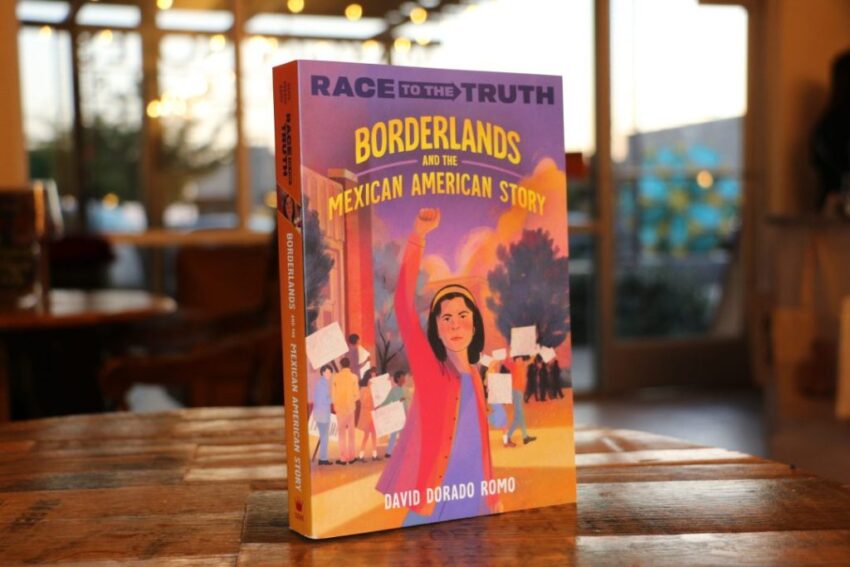

El Paso author David Dorado Romo’s latest book examines the often-overlooked history of Mexican Americans in the U.S. Southwest – stories marked by struggle, resilience and hard truths that resonate today.
“Sometimes people want to forget the bad parts of history – both those who are ashamed of what they did and those who suffered through it. Sometimes learning about history hurts. It feels like a wound,” Romo writes in the introduction to his book,
“Borderlands and the Mexican American Story.”
“But if we want to heal from these wounds, we first have to learn the truth. We have to remember,” the introduction continues.

“Borderlands and the Mexican American Story” is the latest selection of the El Paso Matters Book Club. Published by Crown Books for Young Readers in 2024, it’s part of the Race for the Truth Series that aims to present a more inclusive history of the United States.
The book opens with a look at migrations between what are now Mexico and the United States, with chapters taking readers through colonization, the Mexican American War, Civil War, the Underground Railroad, Mexican Revolution and World War II – and citing Mexican Americans’ roles and contributions to those key points in history.
In other chapters, Romo writes about what he calls the “ethnic cleansing of brown America,” as well as the Chicano Movement, the Hispanic decade, the border wall and la lucha que sigue, or the fight that continues.
In its “Let’s Think About This” pages, readers are asked to consider the passages and what they mean, providing discussion questions at the end of each of its 15 chapters.
“It’s not a Mexican American story for dummies,” Romo said during an October lecture at the Kansas City Public Library. Romo said though the book is aimed at middle-grade readers, even those with a Ph.D. in history might find something they hadn’t known or thought about from the point of view of the border.

Romo is also author of “Ringside Seat to a Revolution: An Underground Cultural History of El Paso and Juárez, 1893-1923,” published by Cinco Puntos Press in 2005. In that book, Romo tells about the role the El Paso-Juárez area played in the Mexican Revolution through essays and archival photographs.
His essays have appeared in the Washington Post, the Texas Observer, and in El Paso writer Sergio Troncoso’s book, “Nepantla Familias,” among others.
Romo, aside from being an avid cyclist and musician, is a historian and cultural activist. He co-founded Paso del Sur and Project Regeneración, organizations that seek to restore and preserve South El Paso and the Duranguito neighborhood. He authored “Remember Duranguito!: A Walking Tour of the Other America,” a public history book published by Liminal Zones Press in 2024.
Originally from San Jose, California, Romo received a bachelor’s in Judaic studies from Stanford University, and a master’s and doctorate in borderlands history from the University of Texas at El Paso.
Below is an excerpt from his latest book, as well as a reading schedule so you can follow along with the El Paso Matters Book Club.
Excerpted from “Borderlands and the Mexican American Story” by David Dorado Romo, published by Crown Books for Young Readers.
“WE’RE NOT HUNGRY!” A WALKOUT FOR DIGNITY
On the morning of November 2, 1937, students at Bowie High School in El Paso waited for the morning bell to ring. They felt nervous. They didn’t know it, but they were about to make history. As soon as the bell rang, about two hundred Mexican American students walked out of their classrooms. It was the first student walkout held at a predominantly Mexican American high school in the United States. They left their red-brick school building without saying a word. Many of them carried signs reading: “We’re not hungry!” Some of the students carried a milk bottle under one arm and a loaf of bread under the other. They marched silently toward the offices of the El Paso Herald. The newspaper’s offices were not too far from where Bowie High was located.
A few days before, the El Paso Herald had published articles that students felt insulted their dignity. The articles made them feel ashamed. The bold headline of one article read: “Bowie High Students Face Hunger Again. Girls Lie Down in Rest Room and Weep as Others Eat at Noon. Some Save Scraps for Supper.” Although calling someone hungry in English is usually not considered an insult, the students felt embarrassed to be singled out publicly the way the newspaper article did. In Spanish, the term un muerto de hambre, “a starveling,” is considered an insult. The newspaper wrote that hunger made many Bowie students faint. It added that “even some of the football players have become so weakened through hunger that they could not play well.”
One of the leaders of the school walkout was Ruth López. She was a fifteen-year-old sophomore at Bowie. She stood in front of the crowd of students and reporters and explained the reasons for their protest. “We may be poor, but we’re not starving to death,” she said. “We don’t want the students of other schools to taunt us and call us starving beggars (muertos de hambre). That’s what they’ve been doing. We will defend our school!”
The English-language newspaper wasn’t trying to deliberately humiliate the Mexican American students. The El Paso Herald wrote the articles to encourage readers to contribute money to feed the students. But the Bowie students didn’t like how it was done. They felt the articles were exaggerated. Sure, their families were going through a rough time. But this was the Depression. A lot of people in the United States had lost their jobs. Why did the newspaper’s calls for charity have to be so demeaning? “There were also hungry students at El Paso High,” explained Bowie senior class president Luis Pérez. “They feed them there without publicity.”
A few days after the Herald articles came out, the Bowie football team played against El Paso High. El Paso High was located in a wealthier Anglo neighborhood north of the railroad tracks, where almost no Mexican Americans lived. During the game, their fans made fun of the Bowie players for being “weak” and “starving” and for “fainting from hunger.” They thought this was hilarious. They used the same words from the Herald newspaper article to ridicule the Mexican American players.
This really upset the fans from the Segundo Barrio, the Mexican American neighborhood where Bowie High was located. They were proud of their team. Bowie football, baseball, and track teams won many city championships in the 1930s and 1940s. Javier Montes, one of the star athletes who competed for Bowie in the 1940s, would later represent the United States at the 1952 Olympics. The students felt it was the newspaper’s fault that the opposing teams were now laughing at them.
The Bowie protesters demanded an apology from the editor of the El Paso Herald. “We just want this publicity to stop,” one of the school walkout leaders said. But the newspaper editor refused to apologize. The school strike continued for several days, until the Bowie principal arranged a “peace conference.” It was held in the school auditorium. The peace conference was packed with students, parents, teachers, and local community leaders. The principal invited the mayor of El Paso and the chief of police to speak at the meeting. The mayor scolded the Bowie students for “acting like irresponsible juveniles.” Other adults called the protesters “hoodlums.”
But the students stood their ground. They explained other reasons why they joined the school walkout besides the recent newspaper articles. Some students complained that teachers often belittled their Mexican parents, calling them “backward” and accusing them of “living in the past.” One student read out loud from a letter several Bowie students wrote together. “We go to school to learn, not to be put down or criticized, and we especially don’t want our parents to be publicly disparaged.”
There were other ways that the school put down the culture of the Mexican American students. Mexican American students who violated the English-only rule were usually sent to detention. Others received swats on the behind with a wooden paddle. Some had their mouths taped shut. Punishing and humiliating students for speaking Spanish didn’t make sense. It was an advantage to speak two languages. It opened up many job opportunities, especially on the border, where a lot of people were bilingual. But these school rules made the Mexican Americans feel that their language and culture were something to be ashamed of, rather than celebrated.
The Mexican American students of Bowie High School who staged the first walkout for dignity were themselves an important part of the history of the borderlands. It is a history that is worth remembering.
Published with permission from Crown Books © 2024.
ABOUT THE BOOK: “Borderlands and the Mexican American Story”
- Author: David Dorado Romo
- Published: Crown Books for Young Readers, Aug. 20, 2024
- Genre: History, nonfiction
- Pages: 352
Note: Part of the “Race to the Truth” series for middle-grade readers, though author notes it’s for readers of all ages.
BOOK CLUB READING SCHEDULE
- July 2-8: chapters 1-2, pages 1-40
- July 9-15: chapter 3-4, pages 41-83
- July 16-22: chapters 5-6, pages 84-120
- July 23-29: chapters 7-8, pages 121-160
- July 30-Aug. 5: chapter 9-11, pages 161-207
- Aug. 6-12: chapter 11-12, pages 208-261
- Aug. 13-19: chapter 13-14, pages 262-302
- Aug. 20-26: chapter 15-end, pages 303-334
The post ‘To heal, we must remember’: David Dorado Romo’s ‘Borderlands and the Mexican American Story’ examines often untold perspective appeared first on El Paso Matters.
Read: Read More