



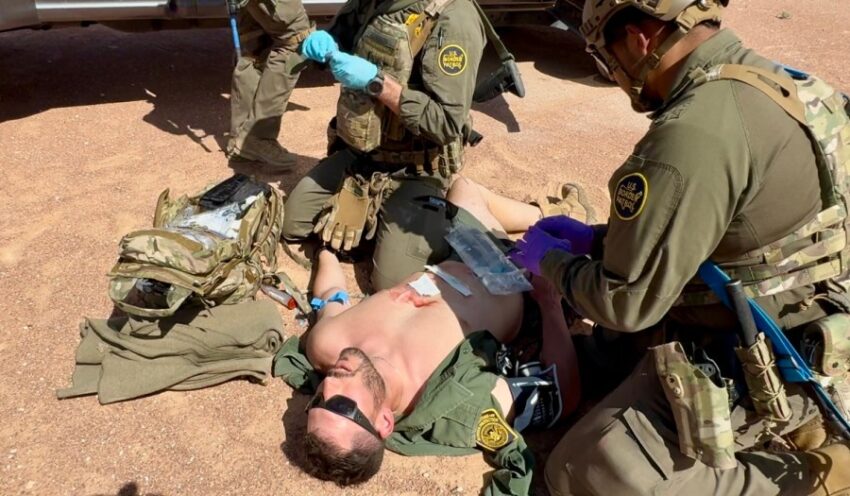
OTERO COUNTY, N.M. (Border Report) – Shots ring out in the desert and a man in a green uniform falls to the ground. With a bullet wound in a leg and another projectile having pierced his torso, the man starts yelling for help.
A man and a woman in similar green garb hurry to the scene, toting rifles as they run.
“Can you walk?” one of them asks his fallen comrade.
“Barely, dude. But it hurts. It freaking hurts!” the prone man responds.
They carry him to a vehicle some 50 yards away where the male proceeds to stop the bleeding and tend to the injured man’s wounds; the female writes down vital signs on the palm of her surgical glove and calls for assistance.
Should this have been a real life-or-death emergency, a U.S. Customs and Border Protection helicopter would have reached the scene in 20 minutes to evacuate the injured Border Patrol agent.
But the scenario played out on a hot July afternoon at McGregor Range in the New Mexico desert was part of the training agents vying for a coveted spot in the U.S. Border Patrol’s Search, Trauma and Rescue unit, or BORSTAR, receive.
Candidates are put through rigorous physical endurance trials. Those selected are told to get certified as emergency medical technicians (EMTs) and expect to be back for three weeks of special forces training from which 7 out of 10 end up being dismissed.
“Those few weeks they’re going to go through sleep deprivation, testing of attributes and abilities, including having the right mental attitude, and team-building exercises,” said Eric Wells, national commander for BORSTAR operations with headquarters in El Paso, Texas.
BORSTAR last year participated in 5,400 rescue attempts along the Southwest border. Most involved finding migrants lost in deserts or mountains. But many involved pulling individuals gasping for air from the fast-moving water of canals or lowering the temperature of dehydration victims. Not all rescue attempts had a happy ending.
Wells said the Border Patrol formed the unit in 1998 primarily to assist agents injured as they chased migrants over hazardous terrain far from cities where they could expect assistance from the local fire department or emergency medical services.
But as migrant traffic increased exponentially in the following two decades, BORSTAR now mostly rescues migrants in distress.
Still, rendering aid to Border Patrol agents remains a priority.
The scenario played out this week at McGregor Range, for instance, was based on a January attack on border agents in Fronton, Texas. The bullets missed the agents but the Border Patrol wants to be ready in case other smugglers or drug traffickers have better aim next time.
“These are real-life scenarios replicated to give these guys an opportunity to see how they would respond in a scenario that could happen to them,” said Jesus Felix, supervisory Border Patrol agent for special operations focused on medical assistance.
He and Wells said the El Paso and Big Bend regions of West Texas as well as the unforgiving desert of New Mexico provide the perfect training ground for BORSTAR.
They also said fewer migrants and agents are getting hurt since the federal government cracked down on illegal entries. The fewer people come in, the less chance they have of falling from the border wall, twist an ankle in the mountains, drown in the Rio Grande or run out of water in the desert.
Wells said he joined BORSTAR several years ago because he wanted to save fellow agents – or migrants – who could count on no one else to go find them in the middle of nowhere.
“If they found themselves in that situation, I wanted to be that person that was able to assist them to get out of that situation,” he said.
 Read: Read More