



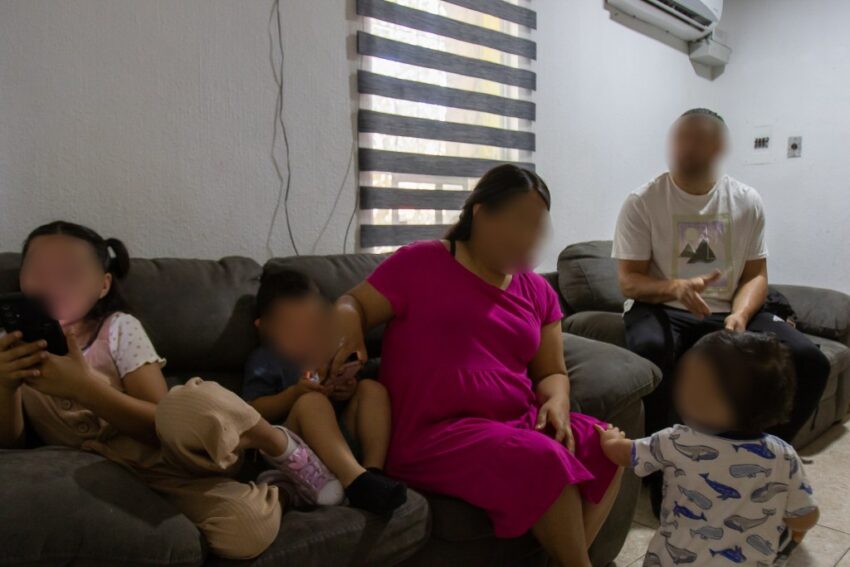

Seven-year-old Rene curled up in the corner of the sofa in her family’s one-bedroom apartment in downtown Ciudad Juárez as a cheery children’s song emanated from the phone in her hand.
Her brothers – Andres, 4, and Emilio, 3 – clambered up their mother’s legs to demand her attention. Daniel, the 1-year-old, clung to a bag of chips, his small chubby fingers coated in copper-colored dust.
A gated metal door separated the four young siblings from the busy street and crumbling buildings that dot Colonia Bellavista, a largely abandoned neighborhood just blocks away from the Paso del Norte port of entry that connects Juárez and El Paso.
Months earlier, the children, who are U.S. citizens, were living with their parents and grandparents in a South El Paso home near the bridge, where they had their own bedroom and plenty of space to run and play. Rene and Andres attended Aoy Elementary School, where they made friends and were close to their teachers. They received treatment and medications for an array of neurological conditions and developmental delays that affect their day-to-day lives.
Their lives changed dramatically in February, when their mother, Rosa, 28, who had been in the country with an expired tourist visa, was detained by Customs and Border Protection after a series of complicated events. She was eventually deported – taking her children with her to Juárez. The children’s father, Oscar, 29, had been deported months earlier.

Now crammed into a one-bedroom apartment in Juárez, the family of six is attempting to navigate the education and medical landscape in a country they say offers limited assistance. The parents asked that their family’s real names not be used to protect their identity and potential to return to the United States in the future. They worry that being uprooted from the only country they’ve ever known will affect their children’s health and development.
“Ha sido un sube y baja de emociones y cambios … Allá teníamos una vida diferente,” Rosa told El Paso Matters in Spanish as she sat with her children in mid-April. “It has been a roller coaster of emotions and changes. … We had a different life over there.”
Decades of research have shown that the deportation of parents and families has had profound effects on children’s development, including their ability to learn, play, socialize and regulate emotions, particularly children with developmental delays or other mental health conditions, said Dana Rusch of the University of Illinois Chicago. She serves as associate professor of clinical psychiatry and director of the Immigrant Family Mental Health Advocacy Program.
“This kind of sudden and forcible separation from their home, their routines, their friends, their health care services and educational services, has short and long-term consequences,” Rusch said.
It’s unclear if Rosa’s case was affected by new policies under the Trump administration – past administrations have also targeted those who overstayed their visas. Still, immigration advocates worry the more aggressive, zero-tolerance crackdown on immigration enforcement and mass deportations efforts under Trump could have far-reaching consequences for some of the country’s most vulnerable citizens and the communities in which they live.
“Unfortunately, this isn’t an isolated case. It’s something we see a lot in our community,” said American Civil Liberties Union policy and advocacy strategist Maria Cordero, who works in the Rio Grande Valley and focuses on border and immigrants’ rights. “There have always been immigration policies, but now we are seeing Americans being directly affected as collateral damage.”
Estimates on the number of children that could be affected by immigration enforcement efforts vary widely.
The Pew Research Center found there were 4.4 million U.S.-born children younger than 18 living with an unauthorized immigrant parent in 2022.
Between 2013 and 2018, ICE deported more than 231,000 parents who had U.S.-born children, according to data compiled by the Marshall Project. In 2019 alone, that number was close to 28,000.
While ICE does not track what happens to the children of parents who are deported, parents normally have two options: try to reunite in their home country or leave them in the custody of someone in the U.S.
Rosa chose to keep her children by her side in Mexico.

A call from CBP
Rene was born in El Paso in 2018 after her parents entered the U.S. on tourist visas, which allow up to six-month stays for purposes like medical care. As Rene grew older, she developed absence seizures, brief episodes of unresponsiveness. In March 2020, just before pandemic lockdowns, Rosa and Oscar returned to El Paso with Rene seeking treatment and stayed with Oscar’s U.S.-citizen parents.
Rosa soon became pregnant with Andres, who later was diagnosed with ADHD and developmental delays. The family remained in El Paso, where Oscar worked in construction without authorization while Rosa stayed home. In late 2024, Oscar returned to Mexico for a family reunion but was detained by Border Patrol while trying to reenter.
In February, Oscar’s brother, a U.S. citizen, took baby Daniel to visit Oscar in Juárez. When the brother was returning to El Paso through the Bridge of the Americas, he was detained by CBP. Rosa received a call at midnight Feb. 16 asking that she come identify her son.
“I got scared … I thought they might take my child, so, I took off running,” Rosa recalled.
CBP didn’t comment on her case to El Paso Matters, but noted children usually need parental permission to cross with relatives. Rosa said the permission note didn’t include the uncle’s name.
When Rosa arrived at the bridge, CBP questioned her status and detained her. After three days at the port of entry, Rosa was transported to the Otero County Detention Center in New Mexico.
Desperate to see her children, Rosa requested to take a voluntary departure from the country rather than wait to see a judge, which would have allowed her to leave the U.S. without going through a formal deportation process.
Rosa said her request was denied due to her charges.
She spent three weeks there before seeing a judge March 10, when she waived her right to a trial and was deported to Mexico. Now she won’t be allowed to apply for a visa to enter the U.S. for 10 years.
“Yo quisiera haber peleado el caso. … Pero estar allá dentro y los niños afuera es algo muy difícil,” Rosa said in Spanish. “I would have liked to fight the case. … But being in there with the children outside is something very difficult.”

While people in Immigration and Customs Enforcement detention can request bond, the process can be daunting for many migrants who do not have the funds to hire an attorney or outside support to navigate the process, said Senior Policy Counsel for the American Immigration Council, Adriel Orozco.
“When you go before an immigration judge, they are trying to process cases very quickly and are not giving much time for people to ask questions,” Orozco said. “That really just demoralizes somebody and puts them in a position where, if the easier, fastest way of getting out of that place was to accept a removal order.”
A new life in Mexico
Rosa recalled watching videos after she was released of her children crying for their mother while she was in the detention center.
“Nada más estaban llorando pensando que yo los había dejado o algo. Nunca había dormido lejos del bebe más chiquito,” she said in Spanish. “They were just crying, thinking that I had left them or something. I had never slept away from the youngest one.”
“Three weeks later, he didn’t recognize me,” she added. “He didn’t even want to hug me. I think he feels like I left him.”
Though the children were only away from their mother for a short time, Rusch said the sudden separation can cause separation anxiety and behavioral issues.
“When I think about the detention of a family member, it’s almost like a separation anxiety disorder on the highest level,” she said. “It doesn’t matter if that separation was for a couple of hours and the parent returned, or if it’s longer.”
Research compiled by the American Immigration Council found that children who have a parent who was deported or detained have high risks of developing mental health problems like depression, anxiety, and post-traumatic stress disorder, as well as physical conditions such as cancer, diabetes and heart disease.
One study found that children who went to Mexico with their deported parents displayed more depressive symptoms than those who remained in the U.S.
Rosa and Oscar said the children initially struggled to adapt to their life in Juárez, occasionally acting out or asking to return to El Paso, but started to get used to their new environment over time.
“Ya están mejor, ya están más quietos, más cómodos,” Rosa said in Spanish. “They are better now, they are calmer, more comfortable.”
Oscar is taking classes to become a barber and open his own business. He said it has been difficult to make a living in Mexico. The family has been relying on help from Oscar’s parents, citizens living in the U.S., who occasionally send money for groceries and other necessities.

“Es muy dura la vida sinceramente aqui en Mexico. Es una de las cosas que le aplaudo a los estados unidos que podías ser migrante o ciudadano Americano, si ayuda le gente,” Oscar said in Spanish. “Life is honestly very hard here in Mexico. It’s one of the things I applaud the United States for. You can be a migrant or an American citizen and you’ll still get help.”
In the U.S., Rosa’s children had Medicaid and regular access to specialists through schools and doctors.
After her deportation, Rosa received 2,000 pesos (about $100) through the Mexico Embraces You program but struggled to find neurologists and medication for her children. With only a couple of months’ supply left, she feared Rene’s seizures would return.
The family eventually found a neurologist in Juárez but couldn’t find proper schooling for both children.
While Rene was enrolled in a school in Juárez, no school had the resources to handle the complex needs of a young child with ADHD and developmental delays like Andres.
Without school-based therapy, Rosa fears Andres is falling behind.
“Siento que si estaba avanzando un poco más. Ahorita está (atrasandose) en cosas que antes ya hacía.” Rosa said. “I felt like he was advancing a bit more. Right now, he’s having trouble with things he used to do before.”
Experts say without these services, children like Andres risk regressing, facing academic struggles and worsening developmental challenges as they grow older. Many need assessments and individualized education plans to support learning and development, Rusch said.

Rosa hopes her children may someday be able to return to school in El Paso when they are old enough to cross the border on their own.
Until then, she plans to do her best to start their lives over in her home country and try to find the resources her children need to thrive.
Though weary about the idea at first, Rosa said she’s considering getting her children dual citizenship, allowing them to be citizens of both Mexico and the U.S.
“Vamos echarle ganas aqui porque no hay forma de regresarnos,” Rosa said in Spanish. “We are going to give it our all here because there is no way back.”
The effects of immigration enforcement
Research compiled by the American Immigration Council found that children who have a parent who was deported or detained have high risks of developing mental health problems like depression, anxiety, and post-traumatic stress disorder, as well as physical conditions such as cancer, diabetes and heart disease.
Those issues may be compounded for children who leave the country with their parents, who have been deported, said Orozco.
“Some American children have difficulty enrolling into school in Mexico because they might not have the proper documentation,” Orozco said. “Children who have spoken English primarily may have a difficult time being able to integrate into the education systems, which, of course, can trigger even more mental health issues.”
One study found children who experience parental deportation or detention, regardless of whether they stayed in the U.S., are more likely to report mental health problems, but those who went to Mexico with their deported parents displayed more depressive symptoms.
Immigration enforcement affecting schools
While most children of immigrants are U.S. citizens, fears of enforcement efforts and deportation have deterred some families from sending their children to school, said Drishti Pillai, associate director of the Racial Equity and Health Policy Program and director of Immigrant Health Policy at KFF.
Immigrant families had previously expressed these fears, but Pillai said they intensified with the revocation of protections for sensitive places such as churches or schools.
“This could ultimately lead to decreases in public school funding, since it is tied to either student enrollment or student attendance. And while the funding cuts may be relatively small, school districts that serve large shares of students from immigrant families, such as school districts in border areas, may be more heavily impacted,” Pillai told El Paso Matters.
School districts do not ask for parents’ or students’ citizenship status and usually only require a birth certificate or other form of identification and proof of residency, which could be a utility bill, making it difficult for them to track the impact of immigration enforcement.
An Ysleta Independent School District spokesperson said the district does not have a way to track whether students are absent or withdrawn from school due to immigration enforcement. The El Paso and Socorro school districts did not respond to questions asking how immigration enforcement has affected enrollment.
Though teachers can usually only speculate why a student is absent or has withdrawn from school, El Paso Teachers Association President Norma De La Rosa said some have begun to notice missing students after the presidential election.
“I did have teachers tell me that they did have some kids who did not show up back at school, and we pretty well figured out why. They either went into hiding or they may have left,” De La Rosa said.
Schools likely won’t know how immigration enforcement will affect enrollment for the next school year until it starts, she said, because many parents wait to register their kids until right before the first day of school.
“I’m sure we will see a lot of kids not come back to school, simply because their parents want to keep their family together, and I can’t blame them,” De La Rosa said.

At Aoy Elementary, at least two student chairs sat empty for the second half of the school year – seats where Rene and Andres had started learning reading, writing and math alongside their peers before their lives were upended.
As their former classmates prepare to start a new school year in the coming weeks, the young siblings — and potentially countless others — won’t be there to learn alongside them.
Rene shook her head silently when asked if she knew why her family moved or if she knew what had happened to her mother.
All she knew was she missed El Paso, her school and all her friends.
“Ahi estaba una maestra queme quería mucho. Cuando estaba triste ella me abrazaba.” Rene said in Spanish. “Over there, I had a teacher who loved me a lot. When I was sad, she would hug me.”
The post ‘We had a different life’: Deportation forces El Paso family, disabled citizen children into uncertainty across the border appeared first on El Paso Matters.
Read: Read More