



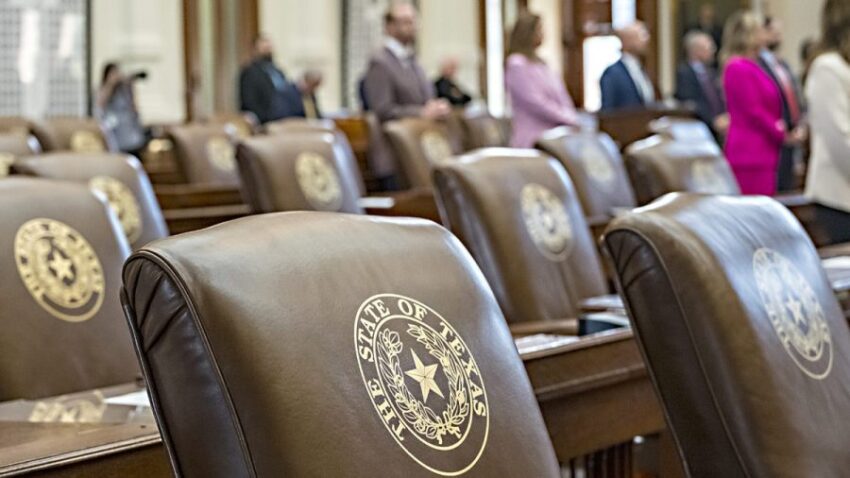
EL PASO, Texas (KTSM) — The Texas House of Representatives is scheduled to reconvene for the 89th legislative session at 12 p.m. MT on Friday, Aug. 8, but it seems unlikely that the over 50 Democrats who left the state to break quorum will show up, despite pressure from Republicans.
“These are the worst maps that we have seen since the 1960s and the passage of the Voting Rights Act. The implications for the Hispanic Latino community in Texas are going to be really bad for decades to come. So I’m prepared to continue talking about these maps,” State Rep. Vince Perez, D-El Paso, said in an interview Thursday afternoon, Aug. 7, when asked if he was going to be present at the special session on Friday.
Perez is one of 50 members of the Texas Democratic Caucus who left the state earlier this week to block a vote on a congressional map that would lean in favor of Republicans come the 2026 midterm elections.
In a previous interview, Perez said he will return to the state until the proposed congressional map is rescinded.
Abha Sing, a distinguished senior lecturer in political science at the University of Texas at El Paso, said it is uncertain how long the stalemate between Texas Democrats and Republicans will last.
“If Democrats continue to break quorum, this session will expire on Aug. 19th. But under the Texas Constitution, the governor of Texas has power to call an unlimited number of sessions. So, he can call one right after this one expires. And then after this, it will be difficult for Democrats to stay far away and for so long from their families and their constituents,” Singh said.
Because the quorum has remained broken, the Texas legislature has been unable to move forward with the special session and address other agenda items that both Texas Republicans and Democrats had said were urgent.
Governor Greg Abbott had placed 18 agenda items for Texas Lawmakers to discuss in the special session. Forming new and improved legislation in the aftermath of the floods in the Texas Hill Country had been presented as a major topic of the special session when Abbott first announced the agenda.
“We delivered on historic legislation in the 89th Regular Legislative Session that will benefit Texans for generations to come,” read a statement from Abbott on his Special Session proclamation. “There is more work to be done, particularly in the aftermath of the devastating floods in the Texas Hill Country. We must ensure better preparation for such events in the future.”
Among the numerous agenda items, Texas lawmakers were set to discuss legislation to provide relief funding for the floods, to improve flood warning systems, flood emergency communications, natural disaster preparation, and recovery.
Over the past few days, Republicans and Democrats have blamed each other for the delayed discussions.
Republicans have said Democrats are to blame because they halted the special session by breaking quorum.
“Texas House Democrats abandoned their duty and are holding flood relief and property tax cuts hostage,” stated Abbott in a post via X on Aug. 4, when he directed the Texas Department of Public Safety to arrest Democrats who broke quorum.
“This order will remain in effect until all missing Democrats are accounted for,” the post read.
Democrats, meanwhile, have said Republicans prioritized redistricting on the agenda items related to the floods.
“Democrats showed up for the special session, and we had sent letters to the Speaker of the House that we had wanted those priority issues to be considered first, starting with the flood relief. But what Republicans did is that they used all of those issues, as critical as they are, as a ruse to keep Democrats there in Austin,” Perez said.
Singh also noted that Democrats have made the argument that Abbott holds the power to provide flood relief funding in the Texas Hill Country without having to wait on the Texas Legislature.
“Under the governor’s authority, he does have the power to find the funding from other sources and release it for flood relief,” Singh said.
As to why both parties have been steadfast in this redistricting battle, Singh said it is because the outcome is likely to have an impact in next year’s midterm elections.
“Based on history, the track record for many decades and centuries is that the party which is in power, the president’s party, loses seats in midterm elections. Now, the point here is that Republicans know they are likely going to lose, but by how many seats? So, they are trying to minimize that loss by redrawing those districts, which are already in the Republican camp. And they are trying to make sure that even if they lose, they still have some cushioning there, especially in those Republican states,” Singh said.
 Read: Read More