



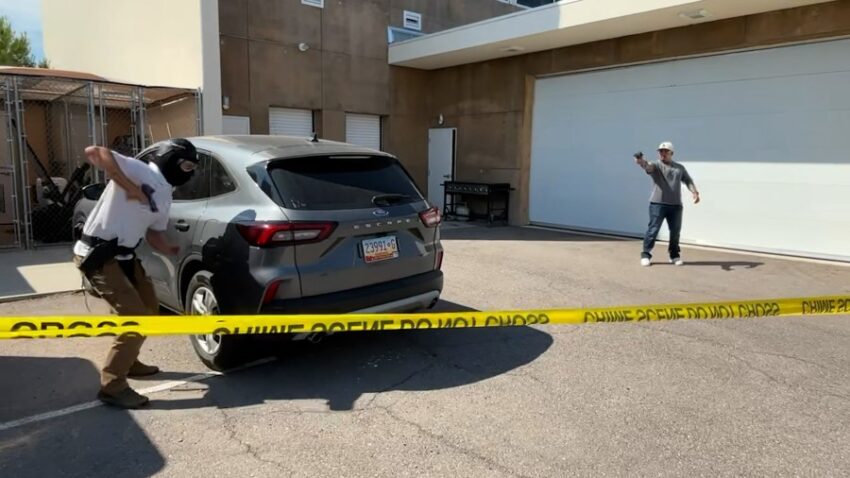
LAS CRUCES, New Mexico (KTSM) — The Las Cruces Police Department held a reality-based workshop for elected officials and news media reporters to participate in simulated scenarios of real-life calls-for-service a police officer may experience any given day.
The workshop was held Tuesday, Aug. 12.


“The goal, first and foremost, was to provide perspective — giving them a taste of what it’s like to actually make those decisions under stress. It’s very easy for all of us to criticize other people or judge their performance when we’re not in their shoes. It’s much harder when you’re actually in that scenario,” Las Cruces Police Chief Jeremy Story said.
The “Real-to-Reel” workshop took participants through five different simulated scenarios where they could assess how they would handle different situations. Participants were given safety gear, a training gun, and the scenarios were simplified to where participants were limited to using a gun or not.
The scenarios included dealing with a suicidal individual holding a gun, responding to domestic call for service, and a suspect armed with a gun acting erratically.
Most participants responded differently to the same exercise. Some participants shot at suspects who threatened to shoot at them. Some pulled the trigger earlier before having a “reasonable” cause under the law to do so. Some participants never even pulled the trigger of their training gun, whether correctly given the circumstance, or to their detriment and wound up “dead” in a simulated scenario.
“When an officer’s determining what to do, especially when talking about reasonableness for a search, for a seizure, for a use of force, it’s based on the totality of the circumstances. So everything’s taken into consideration. You could have two situations, and nine of the facts or nine of the circumstances are identical. But you change the 10th one and you can change what the officer can and can’t do completely. And that’s the reality on every single call, every little detail matters. One detail can change everything,” Story said.
Participants were also given a brief educational briefing on the case law that police officers must be knowledgeable of when responding to a call. Instructors also explained how the complexity of case law makes it difficult for officers to make split-second decisions in a high-stress situation.
“It’s not enough for them to just get basic training at the academy or, you know, take a two-hour legal update every couple of years. They have to know the law as well, if not better than an attorney,” said Erik M. Scramlin, a police legal adviser for LCPD. “If they don’t know the law and have it already worked into their training, then the odds are they’re probably not going to know it during that split-second decision when they have to make a decision.”
 Read: Read More