



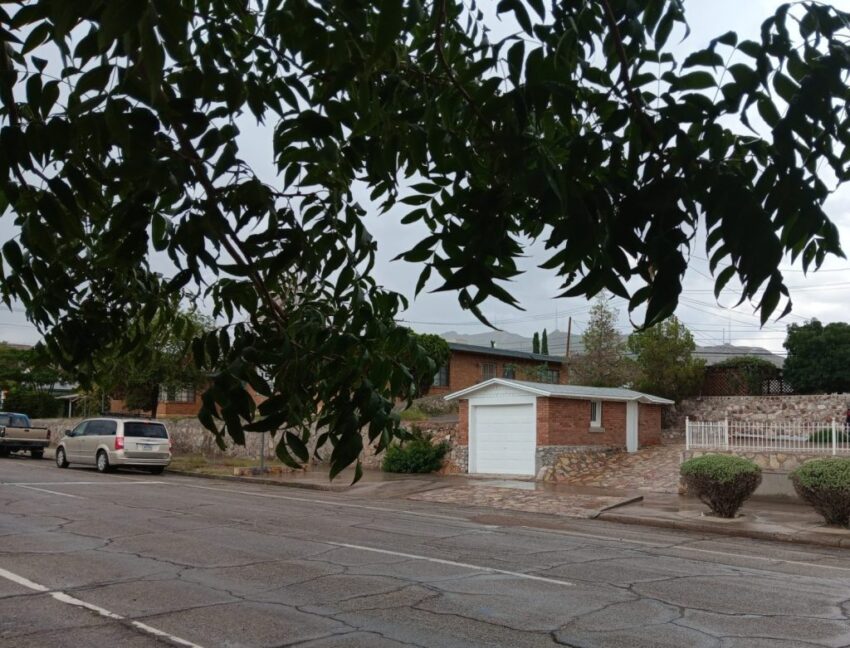

After about three hours of heated discussion, the El Paso City Council on Tuesday deleted three agenda items calling for major zoning change that would have made it easier to build backyard casitas, or accessory dwelling units, in an effort to address a shortage of affordable housing.
The zoning change would have eased restrictions for property owners who want to build a backyard casita on their properties. The City Council also deleted the companion agenda item to approve easing minimum off-street parking requirements for areas in and around Downtown and the areas around Kern Place and the University of Texas at El Paso known as Uptown.
The City Council voted 5-3 to delete the items to give city staff time to return with an outreach plan. City Reps. Alejandra Chavez, Deanna Maldonado Rocha and Chris Canales voted against deleting the items, while city Reps. Lily Limón, Ivan Niño, Josh Acevedo, Cynthia Boyar Trejo and Art Fierro voted in favor.
Those who supported deleting the items raised concerns that public outreach had not been conducted in some parts of the city. While the zoning changes for accessory dwelling units would have applied citywide, changes to off-street parking minimums would have only applied to areas in and near Downtown. Had the zoning changes been approved, they would have gone into effect immediately.
A timeline for the outreach plan or when the City Council might again consider the proposed zoning changes was not discussed. Deleting the item allows the council to discuss the proposals at a later time without a specific deadline to do so.
Dozens of community members applauded the deletion of the agenda items, raising concerns that easing the zoning requirements would attract investment rental properties, unwanted crowding and excess street parking in already congested neighborhoods such as Kern Place.
Some who spoke against the proposed changes said they wanted the City Council to take more time before making the decision.

“Our residential streets are already at near capacity in many areas with UTEP student parking, graduations, concerts, etcetera. Introducing new dense developments without dedicated parking will turn a tight situation into an even worse one,” said Robert Romero, who spoke during public comment.
Romero asked the city to conduct a full traffic study before making a final decision.
City staff analyzed parking along 11 streets, 22 intersections for about two weeks in an area near the University of Texas at El Paso, Mesa Street and Kern Place area along Campbell Street.
“The parking study is missing,” Romero said. “The parking study that was completed is missing all the traffic impacts, vetting through utility companies, safety studies, walkability studies (and) bike studies.”
Others who wanted the city to postpone changing the zoning said more outreach was needed and raised concerns about investors buying up properties to create overcrowded rentals.
Not requiring the owners to live on the property where the casita is located was a key point of contention from the community concerned that investors would develop properties as rentals.
Canales proposed an amendment to the proposed zoning changes that would have added that requirement. The motion failed.
“I’ll state to you at the outset that all of these items need to be deferred to a later date that allows for ample time to communicate with our entire community to do so with accurate information on what these proposed changes to the code will actually mean to their neighborhoods,” said Richard Dayoub, a business consultant and lobbyist who’s a former CEO of the El Paso Chamber.
Dayoub said the proposal would encourage investors to build rental properties that would not be affordable – which would have countered the city’s efforts.
“This plan won’t get us there. It will only serve to increase rent rates, defeating the very purpose of the plan,” Dayoub said.
While most of the speakers were not supportive of the zone changes some said the move would help the city achieve what it is intending to do – allow for more affordable housing options and developments.
“I myself have had to go through multiple parking reduction processes. This is time consuming. It’s uncertain. It adds delays to projects, and in some cases, can just make these projects impossible, or cause the developer to decide not to move forward,” said Robert Palacios, a local developer.
He said the accessory dwelling unit requirements would work to create affordable housing options.
“It would allow more density in our central neighborhoods, allowing more people to share the cost of maintaining (existing) infrastructure,” Palacios said.
Experts say the likelihood of investors and developers swooping in to take over communities is not likely.
“I’m not trying to dismiss people’s concerns, but (it’s just that) these types of units are shown to be very unintrusive, and once people allow them into their communities, (investors taking over neighborhoods) it’s not really a factor,” Yonah Freemark, principal research associate in the Housing and Communities Division at the Urban Institute, a nonpartisan policy research organization, told El Paso Matters this week.
Freemark said parking congestion and overcrowding have not been a factor in other communities where accessory dwelling units are allowed.
“There’s been some interesting evidence from other cities that this has not been a major concern for these types of casitas, because the reality is that the people who often live in these (units) are often people who don’t even have a car. You’re talking about your grandma, or maybe your college-age kid, or something like that – they often don’t even have a car,” Freemark said.
It is also not uncommon for community pushback where zoning for casitas has been eased – mainly by homeowners that are concerned unwanted people will move into neighborhoods, overcrowd streets with parking and alter the appearance of the neighborhood, according to research by the Joint Center for Housing Studies of Harvard University.
Proposed changes to casita, parking zoning regulations
The proposed changes to the zoning codes would allow for elimination of off-street parking requirements for new developments within some areas surrounding Downtown and along the Mesa Street corridor to Executive Center Boulevard.
Casitas could be built on any size lot and could abut the existing home. There would no longer be a minimum on bedrooms, but square-foot restrictions would apply depending on the lot size.
The casita building itself could be at least 800 square feet depending on the size of the lot, but not any larger on lots of 8,000 square feet or smaller. Casitas could be built up to 1,200 square feet on lots that are larger than 8,000 square feet. Height and building code requirements would still apply to the construction of new casitas.
Owners would not have to live on the property where the casita is located and could be used as a rental unit and a designated parking space is not required.
In other City Council action:
The City Council Tuesday also adopted its budget and tax rate for the next fiscal year. To fund the about $1.4 billion all-funds budget, the city adopted the tax rate of 75.9 cents per $100 of valuation. The tax rate represents a 5% increase of about $83 more per year on the average value $221,191 home on the city’s portion of a tax bill. Homeowners currently pay about $1,600 in city property taxes a year.
The post El Paso City Council nixes proposed casitas, parking minimums zoning changes – for now appeared first on El Paso Matters.
Read: Read More