




More on the proposed $165 billion New Mexico data center campus near El Paso
Diego Mendoza-Moyers: $165 billion with a B. That’s how much a firm out of Austin says it’s going to invest to build a huge data center campus in Doña Ana County, next door to El Paso. That’s an absolutely astronomical dollar figure – one so big it raises a lot of questions. Who is BorderPlex Digital Assets, the company behind this? And how could this group possibly plan to spend this much in a small New Mexico border county? What does it mean for our economy, and, maybe more importantly, for the future of our water and electricity systems here in the borderland?
I’m Diego Mendoza-Moyers, a reporter and host of the El Paso Matters Podcast, and I want to spend a few minutes talking through this company’s proposal and see what questions we have answers to at this point and what we still don’t know. And if you want some more background and facts about all of this, you can visit elpasomatters.org to read the story we published last week.
But before we go any further, I want to mention that this El Paso Matters Podcast episode is sponsored by Tawney Acosta and Chaparro, truck crash and injury attorneys. Their team of local, seasoned trial attorneys are ready to help if you’ve been injured in a crash.
To start, the $165 billion figure is so massive, it’s hard to believe. For some context, all of the properties in El Paso County are collectively valued at $95 billion. And for now, I’m fairly skeptical that BorderPlex Digital Assets will truly invest that amount of money in Doña Ana County. Honestly, I’m not sure how any firm could spend that much in Santa Teresa alone. But, maybe that’s a failure of my imagination. And I don’t think a company would toss that number out just for fun. Even if BorderPlex Digital spent one-tenth of that amount, it would potentially transform the area and its economy.
But let’s move past the dollars and get to the question at the top of everyone’s mind when they hear “data center”: How much water will it use? And is this going to drain our water resources here? Remember, Doña Ana County is outside of El Paso Water’s service territory and has a different water system than El Paso. But we all share the Mesilla Bolson aquifer on the west side of the Franklin Mountains, which is a key groundwater resource here. If someone in Santa Teresa over-pumps that aquifer, the whole region, including Ciudad Juárez, will feel it.
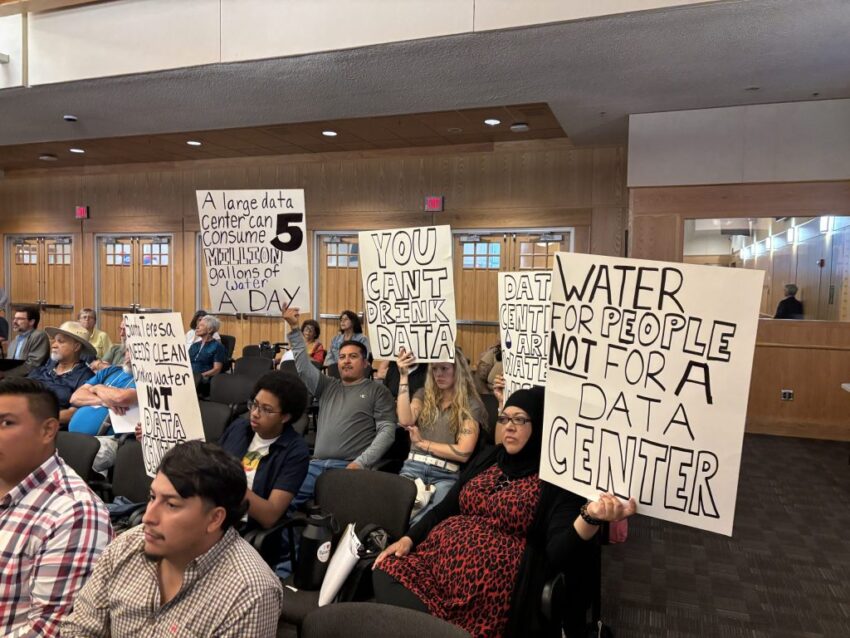
Lanham Napier is the chairman of BorderPlex Digital Assets, and he’s a longtime tech executive and investor over in San Antonio and Austin. At a meeting of the Doña Ana County Board of Commissioners on Tuesday, where dozens of people held signs protesting approval of the data center over water concerns, he said the campus his company wants to build would use quote “minimal” water. He offered few details of the closed-loop technology that the campus will employ, meaning it will recycle the same water over and over to cool the thousands of computer servers that the data centers will house.
Napier said the technology is innovative, and will make this facility very sustainable. When you talk to opponents of this project, they argued this closed-loop technology is novel and unproven. And we hear the stories of data centers straining water resources elsewhere. But he claims the water usage will be similar to an office building that holds 750 workers rather than some water-guzzling mega-user.
Lanham Napier: When it comes to water, this project will invest in all the water infrastructure necessary to pay for it. And we look at water resources that’s required, it’s basically domestic water uses for the employees. So, 750 employees, that’s running dishwasher, running sinks, using the facilities, using the toilet, that kind of stuff. So, the technology is advanced to where data centers run closed-loop systems. Water consumption is minimal. For any water consumption that’s required, this project will invest to fund it. So, we’re going to invest in the power, we’ll invest in the water, we will end up with very valuable jobs on the other side of it.
Diego: Maybe you don’t believe him. The county commissioners suggested they have some information they can’t share publicly that indicated the data center campus won’t strain the water resources in the area.
Shannon Reynolds: But, I gotta tell you, based on what I’ve been able to just to understand about this project over the last couple of months, and probably four months, I think, since I heard about it the first time. I believe if we all really understand this, you’ll find that it’s going to be very beneficial to everyone in the community. And I can’t be specific about that now, but hopefully over the next 30 days, with meetings we’re going to have, with opportunities for you guys to ask questions, you’ll get to the same point that I believe this board mostly is, about why we think this is important to Doña Ana County.
Diego: But, let me explain why some residents in Doña Ana County have a problem with trusting their elected officials. Some of the county commissioners there are the same ones who sat on the governing board of the Camino Real Regional Utility Authority, the water utility that serves Sunland Park and Santa Teresa. And they didn’t stop CRRUA from bypassing malfunctioning arsenic treatment plants that resulted in customers receiving water with unsafe levels of arsenic back in 2023 and last year.
And at the end of 2023, when Commissioner Susanna Chaparro was chair of CRRUA’s board, residents experienced slimy, high-pH water after operator failures at one treatment plant led to caustic soda pouring into the drinking water supply.
CRRUA, to its credit, has improved some in recent months under new leadership, but residents in southern Doña Ana County have experienced a crisis of living with contaminated, low-quality drinking water over the last couple of years.
So, when residents hear their county commissioners in Doña Ana say they have non-public information that assures them this big project is sustainable and they tell residents, “Don’t worry, trust us,” it’s easy to see why people are skeptical of their oversight of this data center campus and its water usage.
Now, that doesn’t mean Napier is lying. It just means that people in Sunland Park and Santa Teresa are justified in their skepticism. Maybe the closed-loop water cooling technology does work and the campus really won’t be a drain on water resources. But, for now, it’s fair to say the company hasn’t offered a lot of proof, at least publicly.
And while we’re on the topic of sharing information about this project with the public, one complaint I heard was how quickly this is being pushed through. What about some meetings to get feedback from residents before the final vote on September 19th?
Napier: Yeah, right now the plan is we’re going to be in the community regularly. We don’t have a specific, whether it’s daily or three times a week yet, that is still forming. But we’re committed to do it. I enjoyed the feedback session today. I think we hear the issues and I think we’ll be able to engineer good answers. I think we’ll deliver a good outcome.
Chaparro: OK. So, I think I need a more profound answer to that than just a regular meeting. So, if I can follow up, are we thinking of maybe, perhaps, two meetings in Chaparral, three meetings in Sunland Park, two meetings in Hatch? What the schedule is. Because I’d really like to get a handle on – I mean, we had a great presentation and I enjoyed the presentation and I can see the pros and cons. But also to include the public as a partner with this project, with this proposed project. And, so, we have a lot of people here. And this is a perfect opportunity to say “These are the meetings we’re going to have on certain dates and we’re planning X amount of meetings in each community,” so that the questions that are being asked today may be answered.
Diego: That was a back and forth between Napier and Susanna Chaparro. Jose Ibarra, a Sunland Park resident and business owner who supports his status center campus, said he would handle community engagement and scheduled public meetings.
Ibarra: So, I’ll be doing the community engagement, and we already scheduled in Sunland Park for a whole month. We’re going to be meeting twice a week Tuesday and Thursday for the next three weeks at the sports complex. That’s how we’re starting with Sunland Park, and we’re going to start moving to La Union, to Anthony, to Chaparral, to Vado, Chamberino, and all the way up to Las Cruces. And we’re not disregarding Commissioner Sanchez’ district either, as we’re going to be engaging with Hatch as well. And now we’re going to start moving forward and scheduling the meetings in different parts of the county. I want to make sure we cover the entire county.
Diego: I asked Sunland Park city officials about the times and dates of those meetings so I could plan to attend and try to ask questions and learn more. But a Sunland Park city spokeswoman told me that, rather than public information sessions, the meetings are quote “intended for local workers and businesses to understand how they can get involved in the construction of the facility” end quote. You all can form your own opinions about that.
In addition to saying the data center campus will use minimal water, Napier also said his firm would pay to develop its own electricity generation and storage component. El Paso Electric said it’s been designing electricity infrastructure to serve the data center for over two years. The details of that power supply agreement aren’t totally clear, but Napier referenced some of the solar power and battery storage projects under construction nearby the project site, just north of the Santa Teresa port of entry.
Napier: So, just know upfront, it will be adding power, we will not be using the existing power, so nobody’s power prices are going up.
Diego: Now, the concerns about whether the facility will be a drain on our water and power resources are fair and understandable, but we also have to think about the upside of a gargantuan private investment, especially when you consider that, at least for now, it seems very likely that a majority of the county commissioners will go ahead and approve this project when they vote in mid-September.
The project could provide over 2,000 construction jobs, and then, once it’s done, 750 permanent jobs for the data centers and power generation facility. They’ll pay between $75,000 and $100,000 a year, Napier said.
And maybe you don’t believe that either. Meta, which is building a big data center in northeast El Paso, only plans to create 50 permanent jobs. But 750 jobs in Santa Teresa near Sunland Park could represent a lot of opportunity for residents in our area. And part of the deal is that, in exchange for not having to pay property taxes, BorderPlex Digital will pay Doña Ana County $300 million in direct payments over the course of the deal, probably 30 years. That would equal $10 million a year, which is substantial, but it still kind of sounds like a small number compared to $165 billion total investment. Especially when you consider Doña Ana County currently brings in about $157 million of tax revenue annually.
Still, we all know that Las Cruces and the El Paso region broadly needs more job opportunities, particularly well-paying ones in a high-tech sector. And I think it’s understandable that Doña Ana County commissioners don’t want to reject a historically massive investment in their county.
Also, you can tell Napier and the people he’s working with are trying to get ahead of the huge concerns residents in our region are voicing about this project. The questions and concerns about water usage and sustainability are not going away.
A company called Stack Infrastructure, a partner in the project, issued a press release on August 28th saying things like the project will quote “safeguard community water supplies” and its backers are quote “prioritizing the protection of community resources.” They also said this project will include quote “tens of millions of dollars in planned investments in county drinking water and wastewater infrastructure improvements.”
Clearly, I don’t think one press release will address the questions of concerned citizens. But, it shows that the developers hear the wave of criticism, and the public relations campaign is on.
I want to say this, too. Napier is affable. He wore brown cowboy boots and a suede leather jacket to the meeting Tuesday, looking the part of a tech investor making a foray into the American Western frontier. He chatted after the meeting with concerned Las Cruces residents. And he politely declined when I asked to interview him after the meeting this week, saying he had to catch a flight.
Before he walked away from me, though, he grabbed his bag and showed me a copy of the book “Abundance” by the center-left writers Derek Thompson and Ezra Klein. It’s a book that advocates building more things in the United States – such as infrastructure, housing, clean energy projects – and it argues too much well-intentioned government regulation and over-empowered individuals have hamstrung American growth and dynamism and made it too hard to build things here. I thought that offered an interesting sliver of insight into the thinking of the man who’s talking about bringing a $165 billion project to our region. Again, I’ll let listeners draw their own conclusions about that.
I could go on more about this project, the almost unbelievable amount of investment proposed and how it could play out. But, I’ll just add that I’m going to seek more information about the water usage and closed-loop technology Napier said this campus will employ, explore who is really putting up the money to fund this and share with listeners how you all can make your voices heard either for or against this mega-project. This isn’t a topic that’s going away.
Feel free to e-mail me at diegom@elpasomatters.org to share any thoughts. And check out elpasomatters.org or sign up for our free newsletter to read our coverage about this and a lot of other important topics here on the border. I’ll leave it there for now.
Thanks for listening.
The post Podcast: Concerns about water, power and oversight arose over planned $165 billion Doña Ana data center. Here’s what we know. appeared first on El Paso Matters.
Read: Read More