



Editor’s note: This is the second part of a three-part series examining how transnational criminal organizations are sowing terror in Juarez, Mexico, and extending their tentacles into West Texas and Southern New Mexico, and challenging the Mexican government’s discourse that 90 percent of the violence is gang-on-gang and does not touch ordinary citizens.
The images are graphic, but that is exactly what the residents of working-class “colonias” and their children are exposed to every day south of the border.
North of the border, the docket in U.S. District Court in West Texas and Southern New Mexico reveals hundreds of cases involving migrant smuggling, migrant kidnapping and extortion, arrests in connection to stash houses, drug couriers and weapons smugglers, and almost daily seizures of narcotics as U.S. ports of entry.
El Paso is a city that prides itself as being one of the safest in America but is being infiltrated by a clever and silent enemy: drug cartels.
_________________
JUAREZ, Mexico (Border Report) – Juarez leaders describe their community of 1.5 million people as hard-working and visitor-friendly. They say their city often gets a bad rap from U.S. news media exaggerating the violence. Some tell Border Report they feel safer here than in U.S. cities like New York or Chicago.
U.S.-run plants here assemble car parts for Detroit automakers and computer motherboards for Asian clients. These factories employ 330,000 locals. Residents of Denver, Albuquerque and San Antonio often make long drives for cheaper dental implants that can be found here or fast-track bariatric surgeries.
American franchises from McDonald’s to Home Depot to Denny’s have multiple stores here.
But outside the tourist stops and affluent neighborhoods, Mexican authorities themselves treat much of Juarez as if it were a war zone. Military vehicles brimming with armed National Guard soldiers patrol the streets 24-7.
State and municipal police often go out in caravans at night. They set up roadside checkpoints and drive through high-crime areas. It is a scene not unlike that of American GIs in Afghanistan or Bagdad in the 2000s. And much like in those places, bad actors take over once the soldiers are gone.
Juarez has now surpassed 2,200 homicides in the past two years. That includes massacres that claimed nine lives at a funeral in the Aztecas neighborhood last year, and a rolling shootout with four dead between rival drug cartels this year on the highway to the Tornillo, Texas, port of entry.
Violence erupted Aug. 11, 2022, in Juarez, Mexico, with a radio crew gunned down outside a pizzeria and assailants firebombing several convenience stores.
Former Chihuahua state criminologist Oscar Maynez explains why well-to-do Juarenses and residents of less affluent areas called “colonias” have a different perception of what’s going on in their city.
“There are areas where certain criminal activity is tolerated, where you can get drugs – I don’t know – where there’s prostitution, any kind of illicit activities as long as long as these activities don’t go into the more affluent areas where there’s commerce, tourism,” Maynez told Border Report. “It’s kind of like a pact between these different groups with the authorities, with the criminal groups. These are the lines you don’t cross.”
But those lines are crossed all too often.
August 11 of last year became known as “Black Thursday.” It began with a shooting inside a prison that left two inmates dead and four wounded. It spilled onto the streets of Juarez, with members of rival gangs killing nine people – including four radio station employees doing a broadcast outside a pizza restaurant – and setting fire to several cars and convenience stores.
The fight between two factions of the Sinaloa cartel in Juarez resumed at the prison this past New Year’s Day. It left 17 people dead, including 10 police officers. The target of the attack, Mexicles gang leader Ernesto Pinon de la Cruz, a.k.a. “El Neto,” escaped. He was gunned down by police days later.
Armed gunmen went into a Denny’s restaurant and shot two men and women dead in broad daylight in June of 2022.
Lines also were crossed in June of last year. Armed gunmen went into a Denny’s restaurant and shot two men and women dead in broad daylight. A chilling security video shows customers laying their heads on tables, hoping not to get shot.
Despite daily killings in working-class neighborhoods, Chihuahua Attorney General Cesar Jauregui insists Juarez is safe for visitors and law-abiding citizens.
“You can see a city full of life, with hotels practically at 100 percent occupancy, with restaurants full, with economic activity in full swing, with lots of businesses wanting to come to Juarez, open their doors and create jobs,” he said this month.
But residents of the “other” Juarez, the one hurting for police protection, the one where most of the bodies are found, beg to differ.
“It’s sad to see so many people lose their lives. Sometimes they take innocent people, too. It affects us a lot as residents and as a society. We cannot go out in peace, and we don’t feel safe even at home,” said Claudia Gutierrez.
She was interviewed in front of a store in the Lote Bravo neighborhood where a man was shot just hours earlier.
She and other residents said drug sales have proliferated in recent years. A gang will recruit young men and women to sell drugs in a neighborhood. Another gang comes to take over the new market. They strike sales points known as “tienditas” or little stores. They kill rivals and whichever customers happen to be there. In September 2021, seven people were murdered and then incinerated inside a home in the Division del Norte colonia where residents said crystal meth was sold.
Border Report in October went to the scene of a double homicide in El Granjero in South Juarez. Three different families showed up minutes apart looking for missing relatives. All three families went home still wondering where their loved ones were.
“They picked them up last week. They were just out (drinking),” said an older woman who was looking for her son and nephew. On the opposite side of the street where the bodies lay, a man in his 30s cried after his gray-haired father talked to police and came back to tell him neither of the bodies was his brother.
Crime analyst Maynez said neither Juarez authorities nor the Mexican government are fighting the cartels when it comes to trafficking drugs to the United States or preventing them from developing a domestic sales market.
“In Mexico, not just in Ciudad Juarez, or in Chihuahua, neither the state nor the city have the capability to confront organized crime,” he said. “Even if they were uncorrupted, they couldn’t do it – and we know there is some involvement of police authorities, at all levels with organized crime.
“We cannot accept it, but as of today, I haven’t seen anything that tells me the state or the city or the federal government are doing anything to try to control it.”
Local police occasionally arrest those who pull the trigger. These are hitmen paid as little as $150 or a handful of drugs for the deed. But the cartel leader who procures the meth or the heroin, the gang boss who presides the takeover of a neighborhood is seldom paraded in front of TV cameras.
Mexican government officials at the highest levels portray their country as one where violent crime is going down and where fentanyl – the drug killing tens of thousands of Americans each year – is not manufactured.
“In Mexico, there are labs, kitchens where methamphetamines are being produced, mostly. There must be some type of arrival to Mexico of fentanyl, and, yes, it goes to the United States. But I insist, Mexico does not produce fentanyl. I want to make that clear,” Federal Public Safety Secretary Rosa Icela Rodriguez said last month at a joint U.S.-Mexico news conference.
Members of the Sinaloa cartel, including the sons of drug lord Joaquin “El Chapo” Guzman, are under indictment in U.S. federal district court for manufacturing and trafficking fentanyl from Mexico to the United States.
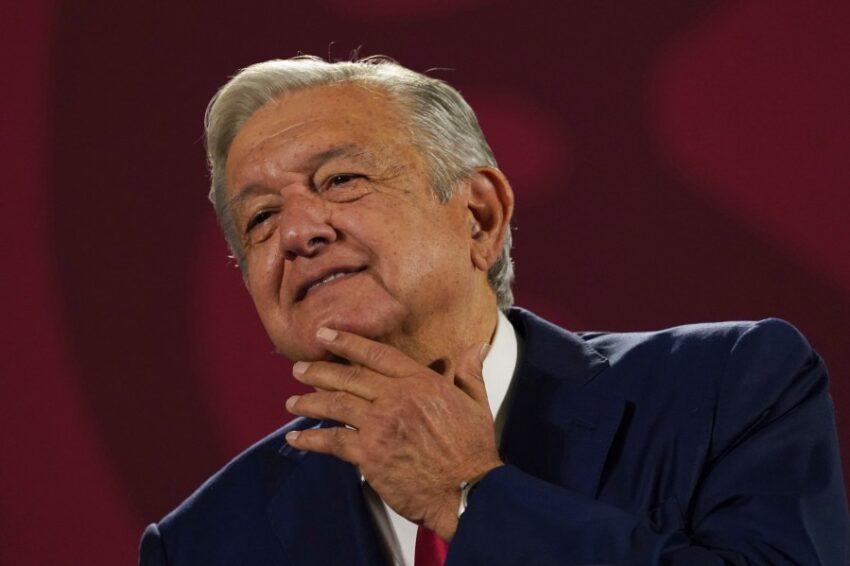
President Andres Manuel Lopez Obrador says crime is going down in Mexico, even though data from his own administration shows homicides at an all-time high.
He blames the violence on his predecessors.
“They say, ‘Look, there is too much violence over here.’ But look how they left it to us. And what are we doing? 17% less now when they made it rise 200%.”
Cartel atrocities are not just happening in Juarez. Gang members are being hung from trees and highway overpasses in Zacatecas. Twelve police officers were gunned down in Guerrero last month, their bodies left next to trees and a wall. Cartels are using drones to drop homemade bombs on rivals in rural areas of Guerrero, forcing residents to flee their homes. Closer to Juarez, a drug cartel hung the mutilated body of an alleged rapist from the entrance arch to the city of Casas Grandes.
The pace of Mexican action – or inaction – against the cartels is prompting some American politicians to want to label the transnational criminal groups as terrorist organizations. That would give the U.S. a green light to go after them wherever they are.
“We are going to designate the cartels to be foreign terrorist organizations or something similar to that. And we are going to authorize the use of deadly force,” presidential candidate and Florida Gov. Ron DeSantis said at a recent televised debate. “We are going to have maritime operations to interdict precursor chemicals going into Mexico. If someone in the drug cartels is sneaking fentanyl across the border, that’s going to be the last thing they do. We are going to shoot them stone-cold dead.”
Political analysts say any such bills will be stillborn in a Congress divided along party lines. But that could change should hardline Republicans take the White House and both houses of Congress in 2024.
Read: Read More