



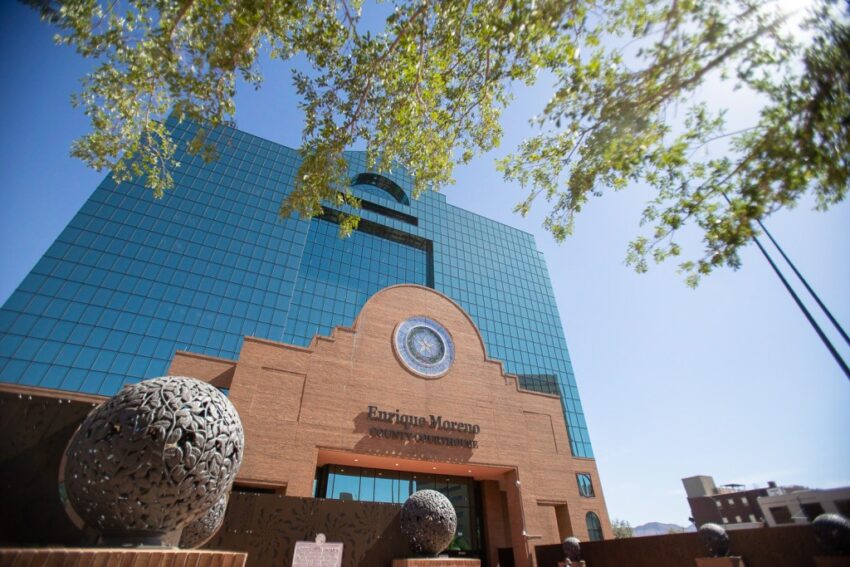

Two El Paso County Courts at Law races are on the March 3 Democratic primary ballot, with three candidates running for each open seat after the incumbent judges chose not to seek reelection.
As they campaign on experience and how they would manage misdemeanor criminal dockets, several candidates have faced past controversies, including a public admonition for judicial misconduct, a protective order over family violence allegations and property tax delinquencies.
Sergio Saldivar, Frances Maldonado and Christina Montes are running for judge of County Court at Law No. 2. The winner will succeed Julie Gonzalez, who has been a judge for about 30 years.
Marcos Lizarraga, Eunice Reyes and Jeffory “Jeff” Rago are vying for the County Court at Law No. 4 judge seat. The winner will succeed Judge Alex Gonzalez, who took office after running unopposed in 2022.
The courts handle criminal misdemeanor cases such as DWIs, family violence, bond forfeitures, burglaries and prostitution.
CANDIDATE Q&A: 5 questions for candidates in March primary contested races
With no Republican challengers, the winners of the Democratic primaries will be seated on Jan. 1, 2027, to serve a four-year term. County Court at Law judges are paid salaries ranging from $157,000 to $193,400 per year depending on their years of judicial service.
El Paso County has seven county courts at law, although the races in the other five courts – Nos. 1, 3, 5, 6 and 7 – are uncontested. The Democratic incumbents in each will be considered automatically reelected since they also won’t face any Republican opponents in November.
Early voting for the March primaries begins Feb. 17 and runs through Feb. 27.

County Court at Law No. 2
Frances Maldonado
After operating her own private practice for several years, Maldonado, 45, wants to return to the County Court at Law No. 2, where she started her law career as a line attorney at the District Attorney’s Office over a decade ago.
She is the only candidate running for the seat to agree to an interview with El Paso Matters.
Over the years, she has worked in multiple felony and misdemeanor level courts, and a specialized unit that prosecutes domestic violence cases. Maldonado said she had also worked on civil cases in her private practice, which she said gave her experience in multiple areas of the law.
As a judge, Maldonado said she wants to ensure the court remains efficient, like it was when she worked there as a fresh-faced attorney.
“That essentially is the priority, ensuring the cases are run efficiently because a delay in the cases means the defendants have to have their case pending for longer. Victims don’t get justice, or have to wait around for their day in court,” Maldonado told El Paso Matters.
Maldonado said she plans to evaluate the court’s efficiency and keep strict deadlines to ensure cases are handled smoothly.
She said the county has several specialty court programs that focus on rehabilitation, such as DWI drug court, and thinks they are a good option for some defendants.
“I think if a person’s willing to go into that program, I think it’s really beneficial as far as implementing them. I think it has to be like case by case, depending on the severity and whether that program is warranted,” she said.
“These are great programs, because they do help rehabilitate people. They get people the help that they need to make any changes that they need to in their life, address any issues, and turn their life around right, so that they don’t come back into the court system,” she added.
Maldonado raised nearly $13,600 in political contributions, according to her campaign financed reports submitted Jan. 15 and Feb. 3. The Wyatt & Underwood Law Firm was among her top contributors, giving $1,000. She also gave herself several loans worth $44,000.
She spent $15,800 in unspecified advertising, consulting and canvassing, and charged over $1,400 worth of unspecified advertisement materials to a credit card.
All the candidates running in the primary for a County Courts at Law seat, except Montes, also paid $1,500 to the El Paso County Democratic Party for filing fees.
Sergio Saldivar
Salvidar, 58, a private attorney who started practicing law in 2002, handles family, criminal and immigration cases, according to his law offices’ website.
He did not respond to El Paso Matters’ request for an interview or fill out a questionnaire sent to candidates in contested races.
Salvidar previously ran for El Paso County attorney in the 2024 Democratic primary, losing to Christina Sanchez.
Saldivar agreed to a protective order in 2019 after he was accused of stalking a woman and family violence. Saldivar denied the allegations in a 2024 interview with El Paso Matters. The protective order expired after two years. He was not accused of violating the terms of the protective order, and no criminal charges were filed.
In 2025, an El Paso Matters investigation found he didn’t pay property taxes between 2020 and 2024 on improvements made to his 2,900-square-foot home in the Upper Valley.
City property tax records show over $23,400 was paid in August 2025 for the past due tax bills, as well as over $10,300 in December for 2025. The payments were made after the El Paso Matters investigation was published.
Saldivar’s campaign finance reports show he collected $3,700 in political contributions, made up mostly of donations under $500. His largest donors include Santiago Hernandez, who gave $750, and Luisa Irene Vasquez and Rebecca Reyes, who each gave $500.
He also received $450 in in-kind political contributions for balloons and appetizers for an event, and gave himself two loans totaling $22,200. Saldivar spent over $14,900 on graphics, yard signs, banners, t-shirts, his website and other advertising material.
Christina Montes
Montes earned her attorney’s license in 2016 and practices at her own firm, which focuses on criminal, family, immigration and juvenile law, according to the State Bar of Texas website.
She did not respond to El Paso Matters request for an interview or voter guide questionnaire.
Montes held a campaign and fundraiser launch party Jan. 20. She collected $1,800 in donations, the largest being $500 each from Fernando Serano, Luis Yanez and Samuel Aboud, her 30-day campaign finance reports show. She also gave herself a $1,600 loan for the campaign and spent over $1,500 on signs, banners and shirts.

County Court at Law No. 4
Marcos Lizarraga
Lizarraga, 69, has served as judge in the 168th District Court for 16 years but said he wants to focus only on misdemeanor criminal cases. He’s the only candidate certified in criminal law, according to the Texas Board of Legal Specialization.
“I want to continue being a judge, if I win this election to be a judge of the County Court of Law No. 4, which only does criminal. So it isn’t anything other than that,” said Lizarraga, whose current term ends Dec. 31. If he were to win the county court seat, he would take office Jan. 1
Last year, Lizarraga was issued a public admonition by the State Commission on Judicial Conduct for engaging in several improper “ex parte” communications in the murder trial of Moises Galvan, who was charged in the 2017 shooting death of Rogelio “RJ” Franco at an East El Paso bar. The trial was declared a mistrial by Lizarraga, who was removed from the retrial of the case in 2022 after the misconduct allegations. Galvan was sentenced to 55 years in 2023.
“I don’t want to give a defense because that’s not how I view it,” Lizarraga said when asked about the admonition, adding that a disclosure on his ballot application states he acknowledged holding these ex parte communications. He was last reelected judge in 2022, when he ran unopposed.
Lizarraga said he is unable to answer questions on his philosophy on balancing defendants’ rights with accountability, his approach to handling cases where judges are given more discretion, or his views on topics like rehabilitation because of the state’s judicial code of ethics.
“We are not supposed to say things that would give any party an indication of how we could rule in a particular case, or in any kind of manner, so I can’t easily answer questions about my philosophy,” Lizarraga said.
Though judges are generally allowed to share their personal thoughts and beliefs, they must avoid sharing information about specific cases or doing anything that could cast doubt on their ability to act impartially, according to the Texas Code of Judicial Conduct.
“All of my actions are going to speak for themselves,” he said.
Lizarraga collected nearly $14,900 in political contributions, including $2,500 each from the Law Firm of Daniela Labinoti and James Scherr, $1,500 from the Walter Boyaki Law Firm and $1,000 each from Marjorie Jobe and the Wyatt & Underwood Law Firm, according to his latest campaign finance reports.
He reported spending a total of $118,396 on the campaign, including $14,200 from his political contributions, $22,600 charged to a credit card and nearly $81,600 from his personal funds. His personal expenditures include a $60,000 payment to his wife and campaign treasurer, former city Rep. Cecilia Lizarraga, to repay a loan, and $15,560 to Chase Bank for his credit card expenditures.
Some of his purchases include consulting services, campaign management, flyers, door hangers, meals and other advertising expenses, according to both reports.
Eunice Reyes
Reyes, 38, said she decided to run after seeing several judges’ plans to retire, feeling she had the right skills, compassion and love for the law to do the job.
“I think it has to be someone who’s actually been in it. Someone who has the experience and someone who has the love for the law to go ahead and be on these benches,” Reyes told El Paso Matters.
Reyes earned her attorney’s license in 2013 and has practiced at her own firm, Eunice Reyes Attorney at Law, since then. Her main focus has been family, juvenile and criminal law, and she has worked cases in juvenile drug court for 12 years.
She has also served as the municipal court judge in Anthony, Texas, and as a part-time jail magistrate judge for about five years.
“The technicality of the level that I know the law is more than just a general lawyer,” Reyes said. “We don’t know what crime is going to come before us, so we have to be very knowledgeable about the elements of a crime.”
Reyes said she believes the court needs to be fair and provide equal justice for everybody, which she says takes balance.
“It’s a balancing system of figuring out whether the defendants’ rights are protected. Are the victims being heard, and is there justice for them?” Reyes said.
Reyes said she supports rehabilitation and diversion programs, especially after working in juvenile drug court.
“When I have criminal defendants, I have advocated and have decided with my client that DWI drug court is the best option for them to be rehabilitated. So we need those opportunities for the defendants because the goal is right in a perfect world, would be that if you’ve committed a crime in our society, there’s a punishment, but we don’t want you to return,” Reyes said.
Her first two campaign finance reports show Reyes loaned herself $28,700 and paid over $7,600 for signs, flyers, banners, t-shirts and a magazine advertisement.
Jeffory “Jeff” Rago
Rago, 61, said he has been considering running as a judge for 15 years and felt it was finally time to throw his hat in the ring.
He earned his license in 1993 and has run his own practice, the Rago Law Office, for over 32 years, focusing on misdemeanor cases, family violence and bond forfeitures.
“Since I’m pretty well versed in handling these types of cases, I’d be a service to El Paso and to the people of El Paso. I’ve got a lot of support from other lawyers, so I think the timing was right,” Rago told El Paso Matters.
Rago said many of the decisions a judge makes are a balancing act between safety, accountability and a defendant’s rights, and are based on the facts of the case.
“You balance out whether this person is going to be a risk to society, and balance that with his right to a bond, because he has an absolute right to a bond, whether the bond is reasonable or not, is something different,” Rago said. “We can be very creative on how we can do different things to safeguard everybody’s protections and rights. So it just depends on what we have coming in, and that would dictate how we deal with it.”
Rago said rehabilitation is a good option for defendants if they are willing to do it.
Records from the El Paso Tax Office show Rago, and his wife, Christina Rago, owe over $98,600 in property taxes dating back to 2015 for his law firm offices in Central El Paso. This includes over $40,700 in fees and interest.
Court records show the Ragos are in the midst of a decade-long legal battle with the city, challenging those fees and interest charges after a judge in 2022 found they were improperly notified of an increase in property valuations in 2015.
Rago said he paid an $87,000 bond toward his property taxes, which will be returned to him if he wins the case, but did not provide records when asked by El Paso Matters.
City officials declined El Paso Matters’ request for comment on Rago’s property taxes due to ongoing litigation.
“This was a contested dispute that went through litigation for over 10 years,” Rago said. “We have it up on appeal now, because they are trying to go back and charge me for something that the judge specifically said they couldn’t do.”
Owing property taxes doesn’t disqualify judicial candidates from taking office.
Rago’s last two campaign finance reports show he collected over $17,000 in political contributions, including $2,500 each from Tim Wegletiner, Todd Flaherty and Altaf Adam, $2,000 each from Jose Lozano and Gabriel Lazar and $1,000 from Ric Barubeault.
He has spent over $2,500 on a cell phone ping advertising service, $2,200 on a voter list, $2,200 on food for a campaign fundraiser and over $2,400 for campaign signs, flyers, cards and pens with custom logos.
The post Conduct concerns surface among El Paso County Courts at Law judicial candidates appeared first on El Paso Matters.
Read: Read More