



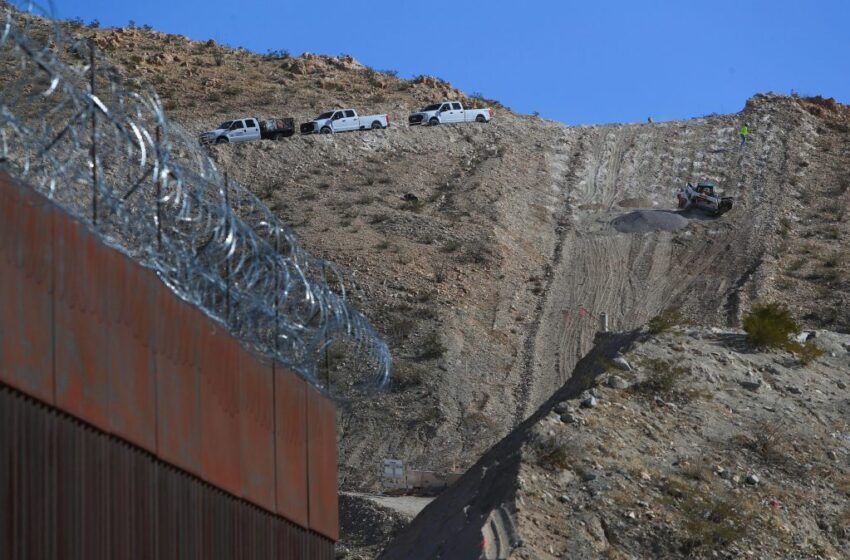

SUNLAND PARK, NEW MEXICO — U.S. Customs and Border Protection began border wall construction last month on Mount Cristo Rey, a mountain straddling southern New Mexico and Mexico with views overlooking El Paso. Video footage of explosions on the mountain’s base circulated on social media in January and federal officials confirmed the detonations were part of the demolition for the wall.
Construction workers are demolishing parts of the mountain to build the concrete base for the wall. Controlled explosions will continue throughout the duration of the project, which is anticipated to finish in October 2027, CBP spokesperson John Mennell said in an email.
Rising to an elevation of more than 4,500 feet, Mount Cristo Rey is a popular hiking and pilgrimage destination known for its limestone statue of Christ at the summit. The geological site stands between the Franklin Mountains in El Paso and the Sierra de Juárez in Chihuahua, serving as a habitat and passageway for wildlife.
Mount Cristo Rey also serves as a treacherous route for migrants crossing its rocky slopes into the United States. Mennell said this area is one of the busiest routes for human smuggling in CBP’s El Paso Sector, which spans all of New Mexico through El Paso and Hudspeth counties in Far West Texas.
The reinforcements come after migrant encounters plummeted by 89% in the El Paso Sector last fiscal year following stricter asylum restrictions, the suspension of the CBP One app for asylum appointments and aggressive immigration enforcement policies. CBP data from this fiscal year, which started in October, show encounters continue to drop.
In June, Secretary of Homeland Security Kristi Noem waived federal environmental laws to expedite new border wall construction, including the 1.3-mile-long segment at the base of Mount Cristo Rey.
But conservationists warn the structure also makes it harder for plants and animals to cross back and forth through their natural corridor – one that’s already fragmented by border barriers, roads and development. They say this spells dire consequences for their long-term survival.

“I think every little bit counts,” said El Paso wildlife biologist Kylie Rezendes. “Scientists say right now that we’re in the sixth great extinction. Mammals are dying at a rapid pace, so any sort of stopping of their ability to survive, I think is uncalled for.”
‘The desert is very special’
Mennell described the Sierra de Cristo Rey as a “barren, rugged mountain system with no natural water sources and very little plant or animal life.”
“A lot of it looks like moonscape because it’s just rock and sand,” said Landon Hutchens, CBP spokesperson for the El Paso Sector. “There’s not much vegetation up there.”
Rezendes disputed these descriptions.
On a recent trek up the mountain, she identified the vegetation she saw around the hiking trail: banana yucca, creosote, Mormon tea, skeleton bush, a sotol that had already lost much of its leaves to hungry mule deer.
“Everyone looks at the desert and they see desolate, brown, dead, empty,” Rezendes said. “You drive around the greater El Paso area and see garbage dumped in back roads. It’s not seen as special. But it takes the desert 100 years to make one inch of quality soil. The desert is very special in its ecology in how long it takes to become viable enough to make plants grow.”

Prey species are abundant on Mount Cristo Rey, Rezendes said. Rodents and hoofed mammals such as javelinas can get water from eating cacti and succulents, while carnivores such as mountain lions can go days without water and make long treks to the Rio Grande or other known water sources, she said.
As Rezendes made her way up the steep incline, she pointed out the side trails formed by years of wildlife movement, then humans following those same paths. She squatted down every so often to inspect a variety of animal tracks and droppings.
“That is a good coyote print,” she said, hovering her hand near the paw pad indentions in the ground. “A smaller version of that would be the gray fox.”
Unlike domestic dogs that tend to splay their paw pads, coyotes keep their paw pads more compact, she explained.
Ray Aguilar, a conservationist in Ciudad Juárez, said preserving the wildlife corridor is critical for genetic diversity in the Chihuahuan Desert.
The Chihuahuan Desert is considered the most diverse desert in the Western Hemisphere, with more than 3,500 plant species and hundreds of different mammals, birds, reptiles and amphibians, according to the U.S. National Park Service. It is also one of the most endangered ecoregions in the world.

The many species that cross the border share information through their DNA to become more resilient and adapt to changes in their environment, Aguilar explained. Those genes get passed through reproduction and with more genetic variation, the better chance for survival.
Habitat divides such as the border wall reduces gene flow of both fauna and flora, he said. When animals eat plants, they disperse the seeds through their droppings. With isolation comes inbreeding.
“Animals who are adapted to climate change on either side of the border, these adaptations can be essential to animals on the other side,” Aguilar said. “Without this information sharing, there’s less distribution, less reproduction … Basically, we condemn them.”
One of the wildlife with low genetic diversity is the endangered Mexican gray wolf, seen near El Paso in 2017. An abundance of Mexican gray wolves once roamed the U.S. Southwest before people killed them off to protect livestock. By the 1970s, people drove them to extinction in the wild. Today’s wolves descend from the same seven captive wolves.
Mexican gray wolves released into the wild face threats other animals experience: illegal hunting, vehicle collisions, habitat loss and blocked migration. Animals that can’t fit through the narrow space between the border wall’s steel bollards try to find other ways to cross, such as through vehicle barriers – fencing made of steel X-shaped structures. The Department of Homeland Security is replacing vehicle barriers along the border with “smart walls.”
How do wildlife cross the border?
The Mount Cristo Rey border wall is part of the El Paso Sector projects announced last year, which include more than 70 miles of primary border wall construction in New Mexico and Texas. DHS and CBP awarded more than $1.5 billion in contracts to out-of-state companies BCCG A Joint Venture and Barnard Spencer Joint Venture for the El Paso Sector projects.

The Mount Cristo Rey segment replaces the existing vehicle barrier located at the base of the mountain. The barrier will stand 30 feet tall with six-inch steel bollards separated 4 inches apart and reinforced with concrete. CBP has plans to install lights, cameras, roads and detection technology along with it.
The new “smart wall” will deter cartel criminal activity, Mennell said.
Hutchens declined to release a schedule of the planned detonations and directed El Paso Matters to Border Patrol’s social media, which shows footage of recent explosions.
The segment joins a half-mile-long, privately funded border wall at Mount Cristo Rey. The project, led by former Trump adviser Steve Bannon, was built in haste over Memorial Day weekend in 2019, surprising Sunland Park officials, who said the construction did not have proper permits.

Rezendes questioned the need for a physical barrier at Mount Cristo Rey when CBP already has long-range sensors, night thermal imaging and other surveillance tools – as well as agents patrolling the area, she added.
Aguilar said the federal government should at least install animal gates. Similar to “doggy doors,” the gates allow small animals to crawl through.
Small wildlife passages, though scarce, improved crossing rates for some animals, according to a 2024 study by the Sky Islands Alliance in Tucson and Wildlands Network in Utah.
Between 2022 and 2024, scientists used cameras to observe wildlife interactions with border barriers on the Arizona-Sonora border. Focusing on 20 species, they found less than half the animals that interacted with barriers crossed, with success rate varying by species and barrier type.
Species such as the mule deer, American black bear, wild turkey and mountain lion had a zero percent success rate at crossing through spaces in the border wall, but had more success crossing through vehicle barriers.
CBP received 224 comments about Mount Cristo Rey wall construction during the public comment period, according to a feedback report. About 40% of the comments expressed concern that the border wall “could negatively impact the habitat, biodiversity and the well-being of wildlife in the area.”
Border wall opponents also argued the project could damage a place with religious, historical and cultural significance.
Mount Cristo Rey is a volcanic intrusion estimated to be 50 million years old. The site contains dinosaur tracks and fossilized sea creatures dating back to the Cretaceous period, indicating the area was once a shallow coast.
Every fall, thousands of visitors make the pilgrimage to the Christ the King statue at the summit. The Catholic Diocese of Las Cruces, which owns 200 acres on the New Mexico side of Mount Cristo Rey, opposes the border wall construction.

CBP responded that the border wall will not affect the pilgrimages because it will be located on the southern base of the mountain, while the trail leading to the summit is located on the northern side of the mountain,
To minimize impacts, CBP consulted with stakeholders including Tribes during the planning process, Mennell said. The agency also completed biological and cultural surveys which will be used to inform an Environmental Stewardship Plan.
“No federally listed threatened or endangered species were observed during the surveys,” the feedback report reads. “Should any listed species be observed during construction all activities will immediately be suspended in the area and the monitor onsite, or a biological consultant will be contacted for guidance.”
The post Border wall construction begins at Mount Cristo Rey, impacting wildlife corridor appeared first on El Paso Matters.
Read: Read More