




As Congress continues to grapple with border enforcement, immigration policy and the rising cost of living, voters in Texas’ 23rd Congressional District are weighing sharply different visions for how — and whether — Washington can address those challenges in one of the nation’s most closely watched border regions.
The sprawling district, which stretches from El Paso’s Lower Valley through West Texas to the San Antonio area, has drawn crowded primary fields from both major parties.
Four Republicans and four Democrats are seeking their party’s nomination in the March 3 primary election.
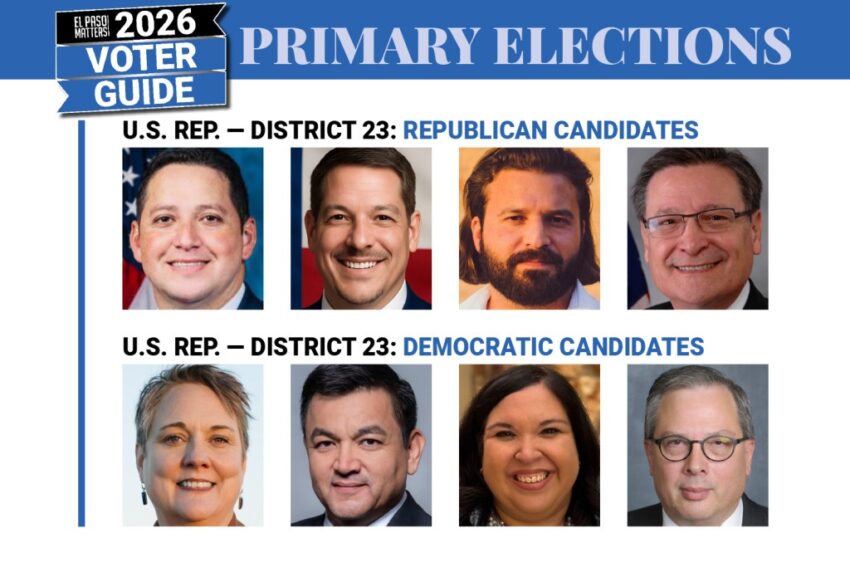
The Republican field of candidates includes incumbent Tony Gonzales, who is being challenged in the primary by Keith Barton, Brandon Herrera and Francisco “Quico” Canseco. The Democratic primary pits Gretel Enck, Santos Limon, Katy Padilla Stout and Bruce Richardson.
Early voting runs Feb. 17-27, with Election Day on March 3. If no candidate in a party primary receives more than 50% of the vote, the top two finishers advance to a runoff May 26. The general election is Nov. 3.
The 435 members of the U.S. House of Representatives introduce bills and resolutions, offer amendments and serve on committees. U.S. representatives serve two-year terms and are paid $174,000 a year.
The races feature a mix of incumbency, prior congressional experience and first-time candidates, with campaigns centered largely on border security, immigration enforcement, economic pressures on families and the role of federal government in a geographically vast and politically diverse district.
Republican Primary: Incumbent Faces Challengers from the Right
The Republican candidates are largely united in emphasizing border enforcement, immigration restrictions and opposition to federal regulation, though they differ in how they describe the federal government’s role in addressing those issues.
Some have argued that current federal immigration policies have failed and that Congress should take a more aggressive approach to border security. While candidates frequently called for stronger enforcement, changes to asylum policy or a rollback of regulations, not all provided details about how those goals would be achieved legislatively or how they would build support for such measures in Congress.
The primary also reflects divisions between candidates with governing experience and those positioning themselves as political outsiders, particularly in their critiques of Congress and federal agencies. In interviews and written responses, some candidates pointed to broad policy priorities without outlining specific bills, timelines or funding mechanisms.
Tony Gonzales, Incumbent
Gonzales, 45, did not respond to El Paso Matters’ request for an interview, but has centered much of his campaign messaging on border enforcement and immigration policy.
In a Feb. 8 appearance on CBS’ “Face the Nation,” Gonzales defended the use of administrative warrants by immigration authorities, saying, “Administrative warrants work,” and that law enforcement should have “every tool they need” to apprehend “convicted criminals.” Administrative warrants are issued by federal immigration agencies and do not require approval from a judge, unlike judicial warrants, which must be authorized by a court upon a showing of probable cause. Gonzales did not outline any specific legislation he would introduce or support to clarify warrant standards or address legal concerns raised by civil liberties groups.
Gonzales also signaled firm opposition to broad immigration relief proposals, stating on the CBS show, “I’ll tell you what’s not going to be in there, amnesty for illegal aliens.” While he drew that line clearly, he did not detail what specific enforcement reforms he would pursue in ongoing negotiations or how he would build bipartisan support for them in the House.
During the interview, Gonzales said he favors prioritizing the removal of “convicted criminal aliens” and described focusing enforcement in jails as safer than “going house-by-house.” When asked about the detention of a 5-year-old with a pending asylum claim, Gonzales responded, “We have to have a nation of laws,” adding, “We can be compassionate, and we can also enforce our laws.” He did not specify what standards he believes should govern family detention or how Congress should address asylum case backlogs.
Beyond immigration, Gonzales has argued that Congress must address economic pressures facing families, though in public remarks he has largely framed those concerns in broad terms and has not outlined district-specific proposals to lower housing, food or health care costs.
Gonzales raised $148,234 during the most recent reporting period, according to his Jan. 30 filing with the Federal Election Commission. He reported more than $1.02 million in total contributions for the election cycle and had about $2.48 million in cash on hand at the close of the reporting period.
His campaign received contributions from corporate political action committees, including $5,000 from Gulf States Toyota Inc. Federal Political Action Committee and $2,000 from Booz Allen PAC, along with transfers from his affiliated Tony Gonzales Victory Fund.
The campaign reported $276,927 in operating expenditures during the reporting period. Major expenses included more than $51,000 to Lilly & Company for finance consulting, printing and postage; $5,000 to Everest Consulting for political strategy consulting; $5,000 to a San Antonio-based digital consultant for advertising; and payments to compliance and database management vendors.
Keith Barton
Barton, 46, a retired Marine Corps officer and logistics executive, said he is running because he believes District 23 has been “completely ignored” outside of election cycles.
“I am not a politician,” Barton said during his interview with El Paso Matters. “If you’re going to talk to me, it’s just going to be normal — you’re talking to just a regular Joe.”
Barton grew up on a small farm in Alaska before serving 20 years in the Marine Corps as a reconnaissance Marine, helicopter pilot and logistics officer. He described himself as “a combat disabled veteran, like, real combat outside the wire.” After leaving the military, he worked in large-scale logistics operations, including overseeing a 2.6 million–square-foot Walmart facility and managing a 24-hour Airbus support operation.
He said that operational background shapes how he views the border.
“The border’s not done,” Barton said about security measures. “It needs to be built in depth, and it needs to be changed from a single push of money to a regular line item in the budget.”
He compared border enforcement to establishing layered defenses in the military: “First you have a physical barrier. You’ll have patrols. You’ll have … surveillance and choke points.” Because cartels “are extremely smart businesses with an illegal commodity,” he said enforcement must continually adapt rather than rely on one-time funding efforts.
Barton said he supports stronger enforcement against unlawful crossings while also accelerating legal immigration processing.
Barton said he strongly opposes illegal immigration while supporting legal immigration pathways. “We have the technology for both in and out goods and services and people to speed this up.” He said it should not take “10 years to get in the country” for qualified applicants, though he did not outline specific statutory changes he would pursue to reform visa processing timelines.
On spending and congressional process, Barton said he would focus less on introducing sweeping standalone bills and more on leveraging committee work and oversight authority. “Most freshmen congressmen have the problem — they go after funding. You don’t go after funding. You go after funding with the savings on top of it,” he said, arguing that identifying efficiencies could allow projects to move forward without significantly increasing federal expenditures.
He criticized lengthy legislation, saying, “Congress has this terrible thing of putting Band-Aids on everything. You’ve got an 800-page bill, you have no clue what it says.” He said many issues could be addressed through more targeted proposals focused on what he described as root causes.
On cost-of-living concerns, Barton said expanding energy production in West Texas and investing in vocational training would create higher-paying jobs.
“Energy is beautiful for West Texas,” he said. “The biggest thing is getting real vocational training now and creating the jobs through energy.”
He argued that trade and vocational programs tied to energy development could raise household incomes and broaden the district’s economic base.
Barton did not file a campaign finance report for the most recent reporting period.
Francisco R. “Quico” Canseco
Canseco, 76, an attorney and former member of Congress, represented District 23 from 2011 to 2013. He is seeking to return to the seat more than a decade after leaving office.
Canseco did not respond to El Paso Matters’ request for an interview. In written questionnaire responses to El Paso Matters, he said his priorities are “strengthening families, protecting communities and preserving the constitutional foundations of our country.”
On border security, Canseco said Congress should restore policies such as “Remain in Mexico,” remove incentives that encourage illegal immigration, “defund sanctuary-cities,” support law enforcement and combat human trafficking. He also said the immigration system “must insure the safety and security of our nation” and should prioritize American citizens and the national economy.
He did not outline specific legislative proposals or describe how he would build support for those changes in the current Congress.
On economic policy, Canseco said Congress should reduce regulations that he argues increase housing, energy and transportation costs; expand domestic energy production; cut federal spending; and make the 2017 Trump tax cuts permanent. He also called for repealing the federal estate tax and reforming the Endangered Species Act and Clean Water Act, saying they represent federal intrusion into property rights.
Addressing health care, Canseco said the Affordable Care Act should be reformed by repealing provisions he said drive up costs while preserving protections for preexisting conditions. He also called for “Health Freedom Accounts” and greater flexibility for states to design health care systems that reflect local needs.
On veterans’ issues, Canseco said the Department of Veterans Affairs “must be reformed,” calling the agency inefficient and saying veterans should have the ability to use a “Card” to see a provider of choice. He did not detail how such a system would be structured or funded.
Canseco reported $32,000 in contributions to himself during the most recent reporting period, according to his Jan. 31 year-end filing.
Canseco also loaned his campaign $48,050 during the reporting period, bringing total receipts for the period to $80,050. He reported more than $201,600 in cash on handand $171,490 in outstanding debts and obligations.
The campaign reported $6,250 in expenditures during the reporting period, including $3,125 filing fee payments to the Republican Party of Texas. Additional outstanding debts listed in the report include legal and compliance fees, consulting services and prior election-related expenses.
Brandon Herrera
Herrera, 41, a firearms manufacturer and social media personality, is mounting his second campaign for the seat after narrowly losing to Gonzales in the 2024 Republican primary runoff. That race exposed ideological divisions within the party, particularly over border enforcement and Gonzales’ willingness to support bipartisan legislation.
In a telephone interview with El Paso Matters, Herrera said his campaign centers on what he describes as restoring federal authority at the border and reasserting congressional control over spending. He argued that the current immigration system has incentivized unlawful entry and that Congress has failed to exercise its constitutional authority.
“For being the biggest border district in the entire country, we need somebody who’s gonna be stronger in that way,” Herrera said, arguing that Congress should “put up all the barriers we can, both physical and legal.”
Herrera said he would support reinstating policies such as “Remain in Mexico,” tightening asylum eligibility standards and increasing both physical barriers and surveillance infrastructure along the southern border. He also said enforcement should prioritize removing individuals who have entered unlawfully and those with criminal records. He did not detail specific legislative text he would introduce or how he would navigate competing proposals within the Republican conference.
Herrera also framed border security as an economic issue, arguing that instability at the border strains federal resources and diverts funding from domestic priorities. He said federal immigration enforcement should be paired with reforms that discourage future unlawful crossings, though he did not specify what metrics he would use to measure success or how he would address humanitarian considerations tied to asylum claims.
Federal budget data show that Congress has appropriated billions of dollars annually for immigration detention and enforcement operations in recent years. The American Immigration Council reports that funding for immigration detention alone has exceeded $3 billion in recent fiscal years, while immigration courts and asylum processing receive significantly less. The Migration Policy Institute has estimated that average daily detention costs exceed $150 per detainee. Analysts have noted that detention capacity and enforcement spending have grown even as immigration court backlogs remain high.
On fiscal policy, Herrera attributed inflation and rising consumer costs to federal spending and regulatory expansion. “All of your tax dollars go to paying down the interest on our debt that we’ve accumulated, which is over $38 trillion now. It’s completely unsustainable,” he said, arguing that reducing federal expenditures and expanding domestic energy production would help stabilize prices. He called for cutting what he described as “wasteful” spending but did not identify specific federal programs he would target.
U.S. importers and consumers absorb the vast majority of tariff costs, meaning higher import duties can translate into higher prices for households and businesses, research from the Kiel Institute for the World Economy found. Additional analyses summarized by Econofact have found that tariffs can raise retail prices for both imported goods and competing domestic products, depending on market conditions.
Herrera also emphasized limiting what he views as federal overreach, saying Congress should reduce regulatory burdens on small businesses and expand domestic manufacturing. He argued that stabilizing the tax code and lowering compliance costs would create economic growth, though he did not outline a detailed proposal for tax reform.
Throughout the interview, Herrera positioned himself as an outsider candidate, contrasting his background with career politicians in Washington. He said voters are seeking representatives who will “actually fight” for conservative priorities rather than compromise on key issues.
Herrera raised $4,621 during the most recent reporting period, according to his Jan. 30 filing with the Federal Election Commission. He reported $139,768 in total contributions for the election cycle and had about $721,738 in cash on hand at the close of the reporting period.
The report shows Herrera loaned his campaign $100,000 in September 2025 and previously loaned $50,000 in 2023, bringing his loans to $250,000.
The campaign reported $139,768 in operating expenditures during the reporting period. Major expenses included $50,000 and $45,000 payments to Texas Strategy Group for campaign consulting, along with database services, compliance consulting, shipping and credit card processing fees.
Democratic Primary: Competing approaches to border policy, federal oversight
Democrats seeking the District 23 seat have centered their campaigns on immigration reform, economic equity and health care access, while also drawing distinctions on how the federal government should balance border enforcement with humanitarian considerations.
The candidates vary in professional background and political experience, but several emphasized during interviews that the district’s size and diversity require sustained attention beyond election cycles.
While each candidate addressed border security and immigration policy, their proposals generally focused more on asylum reform, due process protections and economic development than on expanding physical barriers or enforcement infrastructure. Some candidates outlined specific policy changes, while others framed their campaigns around broader principles of accountability and federal investment.
Gretel Enck
Enck, 57, a former National Park Service employee and first-time candidate, said she decided to run after more than two decades in public service.
“For 25 years, my job — my paid job — was in public service working for the federal government,” Enck said in an interview with El Paso Matters. “I am not done serving my communities or my country in this way.”
Enck most recently led efforts in Marfa to preserve the historically segregated Blackwell School, which became a National Historic Site after years of community organizing and documentation. She said that experience — which involved fundraising, coalition building and navigating federal processes — prepared her to serve in Congress.
On federal policy, Enck pointed to specific legislation she would support. She said she would back the Social Security Expansion Act, which would raise the income cap so higher earners contribute more into the system. “To me, that’s a pretty modest ask,” she said, adding that the proposal would shore up Social Security for decades.
On immigration, Enck said she would support Rep. Veronica Escobar’s Dignity Act and “fast tracking citizenship for DACA people.” She also said, “In this past year, I am convinced we need to abolish ICE,” while adding that she supports Border Patrol and recognizes the importance of cross-border commerce in the district. Enck did not detail what agency structure would replace Immigration and Customs Enforcement or how such a restructuring would be implemented legislatively.
On health care, Enck identified Medicare for All as a long-term goal and said Congress should extend Affordable Care Act subsidies and protect Medicaid funding in the near term. “So many people that I’ve talked to are so afraid of losing what they have,” she said. While she described Medicare for All as a solution to coverage gaps, she did not outline how such a system would be financed or transitioned from the current insurance framework.
Enck also called for increased federal investment in housing programs and social services, arguing that agencies such as Housing and Urban Development and Health and Human Services must be adequately staffed and funded. “Everything that I want to do … is about, ‘How do we take care of our people?” she said.
Throughout the interview, Enck framed her campaign around addressing wealth inequality and expanding social safety net programs.
“The staggering wealth inequality in this country is a choice,” she said, adding that taxing unrealized capital gains is one approach she supports. She did not specify what tax rate structure she would pursue or how such a proposal would advance in the current Congress.
Enck raised $15,986 during the most recent reporting period, according to her Federal Election Commission filing covering Oct. 1 through Dec. 31, 2025. She also loaned her campaign $10,000 during the reporting period.
She reported $6,724 in cash on hand at the close of the reporting period and $10,000 in outstanding debts owed to herself.
The campaign spent $24,261 during the period, including payments for consulting services, digital advertising on platforms such as Meta, yard signs and printed materials, voter file access and a filing fee paid to the Texas Democratic Party.
Santos Limon
Limon, 52, a civil engineer and international infrastructure consultant, is making another bid for the seat after running in 2024. He said his professional background in engineering, rail and energy informs how he approaches federal policy.
“As a civil engineer, we work with clients and developers and even federal and state entities,” Limon said in an interview with El Paso Matters. “I might not have been a politician, but I’ve been around politicians … I learned how the sausage is made.”
Limon said he spent months in Washington last year building relationships and studying federal funding streams. He argued that District 23, which stretches across more than 100 miles of border, requires a representative who understands how to leverage federal resources.
On economic development, Limon outlined an ambitious vision centered on high-speed rail, renewable energy and advanced manufacturing. He said he has been advocating for a high-speed rail line connecting El Paso and San Antonio, arguing it could generate between 130,000 and 160,000 jobs, both directly and indirectly, through infrastructure, housing and related industries.
“It’s a vision for the future of our congressional district,” he said. “My aim is to bring high-paying jobs to the district.”
Limon also called for expanding wind and solar projects, apprenticeships and certifications in renewable energy, cybersecurity, welding and health care technology. “My goal is to slash unemployment with free apprenticeships, certifications in renewables, cybersecurity, welding and healthcare tech,” he said.
While he described the job creation potential of those initiatives, he did not outline how a high-speed rail project would be funded at the federal level or whether private-sector partnerships would be required.
On social programs, Limon said he would “fully fund” SNAP, Social Security and Medicare, arguing that District 23’s poverty levels require greater federal support. He referenced census data showing persistent poverty and said the district remains one of the poorest in the nation.
“If we keep ignoring that we are the poorest district in our nation… shame on him,” Limon said, referring to incumbent leadership. “I will fight to fully fund all these programs that these communities depend on.”
He did not specify how he would offset increased spending within the broader federal budget.
On health care, Limon said veterans in rural parts of the district face long travel times for medical appointments. He proposed expanding mobile VA hubs and increasing federal facilities in rural communities.
“Imagine your grandfather at 90 years old having to travel four hours just to get to one spot,” he said. “We need to bring more of these federal facilities closer to the communities.”
Regarding immigration, Limon said Congress should increase the number of federal immigration judges stationed at the border and pursue comprehensive reform through bipartisan legislation.
“We don’t need to invent anything,” he said. “The bills have been drafted. They’re just sitting there for someone to go find them.”
He also said long-term undocumented residents should be vetted through a structured pathway process, beginning with those who have lived in the country for decades. He acknowledged he did not have a specific bill number in mind but said previous proposals could be revived.
Limon did not file a campaign finance report for the most recent reporting period.
Katy Padilla Stout
Padilla Stout, 40, said her campaign is rooted in social safety net protections, health care access and reducing costs for working families across District 23.
An attorney who has represented foster children across Texas and previously worked as a public school teacher, Padilla Stout said her decision to run was shaped in part by debates over SNAP benefits and other federal assistance programs.
“I think the impetus definitely was the SNAP benefits,” she said, describing how cuts to food assistance programs affect vulnerable children. “Knowing how vital that pipeline is for them not just to eat, but to survive was really, really impactful.”
Padilla Stout has framed affordability as the central issue in the race. She argues that middle-class families are being squeezed by student loan debt, child care costs and health insurance premiums.
On student loans, she said many borrowers are “making those payments for 10 years and now our balance is more than what we started with,” attributing that to interest structures that increase long-term debt burdens. She supports federal student loan reform but did not identify a specific proposal she would introduce.
She also backs universal pre-K, a higher child tax credit and paid parental leave, pointing to other industrialized countries that provide those benefits. “There’s no reason why we shouldn’t be able to,” she said.
Health care, she said, would be her first priority if elected. Padilla Stout supports expanding Affordable Care Act subsidies and increasing funding for community health clinics, particularly in rural and border areas. She sharply criticized Texas’ decision not to expand Medicaid under the ACA, arguing that federal funds were declined for political reasons.
“They were able to get access to millions and millions of dollars … They said, no, we don’t want that,” she said.
She suggested that federal-run clinics could help ensure access in states that refuse Medicaid expansion, though she did not specify what statutory changes would be needed to implement such a model.
On trade policy, Padilla Stout argued that current tariff levels are harming small businesses in the district. She described speaking with a longtime store owner who said he could no longer afford to restock certain goods because of increased import costs. Padilla Stout called the current tariff structure “unconstitutional” and said Congress must reassert its role in trade oversight, though she did not outline a detailed legislative pathway for doing so.
Regarding immigration, Padilla Stout said enforcement and expanded legal pathways should move in tandem. She argued that limited visa availability contributes to unlawful crossings and said increasing legal entry options would allow for more effective vetting.
“When you tell people, ‘Do it the right way,’ but you only have a 3% chance of being able to come … they’re going to look for alternative measures,” she said.
At the same time, she cautioned against enforcement strategies that overwhelm local communities, saying border security should not “take over entire communities in a way that’s not productive.”
Padilla Stout said her background as a teacher and foster care attorney has shaped how she approaches representation.
“I was a teacher who would give up my cellphone to parents,” she said. She said she would apply that same accessibility to the congressional role, emphasizing direct communication and visibility across the district’s 29 counties.
Padilla Stout raised $23,035 during the most recent reporting period, according to her campaign filing covering Nov. 1 through Dec. 31, 2025. She reported $9,346 cash on hand at the end of the period and no outstanding debts.
Her fundraising included both monetary and in-kind contributions. The Texas Democratic Party filing fee of $3,125 was reported as an in-kind contribution, along with expenses for graphic design, website hosting and printing services. Her campaign spent about $21,081 during the reporting period, largely on operating expenses such as campaign materials and digital services.
Bruce Richardson
Richardson, a retired U.S. Army officer and former federal official, is also seeking the Democratic nomination. Richardson previously served in national security and intelligence roles and has emphasized experience in federal governance as a distinguishing factor in the race.
Richardson did not respond to El Paso Matters’ request for an interview. In a January profile published by the San Antonio Report, Richardson said his campaign centers on border policy, national security and what he described as restoring stability to federal institutions. He argued that immigration reform must balance enforcement with expanded legal pathways.
“Border security and immigration reform have to move together,” Richardson said in that interview, adding that Congress must invest in immigration courts and processing capacity to reduce backlogs.
Richardson also emphasized veterans’ issues and government accountability, pointing to his military service and experience working within federal systems. He said he supports strengthening benefits for veterans and improving oversight of federal agencies to ensure funds are spent effectively.
On economic issues, Richardson said inflation and housing costs are straining families across the district. He called for targeted investments in infrastructure and workforce development while also supporting measures to reduce prescription drug prices. While he outlined broad policy goals, he did not detail specific legislation he would introduce.
Richardson did not file a campaign finance report for the most recent reporting period.
The post In race for District 23 U.S. representative seat, primary candidates stake out sharply different plans appeared first on El Paso Matters.
Read: Read More