




By Lisa Landau and Emerson Argueta
Last month, Fordham Law School’s Feerick Center for Social Justice sponsored a group of law students and volunteer attorneys to work in El Paso at the largest-ever U.S. immigrant detention center, screening detainees to ascertain their legal claims for potential representation by a partner community-based organization.

Guided by core Jesuit principles, the law school centers its work “in the service of others,” and consistent with this credo, the Feerick Center has over the past decade brought students, faculty, alumni, and lay volunteers to witness border activities, provide legal support and take action where possible.
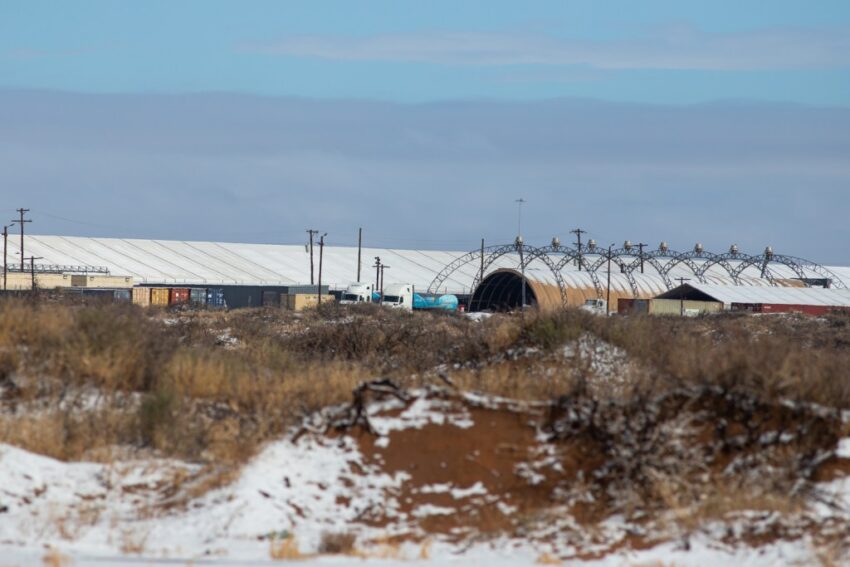
What we saw on our trip to the Camp East Montana facility shocked us. As Congress debates funding for the Department of Homeland Security, we’d like to share our experience.
Opened in August 2025, this facility, built on an Army base and run by a private company shrouded in secrecy, is where Immigration and Customs Enforcement is sending people – thousands of miles away from their homes – when ICE takes them from our communities.
Constructed at a cost to taxpayers of $1.2 billion, the facility can eventually house 5,000 people.
During our interviews, we were alarmed by what the detainees consistently told us about detention. Each barrack contains only five toilets for 72 people – routinely unclean and nonfunctioning. The food is insufficient and often spoiled. People consistently told us about going hungry. Asking for more risks punishment.
Calls for medical care go unattended. Guards instill fear by picking physical fights with detainees and sometimes fomenting detainees to fight each other. Detainees miss court dates when guards delay or outright refuse to facilitate their attendance.
Exercise was severely limited and the “multi purpose room” where we interviewed detainees – intended to function as the law library, recreation room and chapel – contained no apparent legal resources, a few puzzles, an array of prayer books, and only six computer stations for a current population of roughly 3,000.
Unsurprisingly, people we talked to desperately wanted to leave – some to voluntarily deport when faced with prolonged detention. Of additional concern, some detainees initially on our screening list were no longer able to be interviewed: they had moved to other nearby facilities or simply disappeared from the ICE locator website.
Everyone we interviewed had been working in steady jobs – some had paid taxes for decades. Few had disqualifying criminal histories. All had been transported to Texas from distant places in the country including Miami, Chicago, Richmond and New York City, placing them far from families and access to attorneys. They were taken while on the way to work, in street raids, or at court hearings.
What we learned underscored our feeling that, perhaps like other Americans, we don’t recognize our country anymore. Working people living peacefully in our communities are being “disappeared” to places far from their communities. Masked ICE agents hiding their badges are arbitrarily sweeping people off the streets – sometimes in a factory raid, but increasingly in indiscriminate “operations” while people are engaging in their everyday lives: returning from work or putting their garbage out; and often — shockingly — at courthouses, where people dutifully appear for their court dates.
Thanks to endorsement by the Supreme Court, people get stopped and taken based on skin color and other biased factors. The administration justifies these actions claiming that the people being deported are criminals that threaten the safety of Americans and burden our economy by using social services.
The trip we took to the Camp East Montana detention facility revealed just the opposite. The truth is that while emptying our towns and communities of people who have been contributing – by paying taxes, caring for children or the elderly, working in stores, on farms, in construction – we are losing on every front.
We are losing our neighbors and people shouldering necessary jobs. We are losing tax dollars because we are paying a daily rate (upward of $150) for private companies to “house” each deportee after having spent $1.2 billion to build the largest U.S. detention center ever.
But the most important loss is this one: we are losing our humanity, paying to imprison people from our communities to a place where basic standards of food, medical care and sanitation are not being met and violence abounds. Three people have died in custody just in the past two months – two in January 2026, including one deemed a homicide by the county medical examiner.
As we reflect on our service trip to Camp East Montana, so much feels unrecognizable and shameful.
Our country is paying an enormous price for this mass deportation: billions of dollars to private companies for operationalizing, surely, but also the cost of losing our integrity as a nation and as humans. While our country’s basic human needs go unmet, we are outraged by any additional dollars going to federal actions that contradict our basic humanitarian principles.
Congress needs to take action: a congressional delegation composed of representatives across the nation needs to see the conditions at Camp East Montana for themselves, and Congress must continue to continue to push back on any additional funding for ICE.
Lisa Landau is executive director of Fordham Law School’s Feerick Center for Social Justice; Emerson Argueta is the center’s associate director.
The post Opinion: We visited an El Paso ICE detention facility. We don’t recognize our country anymore appeared first on El Paso Matters.
Read: Read More