



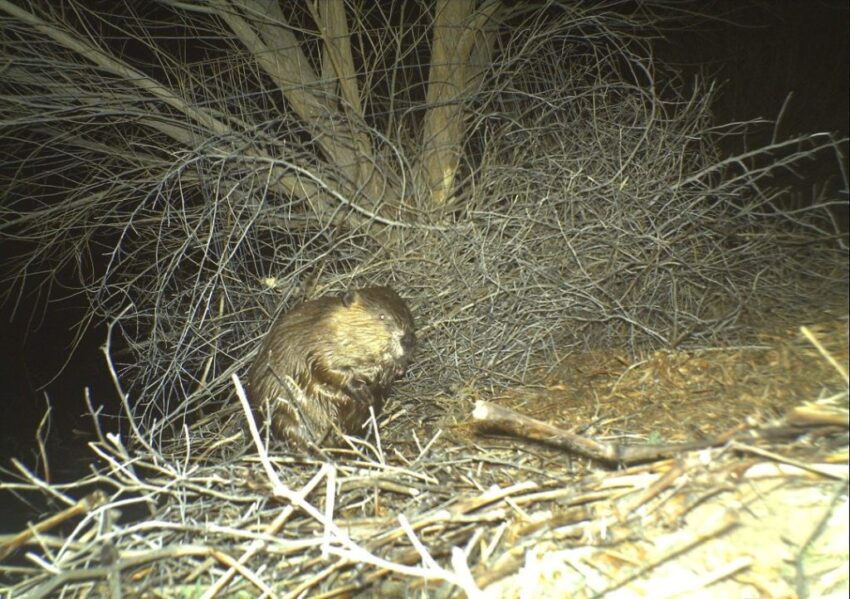

The beaver appeared at dawn on the banks of the old river channel at Rio Bosque Wetlands Park.
A trail camera first captured the beaver on Jan. 22, 2019, just before sunrise as it sat upright at the base of a Goodding’s willow tree. It was not the first indication of the beaver’s presence. A couple of weeks prior, the park manager at the time, John Sproul, photographed the shaved and gnawed-off limbs of another young willow. The protective mesh wiring that caged the tree did not seem to deter the animal, which built its first dam that winter.
The Rio Grande beaver or Mexican beaver, Castor canadensis mexicanus, is one of several subspecies of North American beaver adapted to desert riparian areas. Smaller and lighter in color than their northern counterparts, their range stretches along the river, with 98 active colonies documented at Big Bend National Park in 2015.

Beavers have come and gone through the Rio Bosque, making a handful of irregular appearances since park restoration began in the 1990s. Before the 2019 beaver, the last sighting at Rio Bosque was in winter of 2010.
But unlike the others, the newest visitor stayed.
Local wildlife biologists surmise this lone beaver traveled downriver from New Mexico and, with great tenacity through El Paso’s urban development, wound up at the park where it found favorable enough conditions to stick around.
Seven years and six dams later, the resident beaver of Rio Bosque continues to fascinate visitors who discover its handiwork of dams and dens, chewed tree branches and stripped bark. The beaver itself remains elusive, venturing out almost exclusively at night. None of the park staff or volunteers have seen the beaver in person.

The University of Texas at El Paso maintains Rio Bosque Wetlands Park, located just outside Socorro near the U.S.-Mexico border.
Sergio Samaniego, the park manager, and Sproul, a volunteer after retiring in 2024, led a recent morning walk along the old river channel. Most of the channel ran dry, exposing the beaver’s dams, scattered dens and different animal tracks in the caked dirt.
The Rio Grande once swept through this 2-mile bend before the U.S. and Mexican governments diverted and straightened the wild, meandering river in the 1930s to establish a more controllable boundary. The recreated old channel now receives water from man-made sources of water, including twice a year for about four months from the nearby Roberto Bustamante Wastewater Treatment Plant.
The beaver is most active at the park during these wet periods and keeps a low profile during the dry periods. Samaniego expects the plant to release water again in May or June.

He couldn’t say with certainty where the beaver goes during the dry periods. He speculated the beaver retreated to an undiscovered den in the upstream end of the park where pumped well water keeps a modest segment of the channel flooded.
Walking along the riverbank, he and Sproul shared what they knew – and didn’t know – about the mysterious nocturnal rodent.
Gender? Unknown.
Beavers leave behind secretions that smell like motor oil if male and old cheese if female.
“When we remove sections of the dam, we get a really strong scent, a kind of rancid scent,” Samaniego said, but they have yet to determine the beaver’s sex from the odor.

Age? Beavers disperse from their natal colony when they’re about 2 years old in search of territory to start a new colony. That would place this particular beaver at an estimated 9 years old, Sproul calculated. The beaver is much bigger now than when it arrived, he added.
The lifespan of the North American beaver in the wild is about 10 to 12 years.
BIRDS OF THE BORDERLAND: How to join El Paso’s growing birding scene
Name? Samaniego and Sproul just refer to it as “beaver.”
“Everyone that comes through the park seems to have a good time trying to name it,” Samaniego said. “I don’t think there’s an official name attached to it. John has a good list of the popular names.”
“The first ones were, well, Bucky came up right away,” Sproul said. “And Justin Beaver. … Apparently that suggestion comes up in a lot of places.”
Other popular names include Bernie or Berenice – “because we don’t know if it’s a male or female” – and Theodore after the title character of 1950s TV series, “Leave it to Beaver.”

Lois Balin, urban wildlife biologist for Texas Parks and Wildlife, said the agency doesn’t encourage scientists to name wild animals because it’s considered anthropomorphism.
Balin felt amazed the first time she saw footage of the beaver.
“Unless you lived along the Rio Grande where there’s water, there’s very little chance you would ever see a beaver,” she said.
Samaniego and Sproul discovered the beaver’s first dam in June 2022. After focusing on this dam, the beaver then had an industrious streak that summer when it built five dams in a row.

Beavers are considered a keystone species because they’re ecosystem engineers, said Ben Padilla, a wildlife biologist at UTEP who researches mammals. Like humans, beavers modify their habitat to suit their needs. They create standing pools of water because that’s where they feel safe in their lodges and can store food, he said.
“They’re creating a lot of habitat that wouldn’t be there otherwise, especially in dryland systems like we have here,” Padilla said. “If you think of the keystone of the arch, it’s the stone that holds everything in place and provides stability. When you take that one keystone out, the arch would fall.”
Beavers maintain the presence of water. While they play an essential role for biodiversity and water conservation everywhere, they are perhaps even more crucial to the Southwest because of how ephemeral water sources are in the desert, he said.
Not far from the dam Samaniego pointed out a den at the base of a tree. That entrance would be underwater when the channel is flooded, giving the beaver a hiding spot from predators such as coyotes and bobcats, he said. Inside there’s an elevated chamber.
READ ALSO: First desert bighorn sheep lambs born in Franklin Mountains
This type of den is one of the ways desert beavers differ from the beavers up north, Balin said. Desert beavers probably dig their dens in the side of riverbanks because it also keeps them cool in the summer, she said. Beavers in colder climates with more trees create huge lodges in the water.

Along their walk, Samaniego and Sproul identified the beaver’s favorite Chihuahuan Desert vegetation, tender riparian plants that are easy to cut down and provide nutritious inner bark.
“They can mow through a tree overnight,” Sproul said.
There were Rio Grande cottonwood trees with some of last year’s leaves still hanging on. There were also willow baccharis, a sunflower shrub the beaver wasn’t interested in at first, but eventually figured out would provide plenty of material, Sproul said. He pointed out the trimmings they pruned from cottonwoods, mesquites and non-native salt cedars. The beaver was probably ecstatic when it found pre-cut lumber ready to go, Sproul said.

Sproul recalled one spring when the old river channel didn’t receive water from the wastewater plant and the well’s pump was broken, leaving the entire channel dry. The beaver likely left Rio Bosque because there was no sign of activity through the summer, even after the channel started receiving water again.
Video footage showed a pair of beavers swimming in a storm water basin near the wastewater plant that year. It’s unclear what happened to the pair, but by September, the Rio Bosque beaver returned.
“It started using the same areas around the same dam, so we expected it was the same beaver,” Sproul said.
Beaver sightings are rare in El Paso.
Two centuries of fur trapping nearly wiped out the country’s once-abundant beaver population by the early 1900s, Balin said. Then the channelization of the Rio Grande destroyed El Paso’s historic flood plains and militarization of the border further impeded animal migration.
READ MORE: The quest to save El Paso’s diminished wetlands
Balin said she once saw a desert beaver in an agricultural canal by the border fence, her only local sighting after more than 25 years living in El Paso. Padilla said his colleague documented a beaver at least once at the UTEP research ranch in Hudspeth County.

Sproul said the first time he saw a beaver at Rio Bosque was in the project’s early years. Since water was limited to late fall and early winter, if a beaver moved to the park in the winter, it would leave in the dry periods. That happened about four times until 2010, he recalled. By then the border fence had gone up, which he suspects is one reason why it took so long for the next beaver to appear.
Beavers are social creatures that mate for life. But scientists agree: Chances of this beaver finding a mate and starting a colony are slim.
SEE ALSO: Desert bighorn sheep return to native Franklin Mountains in El Paso
Though beavers can travel great distances up and down river corridors, there’s not enough trees and water in El Paso – the two things beavers need to survive, reproduce and thrive, Balin said.
“This is likely an example of a beaver that dispersed, set up shop and hoped to find a friend, but there haven’t been other animals dispersing that far or to that location,” Padilla said.

Samaniego approached the beaver’s oldest dam, one of the biggest ones, a towering mound of wood, dried mud and rocks covered in a thicket of yellowed cattails.
“Be careful if you climb over,” he warned. “There’s a steep drop on the other side.”
A caged tube lies at the bottom of the riverbed, snaking its way up and through the dam. This is the beaver deceiver, Samaniego said.

Damming the river prevents water from flowing to other parts of the park, so in the past he would remove chunks of the dam to allow water to pass through. But the sound of running water through the dam alerted the beaver to a break. It would patch the holes back up overnight.
Rather than continue this back-and-forth with the beaver, UTEP invested in the beaver deceiver, which allows water to flow through the dam with minimal noise to not alarm the beaver.
“I feel like it’s a real mischievous, light-hearted animal,” Samaniego said “It’s just doing its job, so we like to work with it.”
-

A family of raccoons wade at beaver dam #6 in Rio Bosque Wetlands Park, June 17, 2024. (Courtesy of John Sproul) -

Great blue heron stands over beaver dam #2 in Rio Bosque Wetlands Park, Sep 30, 2022. (Courtesy of John Sproul) -

Various species of mammals and birds leave prints in the now-dried mud of the old river channel in Rio Bosque Wetlands Park, March 13, 2026. (Corrie Boudreaux/El Paso Matters) -

A black-crowned night heron stands on the first and biggest beaver dam in Rio Bosque Wetlands Park, Aug. 3, 2022. The beaver built the dam in 2019. (Courtesy of John Sproul) -

Bobcat crosses the gap in a mini beaver dam in the cattails in Rio Bosque Wetlands Park, Jan. 5, 2023. (Courtesy of John Sproul) -

Trail camera footage shows a common gallinule at beaver dam #3 at Rio Bosque Wetlands Park, June 14, 2023. (Courtesy of John Sproul) -

Three American wigeons lift off the water at beaver dam #4 in Rio Bosque Wetlands Park, Dec. 27, 2023. (Courtesy of John Sproul -

A coyote prepares to cross beaver dam #4 at Rio Bosque Wetlands Park, June 22, 2024. (Courtesy of John Sproul)
These dams aren’t just for the beaver’s benefit. Trail cameras show animals perching for a drink of water. Egrets and ducks wade in the pool backed up behind the dams. Raccoons, bobcats and coyotes cross the river using the dams as bridges.
On the way back to the trailhead, Sproul and Samaniego passed by several beaver dens. Many of the tracks around the dens and dams look like raccoon prints, though some hard-to-distinguish pawprints might have the possible webbing of a beaver.
“The beaver has not gotten a lot of attention,” Balin said, not compared to other “high Hollywood” animals like big cats.
That said, beavers might be making a comeback. The stout, chubby-cheeked mammals star in the Pixar animation and box-office hit “Hoppers,” which premiered in March. Sonoran beavers, another desert subspecies, also made headlines last year in Arizona where conservationists are making a binational effort to restore wetlands.

Padilla said it would be difficult to restore the beaver population in and around El Paso because of the amount of urbanization and farmland from Anthony, New Mexico, to Socorro, Texas.
“We as a species and culture have decided to divert the majority of the river’s water to our use and cities and agriculture,” Padilla said. “There would have to be other choices made to restore a species that relies on and creates wetlands. I’m not sure that’s a choice we are willing to take.”
It’s possible for beavers and people to coexist, he added. Beavers are adaptable creatures found in suburban and urban areas in the Northeast and Pacific Northwest where he previously lived. In El Paso, this could look like restoring and expanding pockets of woody, riparian habitat such as Rio Bosque, which would encourage animals to disperse there and pause to hang out, he said.
“When we create those habitats, animals find them,” Padilla said.
In search of the Rio Bosque beaver?
The beaver is a nocturnal mammal that prefers to be left alone, but you can find evidence of the beaver’s presence at Rio Bosque Wetlands Park.
- Enter the park at the Wetland Trailhead and make a right onto the trail that runs along the old river channel. Map
- Look for signs of beaver activity in the vegetation, such as teeth scrape marks and chewed branches.
- There are six dams as of April 2026. When the channel is flooded, you can see the tops of the dams made of sticks and woody debris poking above the water.

- When the channel is dry, you can see the entire dams. The second dam you encounter has a “beaver deceiver,” a device that pipes water through the dam without triggering the beaver. You can also see the beaver’s dens dug into the side of the riverbank.

- Visitors who don’t have a park guide should stay on the trail rather than walk on the dry riverbed. You can use binoculars to get a clearer look at the animal tracks outside the dens and dams.

To support restoration of the beaver’s habitat, join or follow Friends of the Rio Bosque Wetlands Park. The group organizes tours and community work days to maintain the park.
The post El Paso has a celebrity beaver and it lives at Rio Bosque Wetlands Park appeared first on El Paso Matters.
Read: Read More