



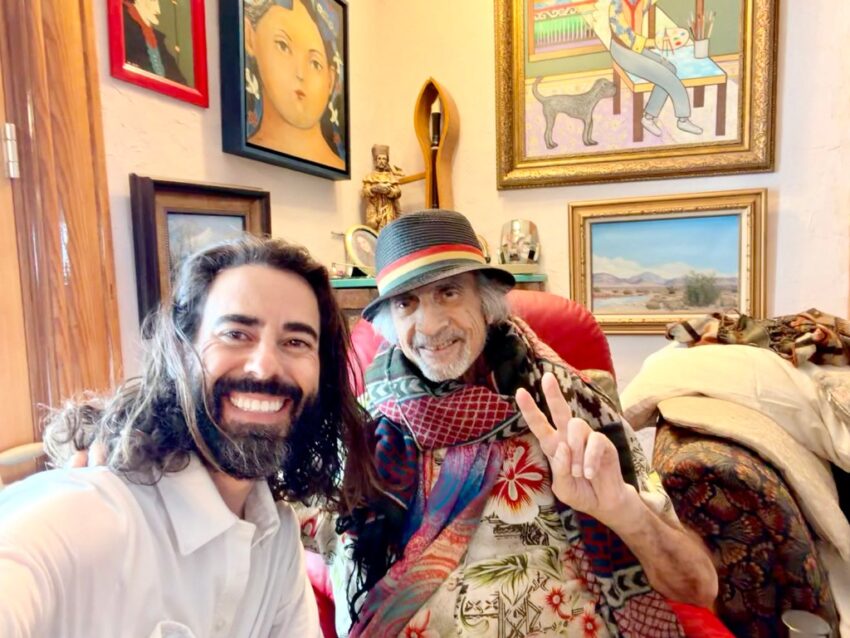

This is a tribute to El Paso artist Hal Marcus, who died Sunday, April 12. The author is Marcus’ friend and collaborator on three children’s books.
By Luke Lowenfield
Hal Marcus lived as a painter. He did everything as an artist, whether it was putting on his shoes or putting on a show. Even in his passing, Hal chose to create beauty.
Of all his renowned artwork, Hal’s life and death became the greatest masterpiece. When most people are tempted to retreat into the messy realities of a dying body, Hal documented it all and shared it with the world.
He invited us to watch because, he said, “People know this happens every day, but when an artist does it, it can be something beautiful. I’ve been creative till the end, and then I’ll be 1,000 times more creative when there’s no time and no physical limitations. I can travel the planetary system as an artist and talk to everyone. I’m not gonna stop being an artist just because this body is disappearing. There’s just a change in my venue,” he laughed as he finished.
He told me he was suffering no pain, his mind was sharp, and he said, “In some ways, I’m the happiest I’ve ever been.”
He responded to a cancer diagnosis last year with a visit to a sacred tree at his daughter Adelaide’s California home and took every chance with his beloved wife, Patricia, to visit their favorite retreat on the Pacific Coast. He gave his son, Marco, a father’s blessing, and he turned over his many works-in-progress and partnerships to his daughter Leilainia to carry on his legacy of creating a more peaceful world.
RELATED: Hal Marcus, celebrated El Paso artist and musician, dies at 74
His first wife, Judy, and her husband, Duncan, Hal and Patricia’s dearest friends, shared memories and massaged his feet, continuing the joyful connection to the end. Hal spent his life bringing people together, and he passed peacefully listening to ocean sounds in his El Paso home with a gentle smile.
He was inspired by the permanence of the masters, like Modigliani and Matisse; people that lived long ago but persevered in their influence for centuries. In addition to the legacy, the lifestyle of an artist was irresistible to him.

Hal needed freedom to travel and meet interesting people, to be his own boss and enjoy control over his schedule. He was probably his hardest boss, given his uncompromising execution of what he saw – in this world and beyond it.
He often painted himself with wings because he felt like an angel when he did his work. There were times he would finish a piece, and then marvel at the miracle of its creation – like, “How did this happen?!”
He was his favorite artist, and his favorite work was always the one he was working on. It wasn’t prideful, it was his true calling.
In light of the passion that fueled his incessant creativity, his ability to turn around and sell the artwork was all the more remarkable. He loved seeing others with his paintings.
Almost never would he tell what he saw on the canvas or what he intended with it. Giving his opinion, he said, would just get in the way. He wanted each viewer to find their meaning and get excited about the connections they found with it.
One piece that he broke his rule with is called “Quiet Time,” made with patches of his signature shirts, over which he painted a male figure and a female figure, seated back-to-back, with a red tulip rising between them and hanging over them. Hal explained to me his idea that we all need to take a break sometimes to think and reflect, and nature will always bring us back together.
Nature was where Hal admired the great artist. In one of our last talks, Hal said, “I want to tell everyone to chill out. People need to know: God is everywhere at all times, not an old man with a beard. The whole point of life is to enjoy God’s glory, and you do that by hanging out with your kids, by looking at the birds and the trees and butterflies, by seeing new species emerging. Things evolve, we evolve, too. It’s OK, I’m just getting into a different vehicle,” referencing John Lennon.
“My real religion is creativity,” he told me, as he described his passionate curiosity and willingness to do hard things. “If it’s not a big challenge, it’s not worth doing,” he said in agreement with Picasso.
His eyes had grown tired as he was sharing this with me, and he tried looking at his calendar, a little frustrated and unable to make out the dates. He said, “By April 13, I’ll be on the other side … you can’t really plan these things, but that’s the intention. I’ll go as deep, spiritually, as I can, then I’ll say, ¡Adios, Amigos!’”
And that’s exactly what he did.
I will live and die differently because of Hal. He would not tell everyone to be an artist like him because that was “Hal’s way.” Rather, he would cheer us all on in finding our passion and living it fully every day, with loved ones in beloved places.
A life of sovereign choice and creative freedom is what he modeled for us. May we all be so devoted to the fleeting masterpiece of our life, and may everyone get the joy of having a friendship like the one Hal gave me.
Luke Lowenfield is an El Paso author who wrote three children’s books that were illustrated by Hal Marcus.
The post El Paso artist Hal Marcus turned his final days into a public work of art – and a lesson appeared first on El Paso Matters.
Read: Read More