



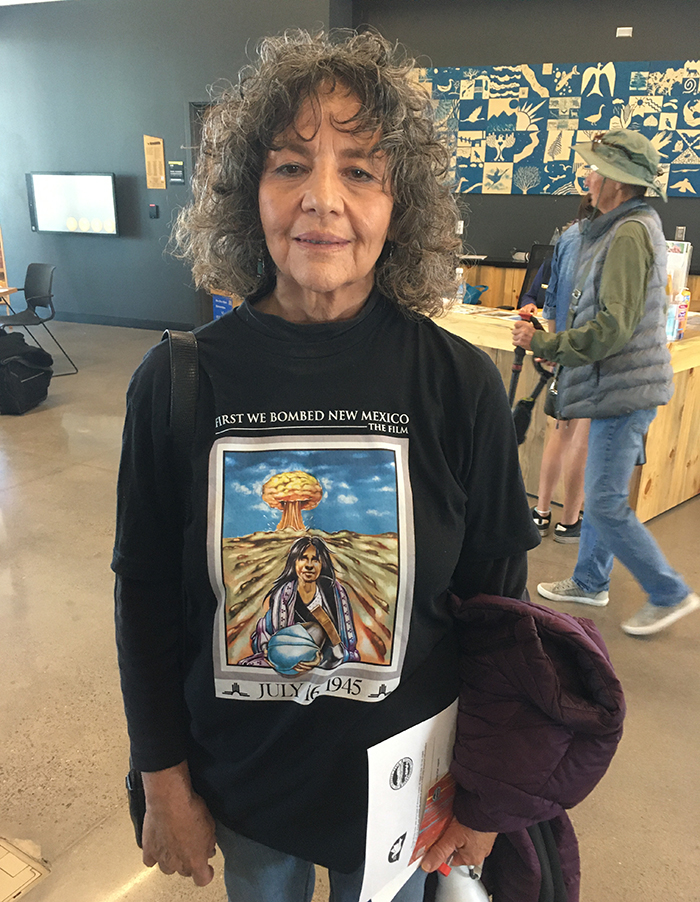
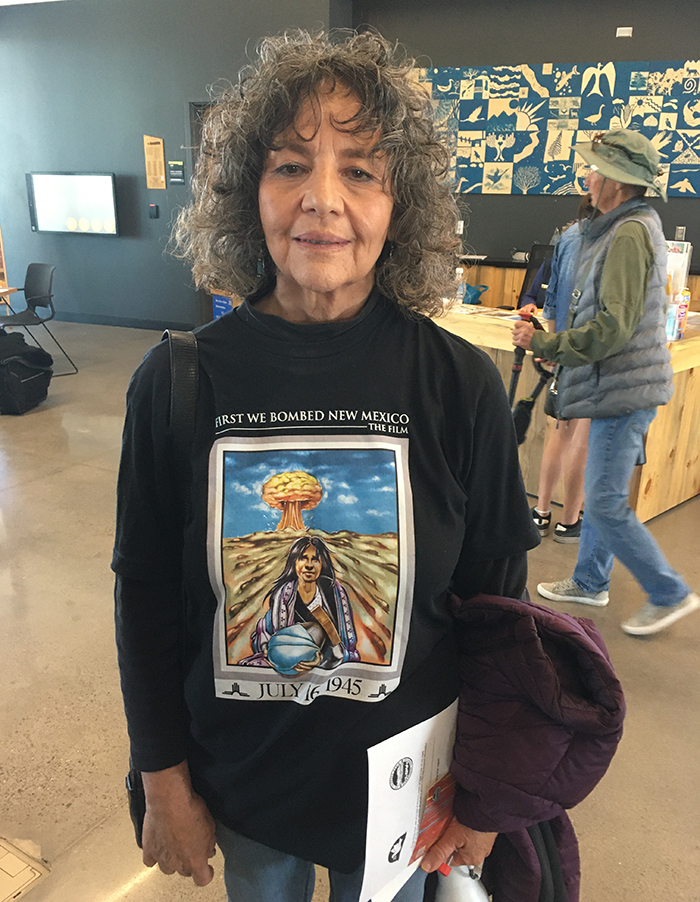
Downwinder leader Tina Cordova speaks at the Valle de Oro Community Earth Day event. Seated to Cordova’s immediate left is Loretta Anderson and next to her is Gina Grimes. (Photos by Kent Paterson.)
By Kent Paterson
Tina Cordova and Loretta Anderson can tell you many stories of disease, suffering and death that can be traced to nuclear weapons testing and production in the U.S, especially in New Mexico. But they can also share victories on their long road for environmental and public health justice. Activists for compensating victims of nuclear weapons testing and the mining of uranium used in making bombs, the two women recently spoke as part of the 2026 Community Earth Day celebration held at the Valle de Oro National Wildlife Refuge near Albuquerque.
Kicking off the April 18 event, co-sponsor Sofia Martinez of New Mexico’s Los Jardines Institute acknowledged that participants were gathered on the historic lands of Isleta Pueblo.
“We are on Turtle Island, all of the U.S. is on Turtle Island,” Martinez said, using the indigenous name for North America. “We are all visitors on this land.” Martinez praised former Isleta governor Verna Teller, who was elected the first female Pueblo governor in 1987, for being instrumental in legally pressuring the City of Albuquerque over its wastewater discharges into the adjacent Rio Grande so vital to the Pueblo’s culture and making sure that the big city upriver “cleaned up its act a little bit.”
A captivating speaker, Cordova leads the Tularosa Basin Downwinders Consortium, an organization she has worked tirelessly to build since 2005. The Consortium has advocated for survivors or relatives of survivors of the U.S. government’s first test of the atomic bomb at the Trinity Site in south-central New Mexico on July 16, 1945.
As Cordova outlined, radiation from the massive, secret blast showered nearby communities, largely composed of Spanish-speaking New Mexicans, contaminating their homes, farms and lands. The residents typically lacked electricity, running water and even grocery stores. Consequently, the people of the land produced their own meat, vegetables and fruit, all of which were contaminated by the radioactive fallout, along with water sources, Cordova stressed.
Based on updated research on the true impact of nuclear testing, Cordova dispelled myths that the deadly and cancer-causing radioactive fallout was confined to a limited area of New Mexico. Research identified fallout hitting 46 U.S. states, including all of New Mexico and Texas, as well parts of Mexico and Canada. “It was a huge environmental invasion,” she said.
Cordova likewise sketched out other cases of reckless government handling of nuclear materials in the Land of Enchantment. For instance, Los Alamos National Labs dumping of radioactive waste into the canyons connected to the upper Rio Grande until the 1970s.
The story of the downwinders and their communities is depicted in the award winning 2024 film by Lois Lipman “We First Bombed New Mexico.” The documentary has been shown in festivals and selected venues, but the producer is still ironically struggling to get a streaming platform from a state renowned for its film industry- and the generous taxpayer incentives lavished on it, Cordova lamented.
The Human Impact
As the nuclear arms race ramped up in the 1940s and 1950s, Native American lands in what became known as the Grants Uranium Belt, a swath of territory west of Albuquerque extending from the Pueblo nations of Laguna and Acoma into the Navajo Nation, were transformed into a key center of intensive uranium production. A Superfund site, the closed Jackpile uranium mine on the edge of Laguna Pueblo was among the biggest open pit mines in the world, with 2,656 acres in total mined.
According to the U.S. Environmental Protection Agency (EPA), the mine was operated by Anaconda Minerals Company (ARCO) from 1952 to 1982 under a lease arrangement with the U.S. Department of Interior. During the 30 years of mining, the EPA estimates that about 400 million tons of rocks were moved within the mine area and about 25 million tons of uranium ore were transported by rail to Anaconda’s mill in the community of Bluewater.
Hundreds of other abandoned mines and mills dot the area, with most still not remediated despite the passage of decades and official awareness of health hazards still present.
Loretta Anderson of Laguna Pueblo is another New Mexican with a lot to say about uranium mining and the nuclear industry. Many Native Americans worked in the Grants Uranium Belt between the 1940s to 1980s, including Anderson’s own father who succumbed to cancer, a disease linked to exposure to radon gas from working in the mines.
But with radioactive substances also finding their way into the soil and water, sicknesses linked to the mining are widespread. Cancer cases of children as young as eight years old haunt her community, Anderson said.
After 13 years of advocating for uranium mining victims, Anderson was still visibly moved by the personal stories she hears, “It’s heartbreaking when I get calls,” Anderson said. “‘I’ve been diagnosed with cancer. Can you help me?’” The Laguna activist told how many of her own relatives worked the mines but didn’t think twice about it until disease came knocking on the door. “It has become so terrible after all these years,” she said in an emotion-packed voice.
Anderson and Cordova described the impacts of the nuclear cycle as devastating to the socio-psychological health and economic vitality of their communities, with financial worries from medical expenses whittling away livelihoods and well-being. Cordova recalled that Tularosa Basin communities host constant bake sales, car washes and other fundraisers to pay for medical expenses of cancer or leukemia victims, including children. “I say the Pentagon should have a bake sale to make their budget,” she offered.
A Major Victory for Downwinders and Former Uranium Workers
For years, the Tularosa Basin Downwinders Consortium and Native American advocates have organized, lobbied politicians and raised cane to obtain just compensation for individuals in their communities who’ve been sickened and/or died from the deadly nuclear cycle and arms race. The precedent was set in 1990 when Congress passed the Radiation Exposure Compensation Act (RECA). However, RECA was limited to victims of atmospheric nuclear testing in certain counties of Utah, Nevada and Arizona plus uranium miners employed between the beginning of 1942 and the end of 1971.
Cordova, Anderson and their allies worked exhaustively to expand the pool of eligible beneficiaries to include New Mexico downwinders and uranium industry employees after 1971. Supported by the New Mexico Congressional delegation, advocates were on the verge of a legislative win in 2024 until Republican House Speaker Mike Johnson blocked the measure. An expansion was finally passed in 2025 ironically, as Cordova observed, tucked into the Trump-inspired “Big Beautiful Bill.”
In 2026, though, the long struggle is reaping long-awaited benefits. Among other provisions the law covers 19 different types of cancer, granting $100,000 in compensation to eligible individuals who lived in New Mexico for at least one year between September 24, 1944, and November 6, 1962, while also expanding the pool of eligible uranium industry employees to those who worked through December 31, 1990. One drawback is that the law was extended only until December 31, 2028, with an application deadline of December 31, 2027. Advocates, then, advise eligible persons to apply as quickly as possible.
Applications, including necessary documents, are sent to and processed by the U.S. Department of Justice (DOJ).
Due to postal service problems, Cordova favored sending applications/documents online to the DOJ’s website at https://www.justice.gov/civil/reca
Cordova and Anderson warned against scammers, cautioning also that private lawyers will take a cut in the compensatory award. The application process is free, they stressed. Besides the Tularosa Basin Downwinders Consortium, the New Mexico Department of Health (833-796-8773), University of New Mexico Law Clinic, and New Mexico’s Congressional representatives assist in filing claims.
Gina Grimes of the New Mexico Environment Department’s Nuclear Workers Advocacy Office is another resource for interested persons. Grimes is a member of the Washoe tribe of California-Nevada who began working on the New Mexico downwinders issue about one year ago. Like others, Grimes was struck by the pain and tragedy voiced by affected persons. Nowadays, “I hear these stories every day, very sad stories,” she said at the Valle de Oro panel session.
According to Grimes, of an estimated 50,000 RECA applications expected to be filed just from New Mexico, 8,813 had been received from downwinders as of April 17, 2026. Of these, 1,331 were approved, with others pending. With compensation finally flowing to New Mexicans, Cordova said recipients informed her that the money is “lifesaving.”
The Struggle for Land, People and the Environment is Far from Over
Cordova and Anderson readily credit New Mexico’s Congressional delegation for getting RECA expanded and money out the door. But the two activists caution that much more needs to be done, such as lengthening the extension period for RECA beyond the end of 2028 and incorporating “many impacted communities” that were left out, including Montana, Colorado and the Pacific island of Guam, where nuclear testing was rampant offshore, as well as part of Nevada and Arizona. At the same time, activists are on red alert over renewed efforts to mine uranium in New Mexico.
Targeted lands include Mt. Taylor west of Albuquerque, a mountain sacred to Native American tribes, and the Carson National Forest in the northern New Mexican county of Rio Arriba, a county famous for the epic Spanish-Mexican land grant struggles which have contoured New Mexico history.
A Canadian company has issued a permit request to drill exploratory uranium bore holes near the Rio Arriba village of Canjilon. Residents, New Mexico’s two U.S. senators and New Mexico District 3 Congressional Representative Teresa Leger Fernández are rallying against the scheme.
For historical memory, 2026 isn’t the first time both Mt. Taylor and the Canjilon area have been scoped out for uranium mining. In the late 1970s and early 1980s, the old Mt. Taylor Alliance and indigenous and land grant communities mobilized against ultimately unsuccessful plans to mine uranium in the two locations. With a national nuclear waste dump, the Waste Isolation Pilot Plant, then on the federal agenda for an underground site near Carlsbad, the concept of New Mexico corralled as a National Sacrifice Area was in vogue among community and environmental activists at the time.
More than forty years later, has the power relationship between New Mexico and the nuclear industry fundamentally changed?
“(Mt. Taylor) is right behind our home. It’s a sacred mountain to our people,” Loretta Anderson said. “We are still dealing with contamination, and they want to mine?
Urging defense of the land and its people, Tina Cordova added, “They haven’t cleaned up the messes from the past, and they’re exploring for more. We have human rights. These are human rights violations.”
For more information:
“First We Bombed New Mexico” trailer

Tularosa Basin Downwinders Consortium
U.S. DOJ downwinder/uranium exposure website: https://www.justice.gov/civil/reca
Read: Read More