




The National Science Foundation knew that allegations of false statements in a University of Texas at El Paso-led proposal were unfounded almost a month before it canceled a transformative grant on Aug. 12, 2025, according to an NSF Office of Inspector General report.
In the report, dated July 17, 2025, Megan E. Wallace, acting inspector general of investigations, wrote that her office could not substantiate those accusations, which appear to have come from UTEP. The report, by an investigator whose name was redacted, said “no evidence existed to substantiate any of the allegations.”
“We recommend that NSF take any and all administrative action(s) it deems appropriate,” Wallace wrote. It was a suggestion repeated three times in the report. “The basis for our recommendation is described in detail in the Report.”
It is not clear in the report why administrative actions would be warranted when investigators found no evidence of falsification in the grant application, or what actions could be considered.
The report is the first public acknowledgment that the grant, worth up to $160 million, had been terminated by NSF even though its investigators rejected claims in a UTEP internal investigation that the grant’s principal investigator, Ahsan Choudhuri, had falsified elements of the application.
UTEP officials and Choudhuri declined to comment on the inspector general report.
NSF officials declined to respond to a question from El Paso Matters about why the grant was terminated after investigators found no wrongdoing by Choudhuri.
UTEP has maintained that Choudhuri’s application had flaws.
The OIG released about 20 heavily redacted pages of a 499-page report in response to a Freedom of Information Act request from El Paso attorney Richard Mattersdorff, who provided it to El Paso Matters. The news organization’s request for the document was denied by the National Science Foundation. It’s not clear why the agency provided the document to one requestor but not another.
The majority of the unreleased pages were support attachments. Of the available pages, none included the investigator’s recommended administrative actions.
While much of the writing was blacked out, the report offered additional information that was not part of the agency’s Feb. 4, 2026, closeout memo of its investigation. The report makes clear that the inspector general’s investigation focused on complaints made in UTEP’s internal investigation in the spring of 2024.
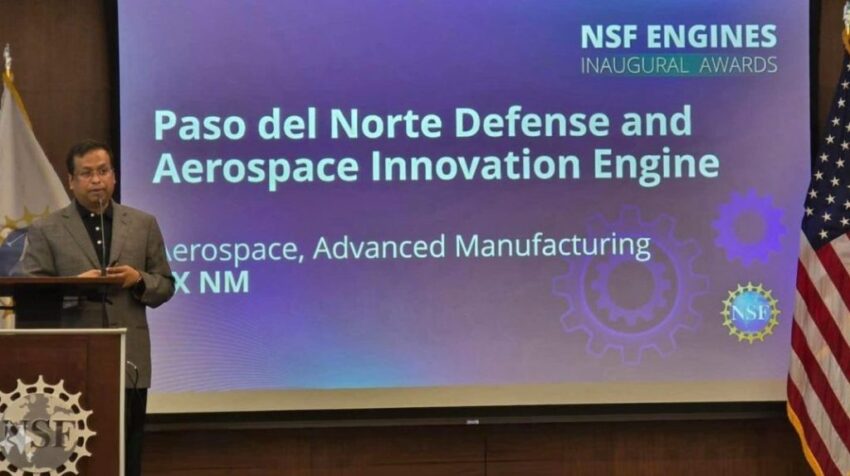
UTEP submitted the Choudhuri-led proposal to the NSF for a Regional Innovation Engine grant in January 2023. The science foundation awarded one of 10 grants to the UTEP-led coalition the following January. The project would get $15 million for the first two years and, if it met its metrics, could have earned up to $160 million for the region through 2034.
Without giving a reason, the science foundation suspended the grant in April 2024 and then canceled it in August 2025. None of the original $15 million was spent.
The NSF has said that it reallocated most of the grant’s funding after the initial suspension. The agency decided to cancel the grant because sufficient funds were no longer available for the project as originally envisioned.

UTEP President Heather Wilson demoted Choudhuri from his leadership position at the UTEP Aerospace Center after an in-house audit found that the NSF proposal had “incorrect statements.” UTEP said the application incorrectly claimed the accessibility of hangar space and that UTEP could use state-owned land in eastern El Paso County for test space.
Choudhuri, who founded the Aerospace Center and had brought tens of millions of research dollars to the university, denied any wrongdoing. He said he was not surprised by the vindication in the Feb. 4 memo.
Choudhuri retired from UTEP in December 2025. He now owns and operates El Paso-based ARC Aerospace, which designs and builds low-cost defense systems.
Susie Byrd, a former director of economic development and workforce excellence at the Aerospace Center, said that she believed that the NSF canceled the grant because officials sensed Wilson’s resentment toward Choudhuri. Byrd resigned from UTEP in 2025.
“While it was clear that the allegations by Dr. Wilson were unfounded, it was probably also clear to the NSF that her deep hostility towards Dr. Choudhuri would make it difficult for him to deliver on such a complex project,” Byrd said.
She mentioned that Ahmad Itani, UTEP’s vice president for research and innovation, had assured the NSF staff who came to El Paso for a site visit that Wilson and the university were fully behind the proposal.

“The actions taken by Dr. Wilson and her staff seemed to indicate otherwise,” Byrd said.
After the inspector general released its closeout memo in February, Wilson published an opinion column in El Paso Inc. and El Paso Times repeating her claims that Choudhuri had committed non-existent resources to the project.
But the inspector general investigator’s report said “the facts do not substantiate the allegations.”
The agency’s OIG report stated that the science foundation received accusations of false statements in the proposal April 19, 2024. The agency’s OIG received similar notices three days later, and two similar accusations in May about the UTEP-led proposal submitted by Choudhuri and the project’s co-principal investigator Ryan Wicker.
Wicker, who sent several emails to UTEP leaders in early 2024 that questioned how the institution’s officials were treating him and Choudhuri, retired that November.
The report included that investigators conducted interviews, subpoenaed relevant reports and reviews of NSF records as well as other sources that were blacked out.
Investigators considered three specific potential violations, which were redacted, but could not find evidence to support the allegations of false statements.
The post NSF canceled UTEP-led aerospace grant after report found no wrongdoing in application appeared first on El Paso Matters.
Read: Read More