



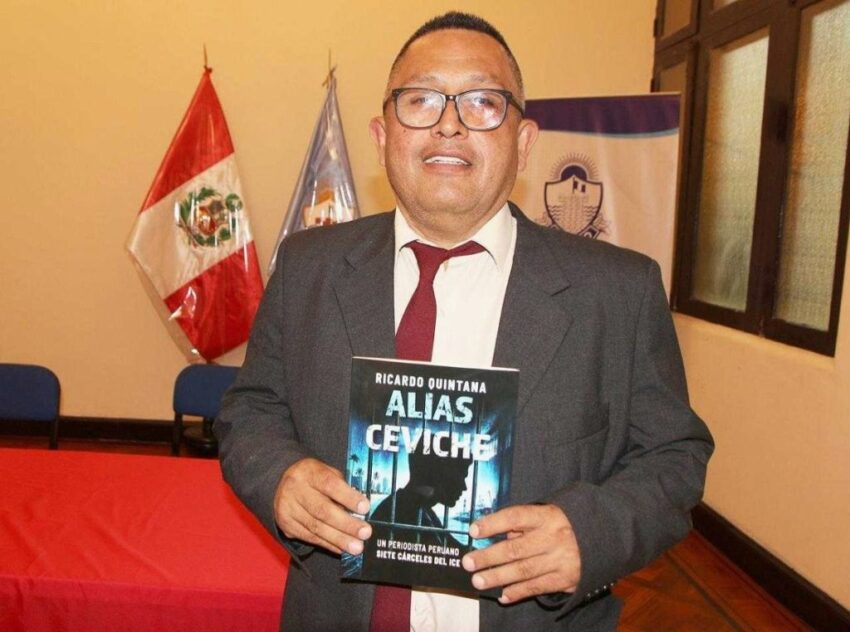

As a journalist, it’s been instinct for Ricardo Quintana Chávez to record his surroundings – writing in his reporter’s notebook or recording on his cellphone whenever something caught his eye.
During his time in Alligator Alcatraz then at Camp East Montana – U.S. Immigration and Customs Enforcement detention facilities fraught with allegations of human rights abuses – the only tool available to him was his memory.
“Your mind is trained to see everything from a journalistic point of view,” Quintana told El Paso Matters in Spanish during a recent phone interview from his home in Callao, Peru, near Lima. “I saw so many things, but I didn’t have a pencil or paper so I had to tell myself, ‘Take note, remember this.’”
“¿Pero al igual, cómo lo puedo olvidar?” he said, “But then, how can I forget?”
Quintana, 57, of Peru, had lived in the United States for four years when police last summer detained him for selling ceviche without a permit on a Florida beach – a civil infraction that typically carries a fine. Instead, he was arrested and transferred to ICE custody despite having a pending asylum case that allowed him to remain and work in the country while awaiting his immigration hearing. He spent about 50 days in ICE detention before being deported in September.

Now, eight months later, Quintana has self-published a book, “Alias Ceviche: Un Periodista Peruano. 7 Cárceles del ICE,” documenting his experiences being held at county and ICE detention facilities after his arrest. The 172-page paperback and a Kindle edition were released in May.
“This is not a story of hate. It is not a political manifesto. There might be moments in which this reads like a grievance and I won’t apologize for that,” the epilogue reads.
“Pero no es el propósito. Es simplemente lo que vi, lo que sentí, lo que aprendí en esas semanas que cambiaron mi vida para siempre,” he writes. “That is not its purpose. It’s simply what I saw, what I felt and what I learned in those weeks that changed my life forever.”
In an emailed statement, the Department of Homeland Security said a pending asylum case or work authorization does not confer any type of legal status in the United States. “If a person enters our country illegally, they are subject to detention or deportation. Each illegal alien receives due process,” the statement reads.
Quintana is among the estimated 400,000 immigrants who have been booked into immigration detention from an interior arrest – and not at the border – since President Donald Trump took office for a second term in January 2025, according to the Brookings Institute.
The DHS in January claimed more than 600,000 people had been deported in 2025, including those turned back at the border by Customs and Border Protection, though tracking organizations put ICE deportations closer to 350,000 without counting the turnbacks. An ICE flight monitor under the organization Human Rights First reports at least 3,300 deportation flights from January 2025 to May of this year, though passenger counts per flight are not publicly available.


The widely criticized mass detention efforts have led to a multitude of accusations of human rights and federal detention practice violations, including at Camp East Montana.
While additional mass detention centers were slated to open under former DHS Secretary Kristi Noem, including in El Paso, acting ICE Director David Venturella recently indicated the planned industrial warehouse park in the city of Socorro slated to hold 8,500 detainees will be scaled down and instead include a training center, U.S. Rep. Veronica Escobar, D-El Paso, said.
And just about a year after opening, Alligator Alcatraz — an immigration detention facility inside the Big Cypress National Preserve in Ochopee, Florida — completed transferring all its detainees to other facilities this month, with the Department of Homeland Security citing hurricane concerns. DHS hasn’t disclosed how many people were moved or where they were moved to, and didn’t say whether the Everglades facility will be permanently closed.
From Quintana’s point of view, the mass detention centers should have never opened so quickly and on such a large scale – or at all.
In his book, Quintana recounts seeing guards insult and assault detainees and detainees fight for scraps of food – often ham sandwiches for breakfast, lunch and dinner. He describes the smell of toilets overflowing without immediate cleanup – two to three toilets with no dividers per cell for 70 or more detainees. He recalls hearing detainees cry of anger, of fear, of pain.
He recounts being shackled to the floor at Alligator Alcatraz. He describes the detention centers being overtly cold, with the lights turned on at all hours. He describes poor medical care detainees received – if any at all – citing as an exception a healthcare provider who showed some compassion toward him and other detainees.
DHS in a statement regularly issued to media in response to such allegations said all detainees are provided with three meals a day, clean water, clothing, bedding, showers, soap and toiletries and that certified dieticians evaluate meals. The agency said it provides “comprehensive medical care” to detainees, and that for many, “this is the best healthcare they have received their entire lives.”
In his book, Quintana, who was nicknamed Ceviche while in ICE custody, also recounts stories of his fellow detainees. He writes about them under their aliases, not always recalling their real names or at times protecting their identities, he said.
There was Bacteria, a 40-something plumber from Cuba who was often breakdancing to entertain others, and Chispita, a 20-something Venezuelan who openly talked about being gay until a newly arrived Jamaican detainee threatened him. They were eventually sent to different cells.

There was Chiquitito, a young Honduran who resembled actor Dwayne “The Rock” Johnson – only a lot shorter. Quintana overheard Chiquitito talk to his father on a video call. He asked his father for forgiveness for some unknown wrong he had committed against the family back home. The father responded, “never,” Quintana writes.
And then there was Luis Frio, a Venezuelan mechanic and influencer well-known for his “how to” social media videos. While detained in Alligator Alcatraz, Frio became severely ill and was hospitalized. It was rumored he had died. But Frio had been transferred to Camp East Montana and was eventually deported. He’s continued gaining followers on his social media platforms.
Detainees passed the time reading and playing cards, some did wall pushups or situps on their bunks. But mostly, they paced and they slept. And they prayed to go home, Quintana writes.
“La gente no quería quedarse más en los Estados Unidos. Quería su esquina, la señora de la tienda, la comida de su mamá,” a passage from his book reads. “Y el sistema los tenía ahí, sin decirles ni cuándo ni por qué, destruyéndolos de a pocos con esa luz artificial y ese frío programado.”
“The people no longer wanted to remain in the United States. They wanted their corner, the lady at the store, their mother’s cooking. And the system kept them there, without telling them when or why, slowly destroying them with that artificial light and that programmed cold.”
Quintana first came to the United States on a visitor visa for a few weeks in 2019 to spend time with his daughters, who had emigrated years prior. He came back to Florida in 2021 on a visitor’s visa. While there, he said, he received death threats at his Peru home for his coverage and criticism of the controversial Peruvian presidential elections that were replete with corruption scandals. He sought asylum.
He said it was never his intention to remain in the United States, but he feared going home under the volatile political climate. He had authorization to work while his asylum case was heard, so he picked up a job as a dishwasher. Eventually he landed some freelance work for Spanish-language media outlets and marketing companies.
Finding that there was an interest in Peruvian food in Florida, he sold homemade ceviche and papas rellenas to make a little extra money.
“No vendía un plato, vendía peruanidad. Cada taper era un embajador con limón, ají y a culantro,” he writes. “I wasn’t selling food, I was selling Peruvianness. Every container was an ambassador with lime, chile pepper and cilantro.”
When he was detained by Miami Beach police, he was transferred to ICE custody and detained in a federal processing center in Miami Dade County. He was later transferred to the Everglades Detention Facility, also known as Alligator Alcatraz, then to an ICE tent facility in Northeast El Paso before ending up in the East Montana Detention Facility known as Camp East Montana.
When he finally agreed to an “exit bonus,” a monetary incentive to give up their cases and agree to be deported, he was sent to the Port Isabel Service Processing Center in South Texas near Harlingen. Shackled at the wrists, waist and feet, he was bused to the Harlingen airport and flown to Peru.
Back home, he said the federal government paid him the promised $1,000 via Western Union, buying himself basic necessities and saving the rest. With some savings and money he had sent home, he published his memoir.
“It was difficult writing this book. I had lots of emotions. I felt shame, embarrassment, anger and humiliation,” Quintana told El Paso Matters. “As soon as I was out, I began to write. I cried a lot. I still do when I re-read some passages.”
“I’m still getting my life back together,” said Quintana, who has started a news podcast in Callao. “I think with this book I was able to release, to talk about, a lot of what I’ve been holding back and I think what a lot of people like me are going through at this time.”
The post ‘How can I forget?’ Deported Peruvian journalist pens book on ICE detention at Alligator Alcatraz, Camp East Montana appeared first on El Paso Matters.
Read: Read More